The Speed of Electricity: A Shocking History
Explore the fascinating journey from shocking experiments to understanding electricity's near-light speed.

Written by AI. Amelia Nwofor
In the 18th century, curiosity about electricity was enough to justify some rather shocking experiments—quite literally. In 1746, French physicist Jeantoan Nole lined up a group of monks with a bold plan to measure the speed of electricity. By connecting them with thick wires and sending a current through, he expected to see them electrocuted sequentially. To his astonishment, the monks were shocked simultaneously, leading him to conclude that electricity must travel with infinite speed. While this assumption was later debunked, it set the stage for a scientific journey that would reshape our understanding of electricity.
The Birth of a Misconception
During the 1700s, electricity was a mysterious force, often thought of as a fluid. The period was marked by an electrifying rush of experiments, with figures like Benjamin Franklin and Alessandro Volta contributing to the discourse. Yet, it was Nole's dramatic demonstration that captured both attention and imagination. The simultaneous jolt experienced by the monks was interpreted as proof of electricity's infinite velocity. In hindsight, this conclusion might seem naïve, but it was a stepping stone to more refined theories.
Electromagnetic Waves: A Paradigm Shift
The narrative took a transformative turn with Michael Faraday's work in 1831. Faraday's discovery of electromagnetic induction—where moving magnets could induce electric current—revealed a profound connection between electricity and magnetism. This foundational insight paved the way for James Clerk Maxwell in the 1850s, who translated Faraday's observations into mathematical equations. These equations described how electric and magnetic fields interact, culminating in the realization that electromagnetic waves travel at the speed of light.
Maxwell's equations were the Rosetta Stone of electromagnetism, showing that light itself was an electromagnetic wave. This revelation answered Nole's question by establishing that electricity, though not infinitely fast, moves at a velocity that rivals light. "In a vacuum, electromagnetic waves move at the speed of light because light waves are in fact electromagnetic waves," Athena Brensberger notes in the NOVA video.
Unraveling the Electron's Journey
The 19th century brought further clarity with Joseph John Thomson's discovery in the 1890s that electricity wasn't a fluid but a movement of particles called electrons. However, it's not the electrons themselves that zip through wires at breakneck speeds. Instead, they drift slowly under the influence of an electric field, akin to a chaotic game of bumper cars. In conductors like copper, electrons bounce around at what's known as the Fermi velocity—about 3.5 million miles per hour.
Yet, this random motion doesn't directly explain why flipping a light switch results in immediate illumination. The answer lies in what physicists call signal velocity. Imagine a line of people, each nudging the one in front of them until the movement reaches the front. Similarly, when electricity flows, the electric field pushes electrons, transmitting energy nearly instantaneously. As Brensberger clarifies, "The signal velocity is nearly 671 million miles an hour, aka the speed of light."
Electricity: Fast but Finite
The historical experiment with monks was more than a quirky anecdote. It was a pivotal moment that propelled the pursuit of understanding a fundamental force. Nole's initial hypothesis, while incorrect, underscored the human drive to comprehend the natural world. Today, we know electricity's speed is finite, yet impressively close to light speed, lighting up our world with remarkable efficiency.
This journey from misinterpretation to enlightenment highlights the iterative nature of scientific discovery. Each hypothesis, right or wrong, becomes a stepping stone to deeper understanding. And perhaps that's the real shocker: how curiosity, coupled with error, can illuminate the path to knowledge.
More Like This
Exploring Time: From Strobe Photography to Trillion FPS
Dive into the world of high-speed imaging, from Edgerton's strobe to modern trillion FPS cameras.
The Enigma of Simultaneity in Relativity
Explore how the relativity of simultaneity reshapes our understanding of time and challenges the concept of a universal 'now.'
The Broken Circuit That Revealed Light Is Electromagnetic
How James Clerk Maxwell solved a capacitor paradox and discovered that light is electricity and magnetism dancing together through empty space.
Magnetic Mayhem: 400 Car Batteries Unleashed
Explore the electrifying effects of extreme currents as a nuclear engineer reacts to a wild experiment with 400 car batteries.
Could CERN's LHC Create a Black Hole?
Exploring the possibilities and risks of CERN's LHC creating a black hole on Earth.
Zeeman Effect: Unveiling Magnetic Mysteries
Explore the Zeeman effect's role in physics, from solar studies to MRI tech.
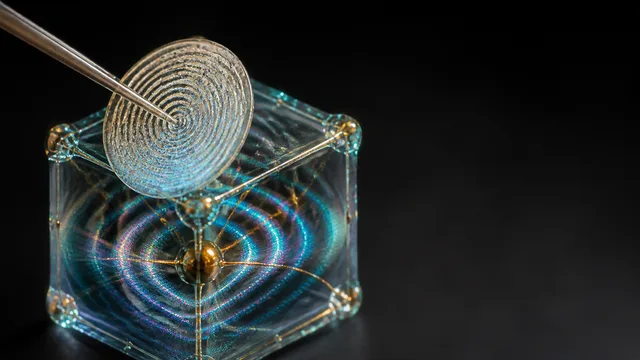
Hannah Cairo Disproved a 40-Year-Old Math Conjecture at 17
At 17, Hannah Cairo overturned the Mizohata-Takeuchi conjecture using a hypercube and a coin diagram. Here's what she actually did—and why it matters.

How Language Shapes Thought, According to Lera Boroditsky
Cognitive scientist Lera Boroditsky explains how the language you speak shapes memory, color perception, and thought—and what's lost when languages disappear.