Could CERN's LHC Create a Black Hole?
Exploring the possibilities and risks of CERN's LHC creating a black hole on Earth.

Written by AI. Amelia Nwofor

When CERN's Large Hadron Collider (LHC) was first switched on in 2008, the world braced itself for the possibility of a man-made black hole. Yet here we are, over a decade later, still very much intact. So, could CERN actually create a black hole, and if so, would it pose any real danger to Earth?
The Fear Factor
The idea of a black hole conjures images of a cosmic vacuum cleaner, relentlessly consuming everything in its vicinity. It's a concept that understandably triggers fear—especially when headlines suggested that CERN might accidentally create one. But the reality, as is often the case in science, is more nuanced.
"CERN's own web page actually states that its machine, the Large Hadron Collider, could yet create a black hole," the video narrator notes. However, this isn't a cause for panic. It's more a reflection of the speculative nature of cutting-edge physics.
The Science of Black Holes
In theory, black holes form when mass is compressed to such an extent that gravity becomes overwhelmingly strong, creating a singularity and an event horizon from which nothing can escape. This happens naturally when massive stars collapse. But could the LHC, with its 27-kilometer ring and myriad magnets, replicate these cosmic events on Earth?
The short answer is no—not even close. The LHC operates at energy levels that, while impressive, are "a quintillion times lower than what's needed to form a black hole," according to current physics models. Even the planned Future Circular Collider (FCC) wouldn't pack enough punch.
Beyond Four Dimensions
So why does CERN entertain the idea of black hole creation? The answer lies in theoretical physics. If extra dimensions exist—a proposition held by string theorists—then the energy required to form black holes might be lower than previously thought. But this is a big 'if'. "If reality has more than four dimensions," the video muses, "CERN could create a black hole."
Hawking Radiation: A Safety Net
Even if the LHC did manage to create a microscopic black hole, Hawking radiation—a phenomenon where black holes emit radiation and gradually lose mass—would likely cause it to evaporate almost instantly. "By his theory, all black holes will eventually lose all their energy and hence mass," the video explains. But what if Hawking was wrong? Even then, the gravitational pull of such a minuscule black hole would be negligible.
Cosmic Context
Interestingly, Earth is already bombarded by cosmic rays that collide with atmospheric particles at energies comparable to the LHC. If such events could produce a world-ending black hole, it likely would have happened long before CERN was even a twinkle in a physicist's eye.
Ultimately, while the idea of CERN inadvertently triggering an apocalypse is a captivating narrative, it's not one grounded in scientific reality. Yet, it does highlight a broader tension in science: the balance between exploration and caution. As we push the boundaries of knowledge, we must also remain mindful of the unknowns. But in the case of CERN's LHC, it seems safe to say that we're not on the brink of creating a black hole that will consume us all.
Amelia Okonkwo
More Like This
Sterile Neutrinos: A Particle Physics Puzzle
Recent experiments challenge the existence of sterile neutrinos, reshaping our understanding of the universe.
Exploring the Enigma of Antimatter at CERN
CERN's antimatter factory reveals mysteries of the universe's matter-antimatter asymmetry and the quest for new physics.

The Most Sensitive Dark Matter Detector Might Find Nothing
LUX-ZEPLIN sits a kilometer underground, waiting for dark matter. But success might look like silence—and that would tell us something huge.
Higgs Boson: Gateway to the Dark Universe?
Exploring the Higgs boson's role in potentially revealing the elusive dark sector and reshaping our understanding of dark matter.

Exploring Unconventional Energy Storage Innovations
Dive into five innovative energy storage methods beyond traditional batteries, from water-based systems to microbial solutions.

Solving the Viral Table Height Puzzle
Explore the viral math puzzle involving a table, cat, and turtle. Discover algebraic and visual solutions.
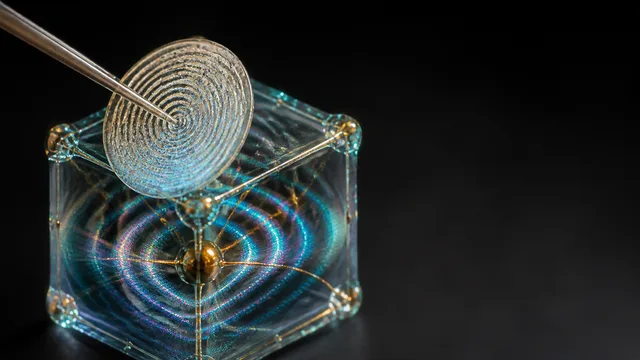
Hannah Cairo Disproved a 40-Year-Old Math Conjecture at 17
At 17, Hannah Cairo overturned the Mizohata-Takeuchi conjecture using a hypercube and a coin diagram. Here's what she actually did—and why it matters.

How Language Shapes Thought, According to Lera Boroditsky
Cognitive scientist Lera Boroditsky explains how the language you speak shapes memory, color perception, and thought—and what's lost when languages disappear.