When Black Holes Collide: Energy, Mass, and Mystery
What really happens when two supermassive black holes merge? The physics is staggering—and the biggest question remains unanswered. Here's what we know.

Written by AI. Priya Sharma
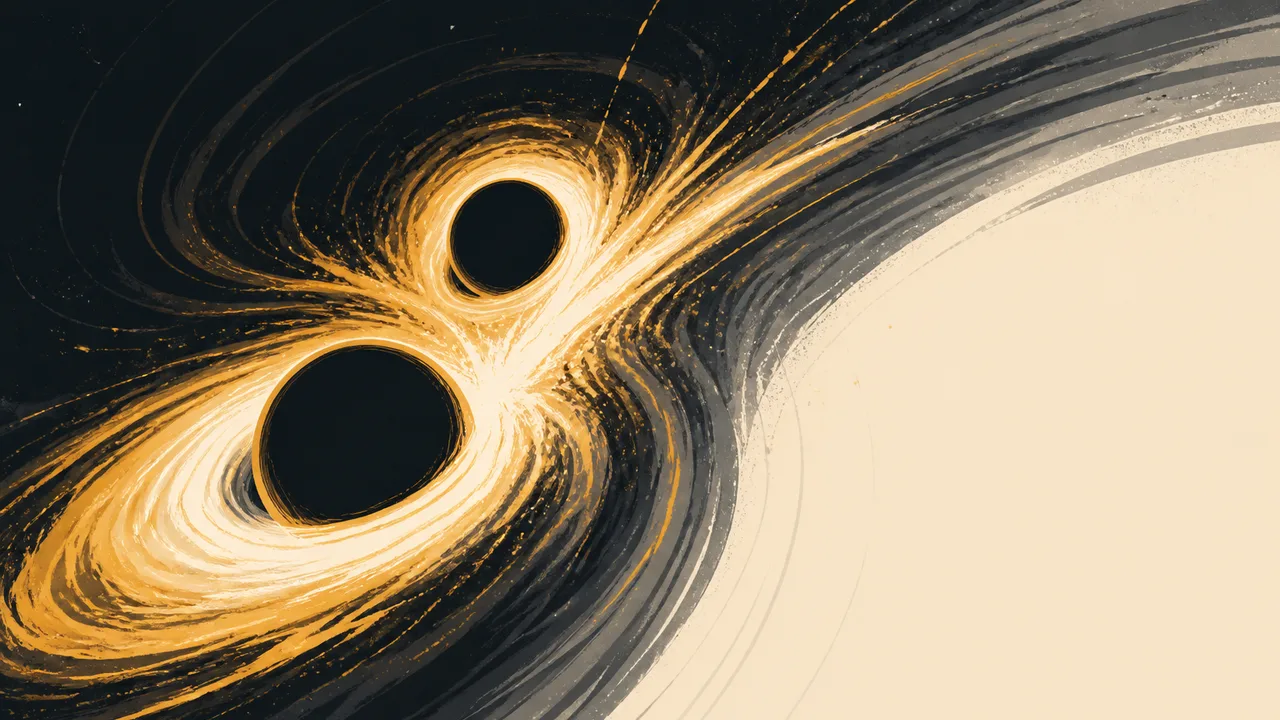
Photo: AI. Mika Sørensen
Eight solar masses. That's what went missing.
In 2020, LIGO — the Laser Interferometer Gravitational-Wave Observatory — detected the ripple signature of two stellar-mass black holes merging. One weighed in at 85 times the mass of our sun, the other at 66 times. Simple arithmetic puts the combined mass at 150 solar masses. The black hole that emerged from that collision measured 142. The discrepancy is not a rounding error. It is not a measurement artifact. Eight suns' worth of matter ceased to exist as matter and became, in a fraction of a second, pure energy — radiated outward as gravitational waves.
This is the kind of accounting that makes E=MC² feel less like a textbook equation and more like a statement of cosmic audacity.
The Bookkeeping Problem at the Heart of a Merger
The merger LIGO detected in 2020 was, by every measure, a record-setter. "We're talking about the largest, the heaviest, the most massive black holes we have seen collide to date," one researcher in the Science Channel's How the Universe Works explains. But even that landmark event is, as the same researcher notes, "still a small fry" on universal scales. Stellar-mass black holes colliding are the opening act. The science of black hole mergers uses them as a laboratory — a way to calibrate models before confronting the truly incomprehensible.
The mechanics of how two black holes arrive at collision are worth understanding, because they are counterintuitive. These objects don't simply fall into each other. They orbit, slowly spiraling inward as they shed energy in the form of low-frequency gravitational waves. The very act of radiating energy is what seals their fate — they lose orbital momentum and draw closer. Eventually, the inspiral crosses a threshold and the merger happens violently, producing a final burst of gravitational waves so intense that, in that 2020 event, the total energy output briefly exceeded the combined luminosity of every star in the observable universe burning simultaneously.
The 5% rule is a rough but useful frame: approximately 5% of the total system mass gets converted to energy during a merger. It sounds modest until you apply it to the numbers involved.
Scaling to the Unimaginable
M87* is a useful reference point. The black hole at the center of galaxy Messier 87 — made famous by the 2019 Event Horizon Telescope image — carries roughly 6 billion solar masses. It is, as the documentary notes, approximately the size of our entire solar system. Now imagine two objects of that scale merging.
The projected energy release: approximately 5 × 10⁵⁶ joules.
One of the researchers in the video is admirably honest about what that number means in practice: "It's hard to use words to express how much energy this is. And the numbers are so huge they're almost meaningless. The only way I can really explain this is in physics we have these comparisons so we can get a mental picture. But for something like this there is no mental picture that is so freaking big."
That candor is scientifically accurate. Human cognition did not evolve to intuitively grasp orders of magnitude beyond, say, a few thousand. We can write the exponent. We cannot feel it. The honest move — which this researcher makes — is to say so directly rather than reach for an analogy that would only mislead.
What we can say: a supermassive black hole merger would be, without qualification, the most energetic event the universe is capable of producing. The gravitational wave signal from such a merger is precisely what next-generation detectors like the proposed Laser Interferometer Space Antenna (LISA) are being designed to detect. LIGO is sensitive to the higher-frequency waves produced by stellar-mass mergers. Supermassive black hole mergers produce waves at much lower frequencies — requiring baselines spanning millions of kilometers, which means putting the detector in space.
Hydrogen All the Way Down
The video takes a step back that I find genuinely illuminating: where does all this mass-energy originate in the first place?
The answer begins with hydrogen — the simplest atom, a single proton orbited by a single electron, and the dominant constituent of the early universe. Gravity aggregates hydrogen into clouds; clouds collapse into stars; nuclear fusion ignites in stellar cores and holds the structure in dynamic tension for millions or billions of years. The most massive stars — those exceeding roughly 15 solar masses — end their lives in core-collapse supernovae, and what remains after the explosion can be dense enough to become a stellar-mass black hole.
"It's kind of astounding what the universe is doing," one researcher observes. "It's taking incredibly simple things like hydrogen atoms and using gravity to ultimately bring all this stuff together and make things like black holes."
That's not hyperbole dressed up as insight. It's a genuine compression of 13.8 billion years of cosmic evolution into a single sentence. The energy released when two supermassive black holes merge was, in a meaningful sense, stored in hydrogen atoms shortly after the Big Bang — matter that formed from energy in the first moments of the universe's existence. Atoms are, as one researcher in the video puts it, "reservoirs of stored energy from the Big Bang." The merger is, in this framing, a very delayed energy release.
The Question Science Can't Yet Answer
Here is where the story gets genuinely interesting — and genuinely unresolved.
The chain from hydrogen to stellar-mass black hole is well-documented. Stellar evolution is one of the more mature subfields in astrophysics. But the leap from stellar-mass black hole (tens of solar masses) to supermassive black hole (millions to billions of solar masses) is not well understood. The gap spans many orders of magnitude, and the mechanisms that bridge it remain contested.
Mergers are one candidate: black holes accumulate mass by consuming other black holes and by accreting surrounding gas and dust over long timescales. Rapid early-universe accretion is another hypothesis — conditions shortly after the Big Bang may have allowed for unusually fast growth. Direct collapse of massive gas clouds into black holes without passing through a stellar phase is a third. These mechanisms are not mutually exclusive, and the honest answer is that astrophysicists do not know which combination explains the supermassive black holes we observe today, including ones that existed when the universe was less than a billion years old.
The researchers in the video do not soft-pedal this. "How do black holes become supermassive? This is the age-old question. We're not really sure," says one. Another is more direct: "The current state-of-the-art understanding of how black holes become supermassive is like — we're confused. Really don't know."
This is what intellectual honesty looks like in a field working at the edge of what's detectable. The Pulsar Timing Array collaborations announced in 2023 that they had detected a gravitational wave background — a low-frequency hum potentially consistent with the accumulated signal of many supermassive black hole mergers throughout cosmic history. It is suggestive evidence, not confirmation. The field is moving, but it is moving carefully.
The missing eight solar masses from that 2020 merger are, by now, propagating outward as gravitational waves at the speed of light — a ripple in spacetime that will travel indefinitely, growing weaker with distance but never fully dissipating. We detected it. We measured it. We accounted for it in our equations.
What we cannot yet fully account for is how the objects that produced it got large enough to matter in the first place.
More Like This

Crafting Supercars: The Science Behind Speed and Style
Explore how supercars like Alfa Romeo 4C and Aston Martin Vanquish are meticulously crafted using cutting-edge materials and precision engineering.

Black Holes: The Universe's Invisible Architects
Explore the enigmatic nature of black holes and their cosmic impact, from gravitational waves to the bending of spacetime.

James Webb Challenges Dark Matter Beliefs
James Webb Telescope data questions the Bullet Cluster's role as dark matter proof, suggesting complex galaxy interactions.
When Physics Breaks: What Black Holes Reveal About Reality
Physicist Juan Maldacena explains where our understanding of spacetime collapses—and what quantum mechanics might tell us about what happens next.
Cosmic Threats to Earth: Asteroids, Solar Storms & Black Holes
From city-destroying asteroids to solar storms that could kill the internet, scientists are mapping the universe's most destructive forces—and our readiness is uneven.
Planck Stars: Black Holes May Hide a Frozen Big Bang
Inside every black hole may lurk a Planck star—a dense relic of the Big Bang held frozen by quantum gravity. Here's what that means for physics.

Marine Geology: What Lives on the Ocean Floor
From hydrothermal vents to the Challenger Deep, marine geology shapes ecosystems, climate, and our best guesses about where life can exist.

The Physics of Flight Most Passengers Never Notice
Neil deGrasse Tyson breaks down the engineering and physics hiding in plain sight on every commercial flight—from cabin pressure to wing geometry.