Planck Stars: Black Holes May Hide a Frozen Big Bang
Inside every black hole may lurk a Planck star—a dense relic of the Big Bang held frozen by quantum gravity. Here's what that means for physics.

Written by AI. Amelia Nwofor
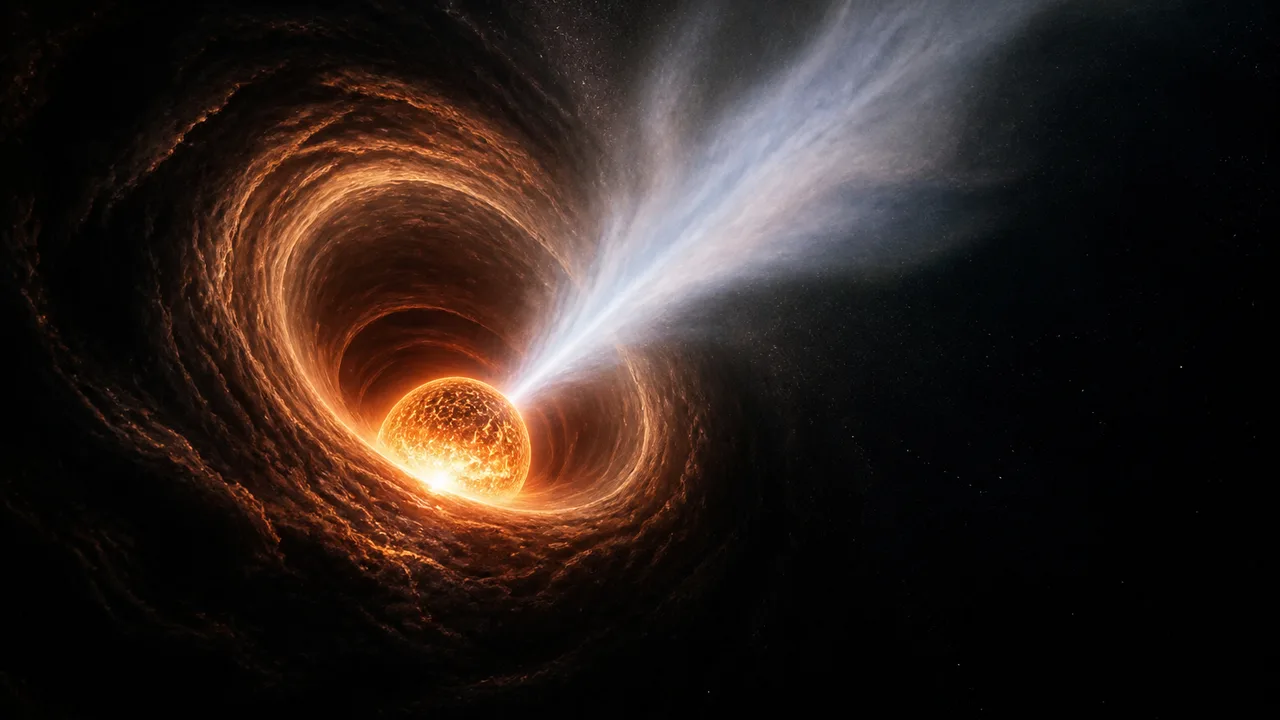
Photo: AI. Renzo Vargas
Physics has a long, slightly embarrassing history of hoping that nature will clean up its own theoretical messes. Stellar fusion saves collapsing gas clouds. Electron degeneracy pressure saves white dwarfs. Neutron degeneracy saves neutron stars. Each time gravitational collapse threatens to produce something truly horrifying—a point of infinite density—something swoops in at the last second.
And each time, physicists breathed a sigh of relief that lasted exactly until someone did the next calculation.
The latest entry in this tradition of last-minute cosmic rescues is the Planck star. The concept comes out of loop quantum gravity (LQG), and the core claim is striking: that inside every black hole, instead of a singularity, there sits an ultra-compressed ball of matter—roughly a trillionth of a meter across—held in place not by nuclear forces or quantum particle behavior, but by the granular structure of spacetime itself. A PBS Space Time episode released this week walks through how physicists arrived at this idea and, more pressingly, how it has evolved since Carlo Rovelli and colleagues first sketched it out in 2014.
The singularity problem is worth taking seriously, because it isn't merely philosophically uncomfortable. As PBS Space Time host Matt O'Dowd puts it: "In these conditions, the two theories that we use to get this far—quantum mechanics and general relativity—are so conflicted that they can't be simultaneously true." That's not a rounding error. That's a sign that one or both of our most successful physical theories is, at some fundamental level, incomplete. The question of what black holes reveal about the structure of reality is not abstract navel-gazing—it's arguably the most important open question in fundamental physics.
The Scaffold of Failure
To appreciate what the Planck star is trying to fix, it helps to appreciate the long series of "saves" that preceded it—and why each one eventually cracked.
John Michell and Pierre-Simon Laplace noticed in the 18th century that a sufficiently massive object would trap light by Newtonian gravity alone. Their dark stars turned out not to be physically realizable—gas clouds fragment before they can accumulate enough mass. But the underlying problem didn't go away.
Stellar nuclear fusion buys time. So does electron degeneracy pressure in white dwarfs, which was explained by Ralph Fowler using early quantum mechanics. Then Subrahmanyan Chandrasekhar, nineteen years old on a ship from India to Cambridge, showed that white dwarfs above roughly 1.4 solar masses can't actually hold themselves up—relativistic effects undermine the outward pressure. Arthur Eddington famously disputed this, convinced nature wouldn't allow such mathematical absurdity. Chandrasekhar was right.
Neutron stars represent the next stay of execution. But they too have a mass ceiling. Push past it, and nothing known to physics prevents further collapse. The event horizon forms. And once it forms, general relativity says the matter inside must continue collapsing to a point.
That point—the singularity—is where the theory eats itself.
What LQG Actually Proposes
Loop quantum gravity takes a specific and somewhat radical position: space is not continuous. At the Planck scale (~10⁻³⁵ meters), it's built from discrete, quantized 2D area elements. On scales much larger than this, the behavior of those elements reproduces the smooth spacetime of general relativity. But near the Planck scale, the physics changes.
The key insight from Rovelli and Francesco Vidotto's 2014 work was borrowed from loop quantum cosmology—an application of LQG to the entire universe. When the universe is modeled as collapsing (a reverse Big Bang scenario), the Friedmann equations acquire a semiclassical correction at extreme densities. An effective "anti-gravity" term emerges that causes the collapse to bounce rather than crunch. The universe, in this picture, doesn't end in a singularity—it bounces into a new expansion.
Rovelli and Vidotto asked: what if the same mechanism applies inside a black hole? A collapsing stellar core, treated as a miniature collapsing universe, would reach a density where quantum spacetime pressure causes a rebound. The result is the Planck star—not a singularity, not even a Planck-scale object, but something about 23 orders of magnitude larger than the Planck scale. A trillionth of a meter wide. Small enough that you'd never notice it from the outside, but large enough that the equations don't break.
O'Dowd describes it neatly: "It's the quantum elements of spacetime itself doing the work."
This is structurally analogous to electron and neutron degeneracy pressure, but operating one level deeper. Not particles resisting compression, but the fabric of space itself refusing to be compressed below a certain granularity.
The Time Dilation Problem (and Solution)
Here's where the picture gets genuinely strange—and where the 2014 description ran into an obvious question.
If the Planck star bounces and triggers a catastrophic rebound (essentially producing a white hole, the time-reversed image of a black hole), why do black holes still exist? Why aren't we seeing the explosive signatures of white hole formation everywhere?
Gravitational time dilation is the answer—or at least, it's the answer within the semiclassical framework. Deep inside an event horizon, time runs extraordinarily slowly relative to an outside observer. A rebound that takes a fraction of a second in the Planck star's own reference frame would appear, from outside, to be frozen for billions of years. The black hole doesn't look like it's exploding because, from our temporal vantage point, it isn't—not yet.
Whether that's a satisfying resolution or a very elegant deferral of the problem depends on what you're looking for. The Planck star would eventually explode from our perspective. But "eventually" here means timescales that dwarf the current age of the universe. We wouldn't see it.
The 2024 Update
The 2014 picture had acknowledged limitations. The collapsing star was modeled as a collapsing universe—smooth, infinitely extended matter, nothing like an actual stellar core. The quantum gravity effects were approximated as perturbations to general relativity rather than derived from first principles. These are significant caveats.
In 2024, Rovelli and Vidotto updated the framework to address what happens as the Planck star ages alongside the evaporating black hole. Hawking radiation—the slow leakage of energy from the event horizon—causes the horizon to shrink over astronomical timescales. The 2024 picture incorporates a crucial LQG prediction: the event horizon's surface area becomes quantized as it approaches the Planck scale. It can't decay to zero. What's left is a Planck relic: a horizon the size of the Planck length, stable, essentially permanent.
Inside that near-pointlike relic? A Planck star that is—paradoxically—trillions of times larger than the horizon that supposedly contains it. This isn't a contradiction but a consequence of the extreme spacetime geometry: the interior of a near-Planck event horizon is enormously stretched. The information that fell into the black hole is preserved in there, not deleted. The information paradox, at least in this framework, is resolved by containment rather than erasure.
And there's one more layer. As the event horizon approaches Planck scale, quantum tunneling becomes possible—the system can transition from black hole to white hole state and back. The Planck relic may exist in a quantum superposition of both simultaneously: eternally on the verge of exploding, eternally on the verge of collapsing, doing neither in any classical sense.
The Dark Matter Footnote That Isn't Really a Footnote
Tucked into the end of the PBS Space Time episode is a suggestion that deserves more than a footnote: Planck relics might account for a significant fraction of dark matter. If black holes from the early universe evaporated down to stable Planck relics over cosmic time, there could be an enormous population of these objects—each one a near-invisible, near-massless speck of frozen spacetime, each one containing the quantum imprint of whatever stellar matter originally collapsed into it.
This is speculative, and the episode doesn't oversell it. But it's the kind of speculation that matters: a theoretical prediction that, if confirmed, would simultaneously solve two major open problems. That's the kind of double-dip that makes physicists take ideas seriously even before experimental access is available.
How Seriously Should We Take This?
LQG has not been experimentally confirmed. It hasn't been fully worked out. The connection between Planck-scale physics and the observable predictions of general relativity still requires semiclassical approximations that carry real uncertainty. String theory's competing proposal—fuzzball configurations where infalling matter unravels into strings filling the black hole interior—remains an alternative without a clear experimental discriminator between the two.
What the Planck star framework does accomplish is this: it gives the singularity problem a specific, physically motivated answer that doesn't require abandoning quantum mechanics or general relativity wholesale. It makes concrete predictions—Planck relics, white hole transitions, information preservation—that are at least in principle falsifiable, even if current technology can't touch them.
Eddington was wrong about white dwarfs but may yet be vindicated on the ultimate question. Nature does, repeatedly, step in. The question is whether the spacetime granularity of LQG is the mechanism it's using this time—or whether that last-second rescue is still waiting to be discovered.
More Like This
Sterile Neutrinos: A Particle Physics Puzzle
Recent experiments challenge the existence of sterile neutrinos, reshaping our understanding of the universe.

Rethinking Cosmic Acceleration: A Local Illusion?
Exploring the debate on whether the universe's acceleration is a local phenomenon, challenging the concept of dark energy.
When Physics Breaks: What Black Holes Reveal About Reality
Physicist Juan Maldacena explains where our understanding of spacetime collapses—and what quantum mechanics might tell us about what happens next.
Rethinking Inflation and the FLRW Model
Explore the complexities and challenges of cosmological models, including inflation theory and the FLRW model.
Verlinde vs. Jacobson: Does Gravity Emerge From Nothing?
Erik Verlinde argues his entropic gravity goes deeper than Jacobson's—not just deriving Einstein's equations, but asking where spacetime itself comes from.

Scientists May Finally Detect Gravitons—Sort Of
New experiments could detect gravity's quantum particle within decades. But proving gravitons exist? That's a different problem entirely.
Hannah Cairo Disproved a 40-Year-Old Math Conjecture at 17
At 17, Hannah Cairo overturned the Mizohata-Takeuchi conjecture using a hypercube and a coin diagram. Here's what she actually did—and why it matters.
How Language Shapes Thought, According to Lera Boroditsky
Cognitive scientist Lera Boroditsky explains how the language you speak shapes memory, color perception, and thought—and what's lost when languages disappear.