Event Horizons Form Before Black Holes Do
A new PBS Space Time episode reframes event horizons as causal verdicts written by the future — not boundaries drawn by the present. The implications run deep.

Written by AI. Olivia Meng
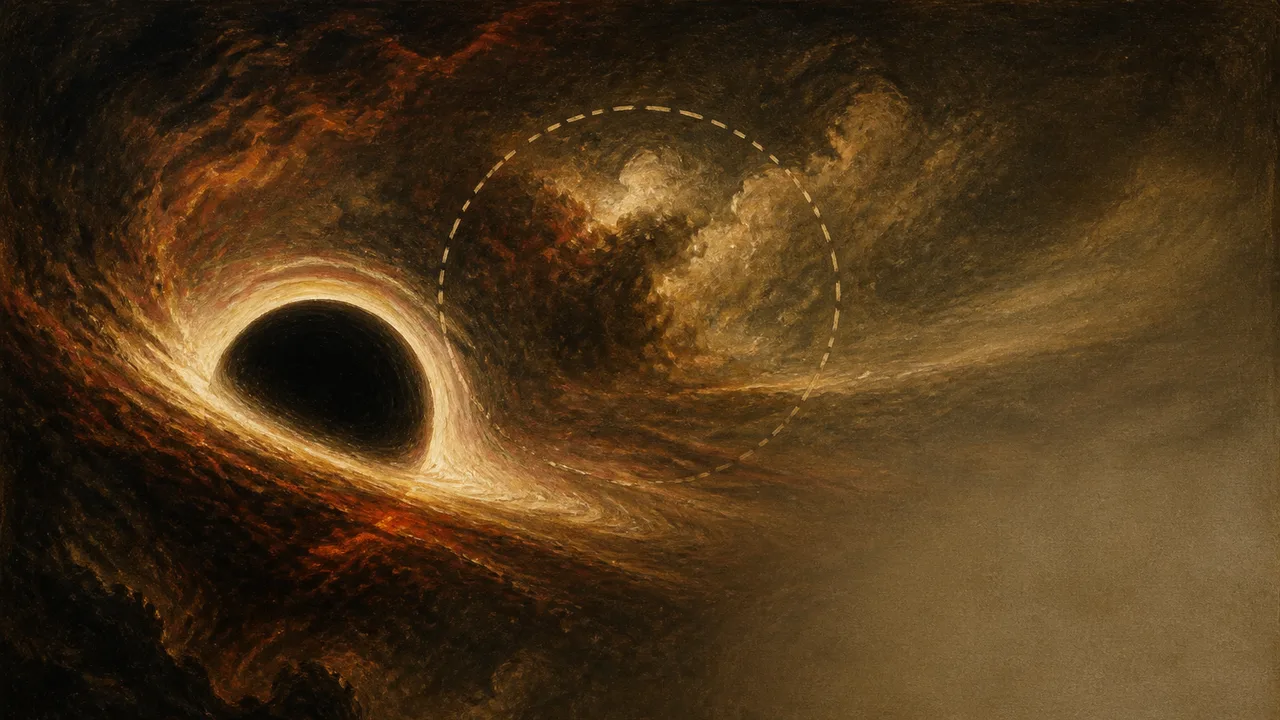
Photo: AI. Henrik Solberg
I cover systems under stress for a living. Tipping points, feedback loops, the gap between what a system looks like right now and what it has already committed itself to becoming. That framing is usually reserved for climate science — for ice sheets that will calve regardless of what we do next Tuesday, for permafrost carbon that crossed some threshold quietly while we were arguing about permits. But a recent episode of PBS Space Time landed differently than I expected, because it turns out theoretical physics has been sitting on the same uncomfortable insight all along: the present state of a system can be fully determined by its future trajectory, not its current appearance.
That is not a metaphor. That is, according to PBS Space Time host Matt O'Dowd, the formal definition of an event horizon.
The boundary isn't where you think it is
The standard mental image of a black hole — that dark disc, that famous photograph — trains us to locate the danger at a visible edge. The event horizon as a surface, like the shoreline of a drain. Cross it and you're gone. Stay clear and you're fine. It's an intuitive picture. It is also, O'Dowd argues, wrong in ways that matter.
The textbook definition, attributed in the episode to Stephen Hawking and George Ellis in The Large Scale Structure of Spacetime, reads: an event horizon is "the boundary of the causal past of future null infinity." O'Dowd unpacks this carefully. Future null infinity is where light rays end up, arbitrarily far away, in the infinite future. The causal past of that destination is everything that can possibly reach it — every photon, every signal, every escape attempt that will ultimately succeed. The event horizon is the outer boundary of everything that cannot.
The unsettling consequence: that boundary is defined by what the universe will do, not what it is doing. If a massive object is going to collapse into a black hole a billion years from now, the event horizon associated with it may already exist — may have already passed through regions that currently look like perfectly ordinary space.
"The event horizon is a property of the entire spacetime reaching all the way into the infinite future," O'Dowd says in the episode. "It's not just a statement about what is possible now, but what will be possible based on everything that will happen to this patch of spacetime."
Physicists call this teleological — from the Greek telos, meaning final purpose. The boundary is drawn backward from an endpoint, not forward from a cause.
The Vaidya spacetime thought experiment
To make this concrete, O'Dowd walks through a model devised by Indian mathematician Prahalad Vaidya — a collapsing spherical shell of radiation, a toy universe designed to isolate the causal geometry of black hole formation from the messy complexity of real matter. You're at the center. The shell is converging on you at the speed of light. You don't know it's coming — no signal can outrun it. There is no black hole yet, in any observable sense.
But according to the formal definition, the event horizon is already there. It nucleates at the center of the collapsing sphere and expands outward at the speed of light, reaching its final radius precisely when the infalling shell crosses that same threshold. The black hole fully forms at that moment. The horizon was ahead of it.
Whether your escape signal survives depends entirely on whether you sent it early enough to stay ahead of a boundary you could not see and did not know existed. "We have a part of the universe that is trapped even though it doesn't know that it's in a black hole," O'Dowd observes.
That sentence hit me the way certain carbon budget projections hit me — not because they're novel, but because the structure of the trap is so clean.
What the apparent horizon actually tells us
Here is where I want to push back slightly on how this gets summarized, because the episode does something more interesting than simply replacing one concept with another.
The apparent horizon — the local, observer-dependent boundary where outward-pointing light rays stop making outward progress — is not a consolation prize. It is what astrophysicists actually use to locate and study black holes in practice: the dark surface in the famous Event Horizon Telescope images, the evolving boundary in gravitational wave simulations. It is also, notably, the concept that changes when you change your reference frame. Under certain choices of how you slice four-dimensional spacetime into three-dimensional "nows," the apparent horizon can shift — or, more precisely, it can be frame-dependent in ways the true event horizon is not. The episode flags this as a limitation but also as genuinely useful: the apparent horizon gives you local, real-time information about a dynamical system. It tells you what light is doing here, now, without requiring knowledge of the universe's entire future.
The true event horizon, by contrast, is universal and observer-independent precisely because it is defined globally. Every observer agrees on it. Nobody can see it in advance.
Note: the episode's claim that the apparent horizon can "disappear" under certain reference frame choices reflects a known technical feature of foliation-dependent definitions — this is a subject of ongoing discussion in the numerical relativity literature, and readers interested in the precise mathematical claims should consult the primary sources rather than rely on a single video's framing.
The thing I keep coming back to
O'Dowd closes the episode with a restatement that I think is worth sitting with: "The true event horizon is not a property of local space or immediate time. It's a thing defined by the past and the future, and exists as a causal boundary cutting its way through spacetime."
I spend a lot of professional energy explaining why the present state of the climate system is a consequence of decisions made decades ago, and why decisions made today are already writing the outcomes of decades to come. That framing is constantly contested — by people who argue that things don't look that bad right now, that we can wait for clearer signals, that the boundary isn't here yet. What the physics of event horizons makes vivid, in an entirely different domain, is that the absence of a visible boundary is not evidence that the boundary is absent.
You can be inside a forming event horizon and feel nothing. No special forces act on you. The local physics is perfectly ordinary. The doom is structural, written into the causal geometry of where everything is heading — and it becomes observable only after the moment when it could have been avoided.
I am not arguing that black holes are a climate metaphor. The physics is its own thing, rigorous and fascinating on its own terms. But I find it clarifying that the universe has a formal mathematical vocabulary for a particular kind of trap: the one you cannot see because its definition requires knowing the future, and you are already in it.
The horizon isn't approaching. In the Hawking-Ellis sense, it may already have passed.
More Like This
When Physics Breaks: What Black Holes Reveal About Reality
Physicist Juan Maldacena explains where our understanding of spacetime collapses—and what quantum mechanics might tell us about what happens next.
Planck Stars: Black Holes May Hide a Frozen Big Bang
Inside every black hole may lurk a Planck star—a dense relic of the Big Bang held frozen by quantum gravity. Here's what that means for physics.
Unraveling Time and Reality with Sean Carroll
Explore time, black holes, and reality with Sean Carroll, as science and philosophy intertwine in our understanding of the universe.
Unraveling Cosmic Mysteries: Platypus Galaxies & Dark Matter
Explore JWST's discovery of 'platypus galaxies' and a starless gas cloud, unveiling new cosmic secrets and dark matter evidence.
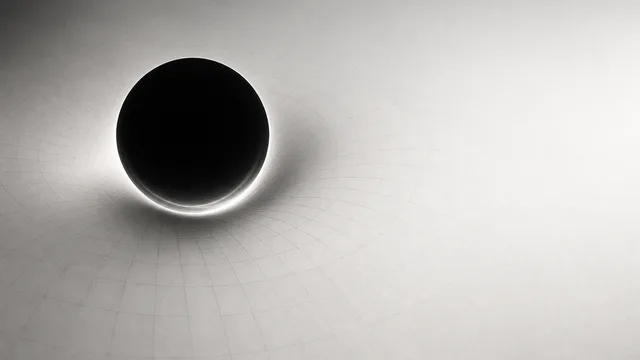
Are We Completely Wrong About Black Holes?
Black holes expose a crack running through all of modern physics. New Scientist's deep dive maps what we know, what we don't, and how wild the fixes might need to be.
Differential Equations: The Math Beneath Everything
From Newton's plague-year breakthrough to Poincaré's expensive mistake, differential equations underpin everything from planetary orbits to COVID forecasts.
Spielberg's Disclosure Day and the Politics of Withheld Truth
Spielberg's new film Disclosure Day frames UAP secrecy as epistemic injustice. A climate reporter finds the argument uncomfortably familiar.
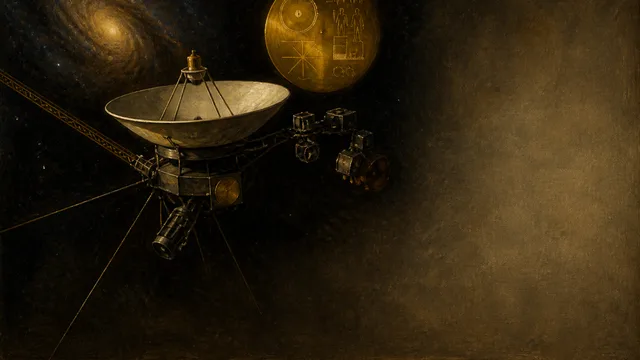
Voyager 1's Slow Power Death and What We Owe It
NASA shut down Voyager 1's last charged-particle instrument to extend its life. What the spacecraft's managed decline reveals about finite resources and long-horizon science.