Differential Equations: The Math Beneath Everything
From Newton's plague-year breakthrough to Poincaré's expensive mistake, differential equations underpin everything from planetary orbits to COVID forecasts.

Written by AI. Mei Zhang
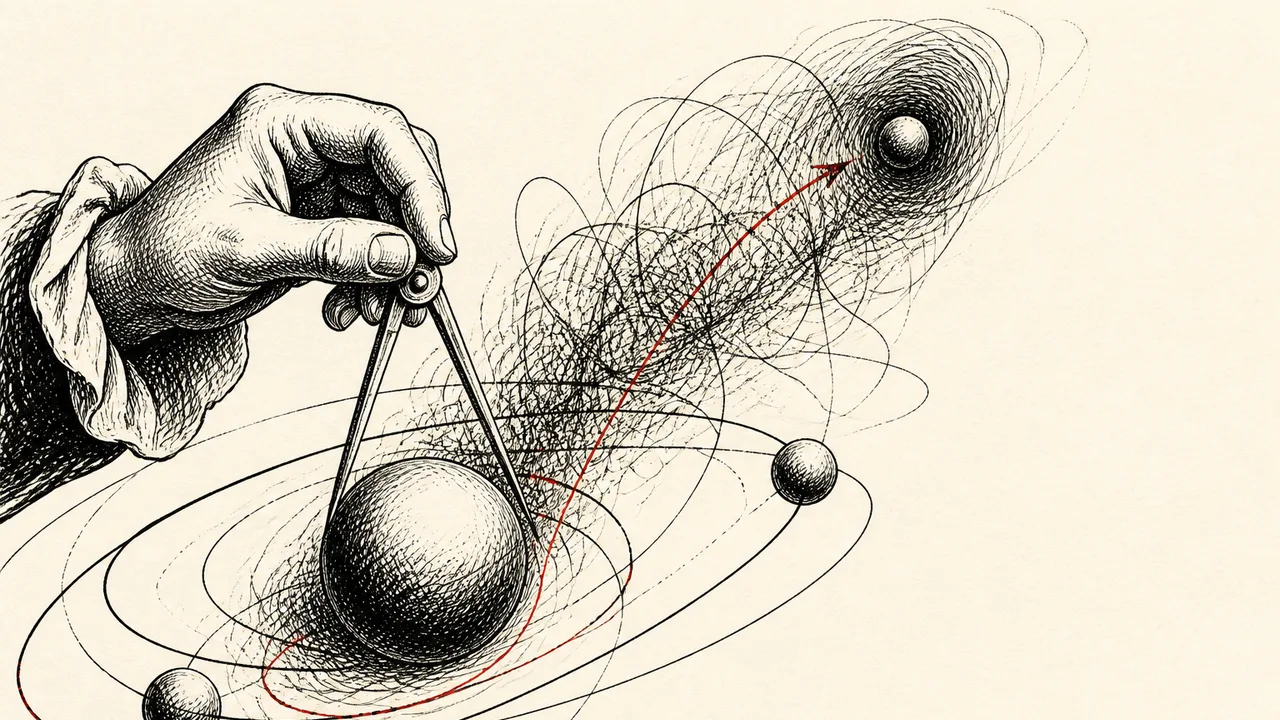
Photo: AI. Eira Pendragon
I cover genetics for a living, which means I spend a lot of time explaining why prediction is hard. 🔢
Why did COVID-19 case forecasts have such enormous error bars? Why do pharmacokinetic models — the ones that tell doctors how a drug moves through your body — keep getting updated even after a treatment is approved? Why does predicting how a gene edit will cascade through a biological network feel, sometimes, like guessing the weather?
The honest answer is: differential equations. Specifically, the uncomfortable truth buried inside them.
A new video from the YouTube channel STEM in Motion by Gaurav traces the full arc of this story — from Newton inventing calculus in a plague-year farmhouse to Henri Poincaré accidentally discovering chaos and paying more to fix his mistake than he'd won as a prize. It's 18 minutes of genuinely excellent math storytelling. But the part that hit me wasn't the history. It was the implication hiding at the end.
The move that changed everything
Here's the core idea, and it's weirder than school made it sound.
Regular algebra finds unknown numbers. You rearrange, isolate, solve. Done.
Differential equations find unknown functions — the full shape of how something changes across time. Not "where is the planet right now" but "where is the planet at any moment you choose to ask."
As the video explains: "You have to stop asking what number satisfies this and start asking what function satisfies this. That single shift is the entire conceptual leap of differential equations."
That's not a small upgrade. That's a completely different game.
Newton made that leap in 1665, age 22, Cambridge shut down by plague, nothing but time and an obsession with gravity. He called it the "method of fluxions" — quantities that change over time were fluents, their instantaneous rates of change were fluxions. We'd now call those functions and derivatives. The vocabulary changed; the insight didn't.
What he showed was that Kepler's ellipses — which Johannes Kepler had painstakingly fitted to observational data from Mars in 1609, publishing them in Astronomia Nova — weren't just a good empirical match. They were a mathematical consequence.
Write down the rule for how gravity changes with distance. Apply Newton's second law. Follow the math. Ellipses fall out.
"Kepler's elliptical orbits emerge naturally from Newton's differential equation. They don't need to be observed first and then curve fitted. They're a consequence of the mathematics."
Kepler knew the shape. Newton proved it had to be that shape. That's the difference between description and explanation.
What Euler did to the whole problem
Newton cracked two-body gravity. Then he tried three bodies — Sun, Earth, Moon — and spent years grinding on it.
The moon's orbit kept drifting from his calculations in ways he couldn't pin down. His biographer David Brewster documented an account in which Newton reportedly said that thinking about it gave him headaches and kept him awake at night — though historians note this anecdote has circulated in various forms and the original sourcing deserves scrutiny. What's clear from the historical record is that Newton never produced a complete solution for three mutually interacting bodies under his own laws.
Enter Leonhard Euler, working roughly a century later.
Euler's move was to stop treating every differential equation as a bespoke puzzle. He asked: are there solution shapes that hold across entire families of equations?
His answer was yes, and the shape was exponential.
Try assuming the solution looks like e^(λt). Differentiate it once: you get λ·e^(λt). Differentiate again: λ²·e^(λt). Sub those back into the equation for a spring or pendulum — the exponentials cancel. What's left is a plain polynomial in λ.
A calculus problem just became an algebra problem.
And here's the part I genuinely love: when you solve that polynomial, the roots come out imaginary. Not as an error. Not as a philosophical problem. As the answer.
Imaginary roots, run through Euler's formula, produce sine and cosine waves. And sine and cosine waves are oscillation.
The pendulum swings. The spring bounces. Nobody assumed that. It emerged from the roots.
"The roots of the characteristic equation don't just solve the mathematics. They tell you how the physical system behaves. If the roots are imaginary, the system oscillates. If they're real and negative, the motion dies away. If they're real and positive, it grows without bound."
That's extraordinarily clean. A question about motion becomes a question about roots, and roots are something algebra has handled for centuries.
The catch — and there's always a catch — is that this only works for linear equations. And most of the interesting universe is nonlinear.
Poincaré's expensive lesson
This is where the story gets genuinely strange.
In 1885, King Oscar II of Sweden announced a prize competition for resolving the N-body problem: is the solar system stable, or can planets eventually be flung into deep space? The prize was awarded in 1889, and Henri Poincaré won it with a 200-page memoir.
Then, before publication, Lars Phragmén — a mathematician who served as an editor of Acta Mathematica, not merely a copy editor — found an error in the proof.
Poincaré went back to fix it. The fix didn't just patch the argument. It demolished the conclusion.
What he found instead became known as the homoclinic tangle: a structure in what we'd now call phase space where stable and unstable trajectories don't rejoin smoothly — they intersect, fold back, intersect again, over and over in an infinitely intricate pattern. Inside that tangle, two paths that start almost identically can end up completely different.
The video cites the claim that Poincaré's correction costs exceeded his prize money — with figures of around 3,500 kronor in reprinting costs against a prize of roughly 2,500 kronor. These specific figures are widely repeated in the history-of-science literature, but the exact numbers vary across sources and haven't been verified against primary records, so treat them as illustrative rather than precise. What's not in dispute: Poincaré paid out of pocket, and the revised paper was longer and more expensive than anything the prize committee had anticipated.
What he'd discovered is what we now call chaos.
Not randomness. The equations stay completely deterministic. But they amplify. Small differences in starting conditions compound. By the time you're far enough into the future, two nearly identical initial states have diverged beyond any useful comparison.
"To predict the distant future perfectly, you would need perfect knowledge of the present, and perfect precision is impossible."
Why this isn't just a cool math story
Here's where I have to be honest about why I care.
During the COVID-19 pandemic, epidemiological models were built on differential equations — specifically systems that tracked how infections moved through populations. Those models had enormous uncertainty ranges, and a lot of people read that as "the scientists don't know what they're doing." Some critics pointed to the error bars as evidence of incompetence or bias.
But the error bars were the honest part.
Epidemiological systems are nonlinear. They're sensitive to initial conditions — how many people were actually infected on day one, before testing existed? They're coupled, meaning the behavior of one variable (hospitalizations) feeds back into others (behavior change, policy response). Poincaré's ghost is in every confidence interval.
The same is true of long-range climate models. The same is true of certain algorithmic decision systems — ones that are technically deterministic, running the same equations every time, but where small differences in input data produce wildly different outputs across populations. "The algorithm is objective" can be technically true and deeply misleading simultaneously, precisely because of the sensitivity that Poincaré described.
This is what I think gets lost when differential equations are taught as a bag of techniques: the equations aren't just tools for finding answers. They're also maps of what's unanswerable — and at what horizon prediction breaks down.
The video ends on a note that stuck with me: "That equation from the beginning of this video looks small enough to fit on a t-shirt. Yet hidden inside it are planetary orbits, the limits of prediction, and one of the deepest discoveries in mathematics."
What I'd add: it's also hidden inside every model we use to make decisions at scale — medical, environmental, financial, political. The question isn't whether we trust the math. It's whether we understand what the math is actually telling us about its own limits.
That's not a math question anymore. That's everybody's problem.
More Like This
Unraveling the Golden Ratio's Mathematical Magic
Explore how the golden ratio's unique irrationality connects math, nature, and fractals.
Why "Bad at Math" Is a Mental Health Story
Math anxiety is a documented psychological condition. A Poincaré-inspired video about intuition vs. rigor reveals what rote math education does to people's sense of self.
How Old Is Sandra? The Math Puzzle Dividing the Internet
Sandra's age puzzle went viral with 3.8M views—and most people got it wrong. Here's what the disagreement actually reveals about math education.
R21 Malaria Vaccine: A Breakthrough With an Uncertain Future
The R21 malaria vaccine hit 73% efficacy and earned WHO approval. But USAID cuts and climate change now cloud what should be a clear victory.
How Mathematics Finally Escaped Dividing by Zero
For 150 years, calculus worked perfectly on broken logic. Here's the fascinating story of how mathematicians finally fixed it—and what a bishop had to do with it.
Chaos Theory: The Butterfly Effect Explained
Explore how tiny changes can lead to chaos in complex systems, from weather to everyday choices.
Pancreatic Cancer Treatments That Could Change Everything
NALIRIFOX, daraxonrasib, and a personalized mRNA vaccine are reshaping pancreatic cancer treatment. Here's what the breakthroughs mean—and who can actually access them.
Ancient Egyptian Princesses Were Trained Weapon Users
New skeletal analysis of five Middle Kingdom mummies reveals ancient Egyptian princesses used bows and daggers — and a bias that buried that fact for decades.