Why "Bad at Math" Is a Mental Health Story
Math anxiety is a documented psychological condition. A Poincaré-inspired video about intuition vs. rigor reveals what rote math education does to people's sense of self.

Written by AI. Samir Patel
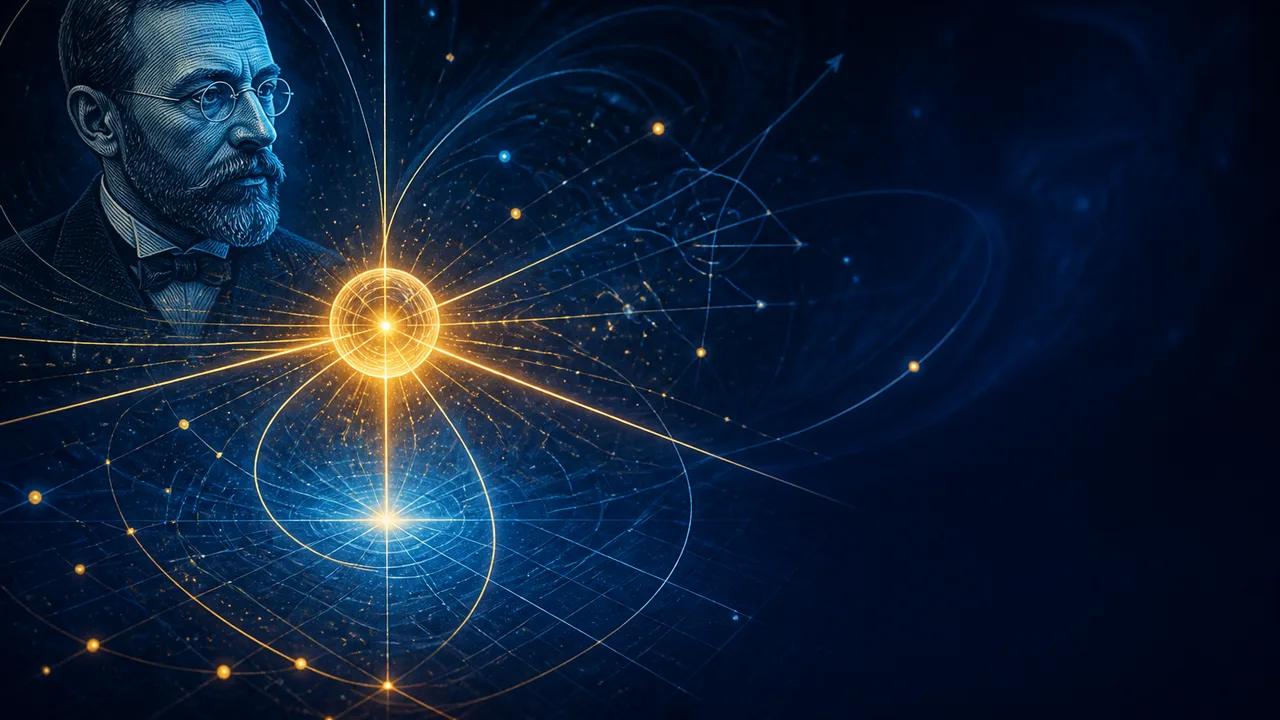
Photo: AI. Dante Nwosu
Think about the last time someone said — or you said — "I'm just not a math person." Notice how it lands. Not as a preference, like "I don't love jazz," but as a verdict. A fixed fact about the self. Something decided long ago, probably in a classroom, probably with some humiliation attached.
That is not a math story. That is a mental health story.
I don't usually cover mathematics education. But a recent DIBEOS video about a deceptively simple question — what is a point in space? — took me somewhere I didn't expect. Not into geometry, but into the psychology of how we learn, and what happens to people when learning is stripped of meaning and replaced with performance.
The question the video poses is this: can you define a mathematical point? Most people picture a dot on paper. Which is technically not a point — it's a representation of your impression of a point. And then the video walks you into the weeds: the dot you imagined a second ago, is it the same as the one you're imagining now? Earth's orbital velocity around the sun is roughly 18.5 miles per second, meaning that in one second, the "stationary" object on your table has actually traveled approximately 18.5 miles relative to the sun. Same place is a frame-of-reference problem. What felt obvious dissolves the moment you push on it.
The video draws on Henri Poincaré — the French mathematician who, in The Value of Science (1905), argued that intuition cannot give us rigor. The Dirichlet's principle episode illustrates exactly why. Mathematicians, including Riemann, had assumed that because a certain energy functional was bounded below — meaning it had an infimum — there must therefore exist some function that actually achieved that minimum value. The assumption felt obvious. It was wrong. An infimum is a greatest lower bound that a sequence can approach indefinitely without ever reaching; Weierstrass's critique demonstrated that the intuitive leap from "a lower bound exists" to "something achieves it" was not logically guaranteed. Intuition, unchecked, had embedded a flaw into serious mathematical physics.
So rigor saves us from our own faulty instincts. Clean so far.
But here's what I think matters more — and where Poincaré makes a turn that most math classrooms never make: rigor alone creates tautologies. Logic can only make explicit what was already implicit in the axioms. It can verify. It cannot discover. "Logic, which alone can give certainty, is the instrument of demonstration," Poincaré writes. "Intuition is the instrument of invention."
In other words: you need both. You need intuition to have something worth proving, and rigor to confirm you've actually proved it.
Now here's my actual question: what have we built when we teach math as only the second thing?
Research on math anxiety — documented extensively by cognitive psychologists including Sian Beilock at the University of Chicago — consistently shows that math-anxious students are not intellectually incapable. They are experiencing a stress response that consumes working memory precisely when working memory is most needed. The anxiety itself impairs performance. And math anxiety is strongly correlated with early educational experiences that emphasized correctness over understanding, speed over sense-making, performance over process. The academic literature on this, including work published in journals like Psychological Science and Current Directions in Psychological Science, describes math anxiety as a distinct and measurable phenomenon with real neurological markers — elevated stress responses, avoidance behavior, and lasting identity-level damage to how people see their own intelligence.
"You can recite a proof perfectly," the DIBEOS video notes, "but still have no idea what is the big idea behind the proof."
A generation of students did exactly that. And then, when they couldn't hold the steps in memory without knowing why the steps belonged together, they concluded something was wrong with them. Not with the instruction. With them.
This is the stigma problem I actually recognize from my beat. The cognitive practice of mathematics involves both formal and intuitive cognition — but we taught one and graded only on compliance with the other. When students failed that compliance test, the cultural verdict was "not a math person," which is a polite way of saying "intellectually deficient in a domain that signals general intelligence." The shame that attaches to that verdict is not mild. It shapes career decisions, academic self-concept, and for some people, a lasting wariness about any domain that feels similarly opaque.
The DIBEOS video distinguishes carefully between different kinds of intuition — which is, frankly, a more sophisticated framing than most math classrooms ever offer. Poincaré's point is that when we call four different axioms "intuitive," we're actually gesturing at completely different cognitive operations. One involves formal logic. One involves a priori reasoning about infinite sequences that you couldn't verify empirically. One requires spatial imagination. One is actually a definitional convention masquerading as a fact about the world. Treating all four as "obvious" doesn't illuminate them — it forecloses the genuine questions they contain.
That foreclosure is what I want to name more precisely. When a student asks why and is told to just follow the procedure, something is communicated that goes beyond mathematics. The implicit message is: your curiosity is an obstacle. What's valued here is compliance, not comprehension. And for students who need to understand why in order to remember how — which, developmentally, is most children — that message lands as personal inadequacy rather than pedagogical failure.
The DIBEOS video ends with a line that I think carries more weight than its context suggests: "When mathematics becomes rigorous, it forgets its historical origin. We can see how we can get answers to questions, but we forget why we had this question in the first place."
That forgetting has costs that mathematics educators might not be positioned to see, but mental health researchers are. When the why is stripped out of learning, students lose not just understanding but investment. And when they fail without understanding why they failed, they don't think "this instructional approach didn't serve my cognitive style." They think: "I'm not smart enough."
Poincaré's argument is that intuition is the instrument of invention — the thing that prompts the question before logic can answer it. If that's true in the creation of mathematics, it's probably also true in the learning of it. Meaning comes before memorization. Curiosity before correctness. The question before the proof.
Most of us were never taught that way. And for a lot of people, the damage from that is real, measurable, and still running.
"I'm not a math person" is a learned belief, not a discovered truth. There's a meaningful difference — and I think we owe it to people to say so clearly.
More Like This

When Feeling Stuck Is Actually Feeling Safe
The Art of Improvement argues comfort—not laziness—is what keeps people stuck. The idea is compelling. It's also worth examining carefully.
Understanding Emotion Regulation with Dr. Marc Brackett
Explore emotion regulation with Dr. Marc Brackett, focusing on practical strategies for emotional intelligence in personal and professional contexts.
The Emotional Resonance of Sound: Teresina's Journey
Explore how Teresina Kerubo uses sound to navigate love and grief, finding peace through recorded memories.
How Tall Is the Dog? The Viral Math Puzzle Solved
A dog, a pole, two measurements—and three different ways to crack it. Presh Talwalkar's viral puzzle reveals something deeper about how we learn math.
Linear Algebra Finally Explained Without the Gatekeeping
A DIBEOS video makes linear algebra intuitive for adults who bounced off it in college. Here's what it gets right — and one thing worth questioning.

The Formula You Memorized Was Hiding Calculus
Why does differentiating πr² give 2πr? The answer reveals the deepest structural idea in mathematics—and it was hiding in plain sight all along.
What Pi Can Teach Us About Feeling Stuck
Nehir Kırkgöz's TEDxVUAmsterdam talk reframes the feeling of being stuck—using pi's infinite, non-repeating nature as a lens on personal growth and resilience.
Discipline Is About Removing Options, Not Building Willpower
Mark Manson argues discipline has nothing to do with willpower—it's about eliminating choices. Here's what the research says, and what the theory leaves out.