The Formula You Memorized Was Hiding Calculus
Why does differentiating πr² give 2πr? The answer reveals the deepest structural idea in mathematics—and it was hiding in plain sight all along.

Written by AI. Priya Sharma
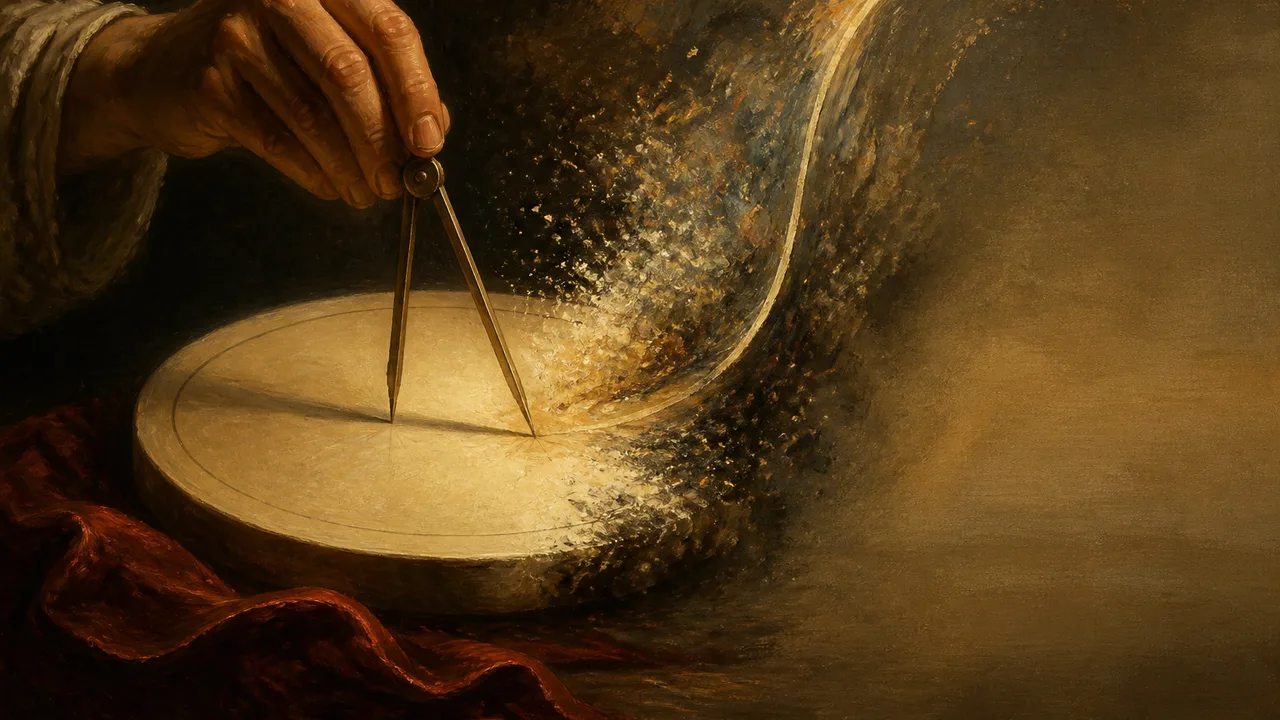
Photo: AI. Henrik Solberg
Most of us left school carrying two geometry formulas with no apparent relationship to each other. The area of a circle is πr². The circumference is 2πr. We memorized them as separate facts, filed them in separate mental folders, and never thought to ask why differentiating the first one produces the second.
That question is the entry point for a new video by Gaurav of STEM in Motion, which traces the history of integration from Archimedes to Henri Lebesgue across twenty minutes of animated mathematical argument. The video is framed as a calculus lesson, but it functions more honestly as an archaeology of ideas—excavating the conceptual foundations beneath the formulas most of us were handed without explanation.
The answer to the πr² question, it turns out, is not a coincidence of notation or a quirk of algebra. It is what the video calls "the footprint of a deep structural symmetry"—the visible surface of the fundamental theorem of calculus, one of the most consequential discoveries in the history of mathematics.
Two problems, one engine
The video opens with a historical framing that rewards attention. For roughly 1,900 years, mathematicians worked on two problems that appeared completely unrelated: the area problem and the slope problem.
Archimedes attacked the area problem around 250 BCE with his method of exhaustion—filling curved regions with polygons of increasing complexity, trapping the true answer between ever-tighter bounds. Using 96-sided polygons, he could bracket the value of pi between 3.1408 and 3.1429. He knew the exact answer existed somewhere in that gap. He could not close it, because he had no mathematical language for what happens precisely at infinity, only for what happens as you approach it.
Fermat, nearly two millennia later, worked the slope problem: how do you find the tangent line to a curve at any given point? These two problems—area and slope—developed along largely separate paths until Isaac Newton, inheriting both in 1665, noticed something nobody had formally articulated.
Newton's insight was to define a new function: not the curve itself, but the accumulated area under the curve, measured from a fixed starting point to a variable endpoint. Call it A(x). The question Newton then asked was deceptively simple: how fast does A(x) grow?
The answer is where the architecture of calculus becomes visible. When x increases by an infinitesimal amount dx, the area A(x) grows by a thin strip of width dx and height f(x)—the curve's value at that point. So the rate of change of A(x) is f(x) itself. The derivative of the area function is the original curve.
As Gaurav puts it in the video: "If differentiating the area gives you back the original curve, then the area function is simply the antiderivative of f of x. And that means to find the exact area under any curve between two points A and B, you do not need to sum rectangles at all."
This is the fundamental theorem of calculus, and its practical import is almost reckless in its efficiency. The infinite sum of infinitely thin rectangles—a process requiring bespoke algebraic grinding for every new curve—collapses into a single subtraction. Evaluate the antiderivative at your upper bound, subtract its value at the lower bound, and you are done. What Archimedes spent entire treatises approximating, Newton's framework could in principle dispatch with arithmetic.
The price of elegance
There is, however, a persistent tension in the video's narrative that is worth sitting with. Newton's geometric argument was convincing, not rigorous. He assumed that as strip width shrank toward zero, the tiny errors introduced by treating each curved slice as a perfect rectangle would vanish. He was correct. But assuming a thing and proving it are methodologically distinct activities, and the gap between Newton's intuition and an airtight proof took roughly two centuries to close—through the successive formalizations of Bolzano, Cauchy, and Weierstrass in the 19th century.
That two-hundred-year lag is worth noting not to diminish Newton but because it illustrates something genuine about how mathematics progresses. Intuition arrives before proof. Proof validates intuition after the fact, sometimes generations later. The theorem did not change. Its epistemic status did.
Leibniz's contribution sits in a different register. Where Newton built the conceptual engine, Leibniz engineered the notation—and notation in mathematics is not decorative. On October 29, 1675, working on sums of infinitely thin slices, Leibniz replaced the clunky Latin abbreviation omn (for omnia, meaning "all") with an elongated S for summa, then appended dx to represent the infinitesimal width. The integral symbol that has appeared in every calculus textbook since is, as the video notes, "not just punctuation. It is a literal instruction manual."
The elongated S means sum all of. The f(x) is the height. The dx is the width. The entire notation encodes the operation: multiply height by width, repeat for every infinitesimal slice, add everything up. That this 350-year-old symbol still accurately describes what software does when computing integrals numerically is a small, underappreciated fact about the durability of good notation.
Where the rectangles fail
The video earns its more advanced sections by demonstrating where the Riemann framework—rectangles in the limit—structurally breaks down.
The example is the Dirichlet function: a function that equals one at every rational number and zero at every irrational. Both rationals and irrationals are infinitely dense on the number line; between any two rationals sits an irrational, and vice versa. Riemann's method requires partitioning the x-axis into intervals and finding the highest and lowest values of the function in each. For the Dirichlet function, every interval, no matter how small, contains both rationals and irrationals. So the upper sum is always one, the lower sum always zero. They never converge. The Riemann integral simply does not exist for this function—not because the calculation is difficult, but because the method cannot handle a function that oscillates infinitely at every scale.
Henri Lebesgue's 1901 solution was structural. Instead of partitioning the x-axis (the domain) and building rectangles upward, Lebesgue partitioned the y-axis (the range) and asked: over how much of the x-axis does the function take each particular value? The video's analogy is clarifying: Riemann pays a debt by handing over whatever bills and coins come out of your pocket in whatever order. Lebesgue sorts by denomination first, then pays each group. Same total, fundamentally different process.
For the Dirichlet function, Lebesgue's framework applies a result from measure theory: the set of all rational numbers, though infinitely numerous, occupies precisely zero total length on the real number line. The function spends zero length at height one. Its Lebesgue integral is zero. A clean answer where Riemann produced no answer at all.
The video is careful here—Riemann's framework was not wrong. It remains the right tool for the smooth, well-behaved functions that populate most applied mathematics. Lebesgue's went deeper, extending integration to a class of functions that Riemann's geometric intuition could not reach. Modern probability theory, Fourier analysis, and quantum mechanics depend on Lebesgue's framework not because it replaced Riemann but because it contained him.
The information that gets erased
One of the video's more philosophically charged observations concerns the plus C that haunts every introductory calculus course. Students are taught to append it as a formality. The video reframes it as a statement about irreversible information loss.
Differentiation destroys constants. x² and x² + 5 have identical derivatives. When you integrate 2x, you recover the shape of the parabola—but not its vertical position. That information was erased when the constant vanished under differentiation and cannot be recovered by integration alone. The plus C is not notational bookkeeping; it represents an entire family of possible curves, all of them mathematically valid antiderivatives, none of them specific. "Integration recovers the journey's shape," Gaurav observes, "but where the journey began—that requires an external observation, an initial condition, something the mathematics alone cannot provide."
This is where the Gaussian enters as a particularly striking example. The bell curve—the mathematical shape underlying the normal distribution, appearing throughout probability theory, signal processing, and quantum mechanics—has a well-defined total area from negative infinity to positive infinity: exactly the square root of pi. This is proven. But the elementary antiderivative, a formula expressible as a finite combination of polynomials, exponentials, logarithms, or trig functions, provably cannot exist. Joseph Liouville demonstrated in the 1830s that no such combination can differentiate back into e^(−x²). Every algebraic path leads to a dead end.
The response to this impossibility is itself instructive. Mathematicians defined a new function—the error function, erf(x)—whose value is the integral. The integral becomes the definition. This function now runs inside virtually every piece of statistical software on Earth, computing probabilities under the normal distribution millions of times daily. Its existence is, in a precise sense, a monument to a proven impossibility.
Back to the circle
Which returns us, finally, to πr². Increase a circle's radius by an infinitesimal dr. A thin ring appears at the edge, with inner circumference 2πr and thickness dr. Its area is 2πr · dr, plus a higher-order sliver that vanishes in the limit. The rate of change of the circle's area with respect to its radius is exactly 2πr—the circumference.
Run it backwards: build the circle from its center outward by stacking infinitely many such rings. Integrate 2πx from zero to r. The antiderivative of 2πx is πx². Evaluate at r, subtract at zero. The result is πr².
"Pi r squared is an integral," Gaurav says. "It always was. A child's formula built by stacking infinitely many circumferences from center to edge."
The two formulas were never separate facts. They were always the same fact, viewed from opposite directions along the same mathematical operation. That this was sitting in elementary school geometry the entire time—unannounced, unexplained, waiting—is either a remarkable pedagogical oversight or a rather elegant argument for teaching the history of mathematics alongside its results.
More Like This
Crafting Supercars: The Science Behind Speed and Style
Explore how supercars like Alfa Romeo 4C and Aston Martin Vanquish are meticulously crafted using cutting-edge materials and precision engineering.
10 Angle Theorems Every Geometry Student Must Know
From complementary angles to circle theorems, here are the 10 angle theorems that unlock most of geometry—explained clearly and without the fluff.
The Mathematical Pattern Everyone Believes But No One Can Prove
For 150+ years, mathematicians have believed in a pattern that seems obvious—yet remains unproven. Here's why the Riemann Hypothesis matters.
Exploring Five Ways to Solve a Circle's Radius
Discover five mathematical methods to find the radius of a circle, each offering unique insights into geometry and problem-solving.
How Mathematics Finally Escaped Dividing by Zero
For 150 years, calculus worked perfectly on broken logic. Here's the fascinating story of how mathematicians finally fixed it—and what a bishop had to do with it.
How Fractals Moved From Math Curiosity to Tech
Fractals aren't just beautiful—they're inside your smartphone antenna, your microchip cooling system, and your eye exam. Here's how the math became engineering.

Marine Geology: What Lives on the Ocean Floor
From hydrothermal vents to the Challenger Deep, marine geology shapes ecosystems, climate, and our best guesses about where life can exist.

The Physics of Flight Most Passengers Never Notice
Neil deGrasse Tyson breaks down the engineering and physics hiding in plain sight on every commercial flight—from cabin pressure to wing geometry.