How Mathematics Finally Escaped Dividing by Zero
For 150 years, calculus worked perfectly on broken logic. Here's the fascinating story of how mathematicians finally fixed it—and what a bishop had to do with it.

Written by AI. Priya Sharma
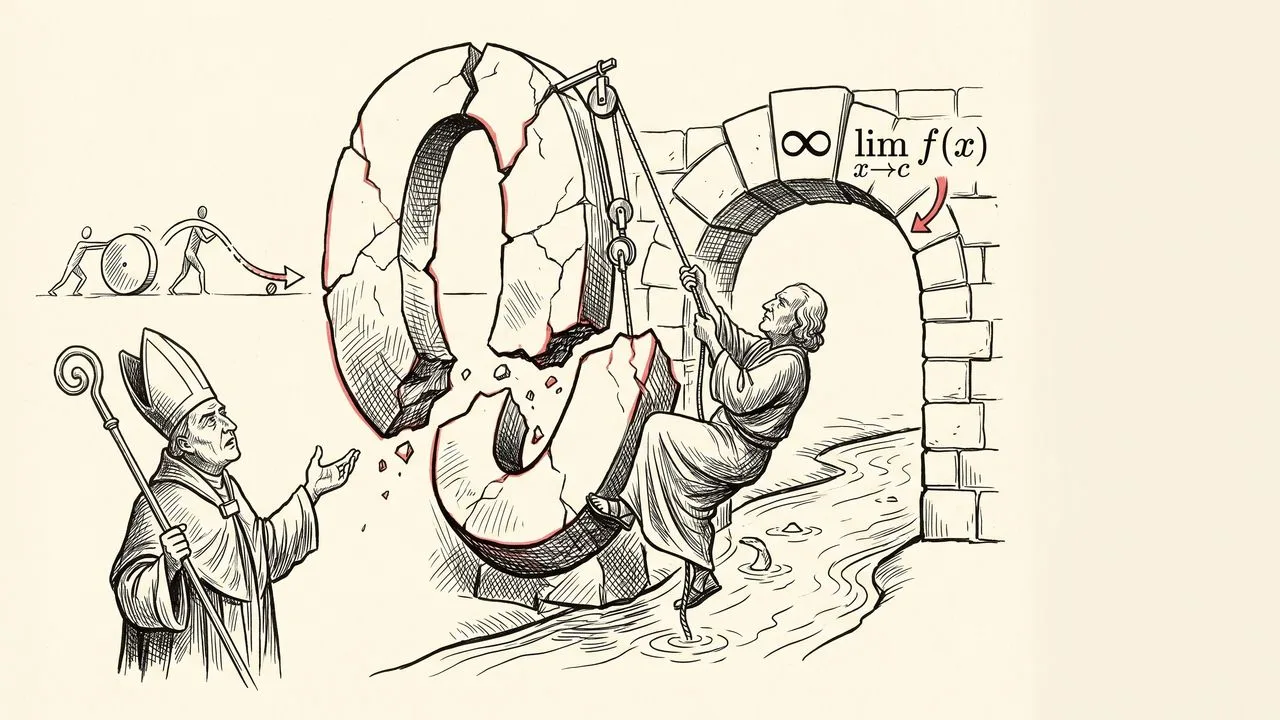
Photo: AI. Eira Pendragon
Freeze time. Right now, completely still. No movement, no duration, nothing passing. Now answer this: what is your speed?
If you say zero, you're wrong — you were moving a moment ago. If you say anything other than zero, you're performing a calculation that, by strict arithmetic, requires dividing zero by zero. Which breaks mathematics. Which means, by the standard rules of algebra, you could use your answer to prove that 2 equals 3.
This is not a word puzzle. For roughly two millennia, it was an open wound in the foundations of mathematics. The derivative — the core operation of calculus — is the instrument that finally closed it. A new video by Gaurav of STEM in Motion traces that closure from Zeno's arrow through Newton's tricks all the way to a 19th-century German mathematician who, in 1861, finally made the logic airtight. The story is more philosophically interesting than most calculus courses let on.
The trick that worked without working
Pierre de Fermat was already circling the problem in 1636. He wanted to find the maximum of a curve — the peak, where the slope momentarily flattens to zero. His method, which he called adequality, involved introducing a tiny artificial quantity into his algebra, grinding through the equations, and then discarding that quantity at the end. It consistently produced correct answers. Fermat had no idea why he was allowed to throw those numbers away. He only knew that doing so worked.
Newton and Leibniz, decades later, ran into the same wall. Their independent formulations of calculus — the calculus rivalry between them is its own remarkable story — both relied on treating an infinitesimally small quantity as nonzero when dividing, then treating it as zero when it became inconvenient. As Gaurav puts it bluntly in the video: "You cannot divide by a number and then magically declare that number to be zero in the exact same calculation. That is not mathematics. That is a trick."
The trick worked spectacularly. It mapped planetary orbits. It predicted artillery trajectories. Euler and Lagrange built careers on it while privately acknowledging, in effect, that the foundations were a mess. For roughly 150 years, calculus was science's most powerful instrument and mathematics' most embarrassing logical gap.
Berkeley's inconvenient precision
In 1734, a bishop decided he'd had enough.
George Berkeley of Cloyne was primarily a philosopher, and he had watched Enlightenment mathematicians dismiss religious faith as irrational — as belief without rigorous proof. So he read Newton's Principia carefully, found the logical crack, and published The Analyst. His critique was not a rant. It was surgical.
Berkeley identified the exact step where Newton divided by a quantity O, and the later step where Newton discarded O as negligible. The complaint: when you divided, O was nonzero — you needed it to be real, or the division was illegal. When you discarded it, O had become nothing. You cannot have it both ways. He named Newton's infinitesimals "ghosts of departed quantities," a phrase that has lasted three centuries because it is exactly right.
What made Berkeley's attack genuinely uncomfortable, though, was his follow-up. He did not just point out the contradiction; he explained why the wrong method kept producing right answers. Newton, Berkeley argued, was making two distinct errors: a geometric error (treating a tiny curved arc as perfectly straight) and an algebraic error (deleting leftover terms at the end). These two errors happened to compensate for each other — the first skewing the result in one direction, the second correcting it back.
His verdict: "By virtue of a twofold mistake, you arrive, though not at science, yet at truth."
That sentence deserves a moment. Berkeley was not claiming calculus was useless — he was claiming it was accidentally correct. A method that produces true results through compensating errors is not the same as a method that produces true results through sound reasoning. The distinction matters, especially when you want to extend the method to new territory where you cannot verify the output empirically.
The destination without arrival
The concept that eventually resolved everything is, in retrospect, almost obvious — which is probably why it took 150 years to formalize.
Watch what happens to the expression 3x² + 3xh + h² as h shrinks, with x fixed at 2. When h = 1, the value is 19. When h = 0.1, it's 12.61. When h = 0.01, it's 12.0601. When h = 0.001, it's 12.006001. Those numbers are going somewhere. They are, unmistakably, heading toward 12. The question that cracks the problem open is this: does h need to reach zero for us to know the destination is 12?
No. We can read the destination without arriving at it.
Augustin-Louis Cauchy began formalizing this intuition in the 1820s, replacing Newton's vague language of "infinitely small" with the more precise language of approaching. Cauchy said an infinitesimal is not a fixed object — it is a variable whose limit is zero. That was progress, but Cauchy's formulation still leaned on intuition in places.
Karl Weierstrass finished the job in 1861 with what mathematicians now call the epsilon-delta definition. The structure is a game. You claim an expression approaches some value L. I challenge you: pick any target margin — call it epsilon — around L, however small. You must prove the expression lands inside that margin, as long as h stays within some corresponding window — call it delta — around zero. Crucially: h must stay strictly greater than zero inside that window. It approaches zero. It never equals zero.
That single constraint — h never equals zero — is the whole fix. You divide by h while h is still a legitimate nonzero number. You observe where the result is heading. You never actually divide by zero. Berkeley's ghost dissolves not through refutation but through redefinition: the question was never "what happens when h equals zero" but "what does the expression approach as h gets close?"
What a derivative actually is
Gaurav walks through the derivation of a derivative from scratch — specifically for f(x) = x³ — and it's worth following the arithmetic once without the formula as a crutch.
You want the slope at some point x. Pick a nearby point at x + h. The slope of the line between them is:
[f(x + h) − f(x)] / h
Expand (x + h)³, cancel terms, factor out h from the numerator, cancel h (legal, because h ≠ 0), then take the limit as h approaches zero. What remains is 3x². That's it. No rule invoked. No formula memorized. The algebra produces it.
The result is not a number — it is a function. Feed it x = 1, you get slope 3. Feed it x = 4, you get slope 48. The derivative of x³ is a new function, 3x², that describes the slope of x³ at every point simultaneously. That's why it's called a derived function. Applying the limit process to a function generates another function.
Run the same process on x⁴ and you get 4x³. On x⁵, you get 5x⁴. The exponent drops to the front; the remaining exponent decreases by one. That pattern — the power rule — is not an axiom handed down from above. It falls out of the limit arithmetic every single time. Mathematicians eventually codified it as a rule because they kept deriving the same result, not because someone decided it should be true.
The half of calculus this doesn't do
The derivative answers one type of question: what is happening at this precise instant? But Gaurav ends the video by flagging the question it cannot answer.
Suppose you have a speedometer reading for every instant of a two-hour drive. You know the rate of change at each moment. What you do not know is the total distance traveled — the accumulated quantity over the whole interval. The derivative slices. It cannot accumulate. For that, you need the integral.
And here is where the story turns unexpectedly elegant: the operation that slices and the operation that accumulates turn out to be inverses of each other. Finding the slope of a curve and finding the area under a curve — tasks that appear to have nothing to do with each other — are two expressions of the same underlying relationship. That connection is the fundamental theorem of calculus, and it is, by any measure, one of the more remarkable things ever written down.
Whether that theorem feels like a discovery or an invention — whether it was always true and mathematicians uncovered it, or whether it is a structure humans built — is a question the formalism doesn't answer. Weierstrass made the logic airtight. What the logic is about remains, perhaps fittingly, a matter of ongoing debate.
More Like This
Crafting Supercars: The Science Behind Speed and Style
Explore how supercars like Alfa Romeo 4C and Aston Martin Vanquish are meticulously crafted using cutting-edge materials and precision engineering.

Math Intuition vs. Tricks: The Gauss Problem
Is math just a bag of tricks, or is there a deeper way to think? The Gauss problem reveals a fascinating argument for building genuine mathematical intuition.

NASA's Nuclear Mars Spacecraft: What SR-1 Freedom Means
NASA approved SR-1 Freedom, a nuclear electric spacecraft targeting a 2028 launch. Here's what the mission actually tests—and what it doesn't solve.

How Fractals Moved From Math Curiosity to Tech
Fractals aren't just beautiful—they're inside your smartphone antenna, your microchip cooling system, and your eye exam. Here's how the math became engineering.
The Rogers-Ramanujan Identity: Beauty in Partition Theory
A math professor's classroom moment reveals why the Rogers-Ramanujan identity—linking partition types through generating functions—is genuinely surprising and beautiful.
One Mathematical Operation to Rule Them All: The EML Paradox
A Polish mathematician claims all math operations can collapse into one function. It's elegant, it's correct, and it reveals something strange about simplicity.

Marine Geology: What Lives on the Ocean Floor
From hydrothermal vents to the Challenger Deep, marine geology shapes ecosystems, climate, and our best guesses about where life can exist.

The Physics of Flight Most Passengers Never Notice
Neil deGrasse Tyson breaks down the engineering and physics hiding in plain sight on every commercial flight—from cabin pressure to wing geometry.