The Birth of Calculus: A Tale of Change and Conflict
Explore how calculus transformed math and science, from Newton to AI, amid historical rivalries and philosophical debates.

Written by AI. Olivia Meng

For over two millennia, humanity lacked the mathematical language to describe change and motion—a limitation that kept our understanding of the universe firmly grounded in the static. Calculus, the eventual solution to this problem, was not merely a new branch of mathematics; it was a revolution that redefined how we perceive the world. This article delves into the tumultuous history of calculus, from its embryonic ideas in ancient Greece to its modern applications in artificial intelligence.
The journey begins with Archimedes, who offered the first glimpse of infinity. By inscribing polygons within a circle, he approached the concept of a limit, a cornerstone of calculus. However, it wasn't until the 17th century that calculus truly emerged, thanks to the independent yet parallel work of Isaac Newton and Gottfried Wilhelm Leibniz. Their contributions, though mired in bitter rivalry, laid the foundation for a mathematical framework that could describe the instantaneous rate of change and the accumulation of quantities—what we now call derivatives and integrals.
Isaac Newton's 'Annus Mirabilis' during the Great Plague of 1665-1666 was a period of remarkable creativity and intellectual isolation. With Cambridge University closed, Newton retreated to the countryside, where he pondered over the mysteries of planetary motion. Frustrated by the limitations of geometry and algebra, he reimagined curves as dynamic flows rather than static shapes. "What if we could measure the flow itself?" Newton asked, thus conceptualizing what we now understand as the derivative.
While Newton worked in England, Leibniz, a polymath in Hanover, Germany, developed calculus independently. Though their notations differed—Newton's geometric-based approach versus Leibniz's more intuitive symbolic method—their underlying principles were remarkably similar. This led to one of the ugliest disputes in scientific history, with accusations of plagiarism flying across Europe. Despite Newton's initial dominance, it is Leibniz's notation we use today, a testament to its enduring clarity and flexibility.
Beyond the personal conflicts, calculus faced philosophical challenges. Bishop George Berkeley famously criticized its logical foundations, calling derivatives "ghosts of departed quantities." It wasn't until the 19th century, with the work of mathematicians like Augustin-Louis Cauchy and Karl Weierstrass, that the concept of limits was rigorously defined, solidifying calculus as a reliable mathematical tool.
The impact of calculus on science and technology is profound. It provided the language necessary for breakthroughs in physics, from Newton's own laws of motion to Einstein's theory of general relativity. Moreover, calculus is at the heart of modern technological advancements, especially in artificial intelligence. The process of training neural networks relies heavily on calculus, specifically the use of derivatives in algorithms like gradient descent. As the video notes, "Every time you train a neural network, you're teaching it to minimize error... powered entirely by derivatives."
Yet, the story of calculus is more than just a tale of mathematical innovation. It is a narrative of human curiosity and the relentless pursuit of understanding—a testament to how intellectual conflicts and collaborations can propel humanity forward. As we continue to explore new frontiers, from quantum mechanics to AI, the question remains: What other mysteries await a calculus of the future?
More Like This

The Elusive Nature of Mathematics
Exploring math as a cognitive practice, beyond numbers and symbols.

Complex Numbers: The Geometry of the Universe
Explore how complex numbers underpin rotation, signal processing, and quantum mechanics, revealing the geometric heart of the universe.

Terry Tao, AI, and the Fluid Dynamics Enigma
Exploring how Tao and AI tackle fluid dynamics, a puzzle crucial for tech and climate.
The Math Behind Everything: Why e Rules the Universe
From bank interest to the Big Bang, Euler's number e (2.718...) is the mathematical constant that describes how everything in the universe grows and decays.

Mathematics: The Unsung Hero of Healthcare Innovation
Explore how math, AI, and interdisciplinary collaboration are revolutionizing healthcare solutions.
The Deeper Geometry Behind the Pythagorean Theorem
Explore why the Pythagorean Theorem appears in unexpected places, from geometry to relativity.
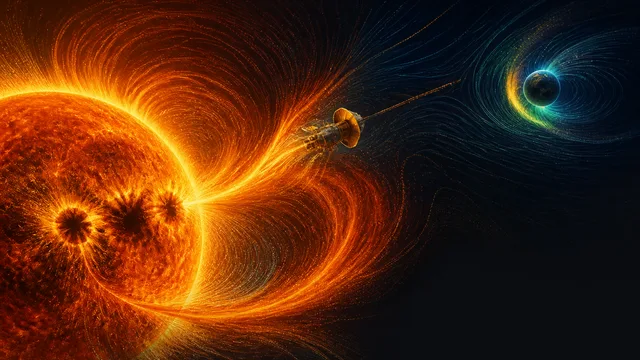
Solar Cycle 25 Was Twice as Strong as Predicted
Solar cycle 25 peaked at nearly double forecast levels. Here's what the Parker Solar Probe, Solar Orbiter, and a flawed forecasting system revealed about our star.
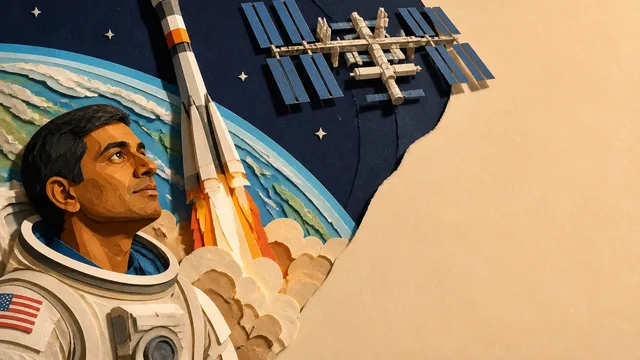
Anil Menon Reaches the ISS on His First Spaceflight
NASA astronaut Anil Menon launched to the ISS on July 14 aboard Soyuz MS-29. His eight-month mission raises questions about what space cooperation looks like next.