How Old Is Sandra? The Math Puzzle Dividing the Internet
Sandra's age puzzle went viral with 3.8M views—and most people got it wrong. Here's what the disagreement actually reveals about math education.

Written by AI. Nadia Marchetti
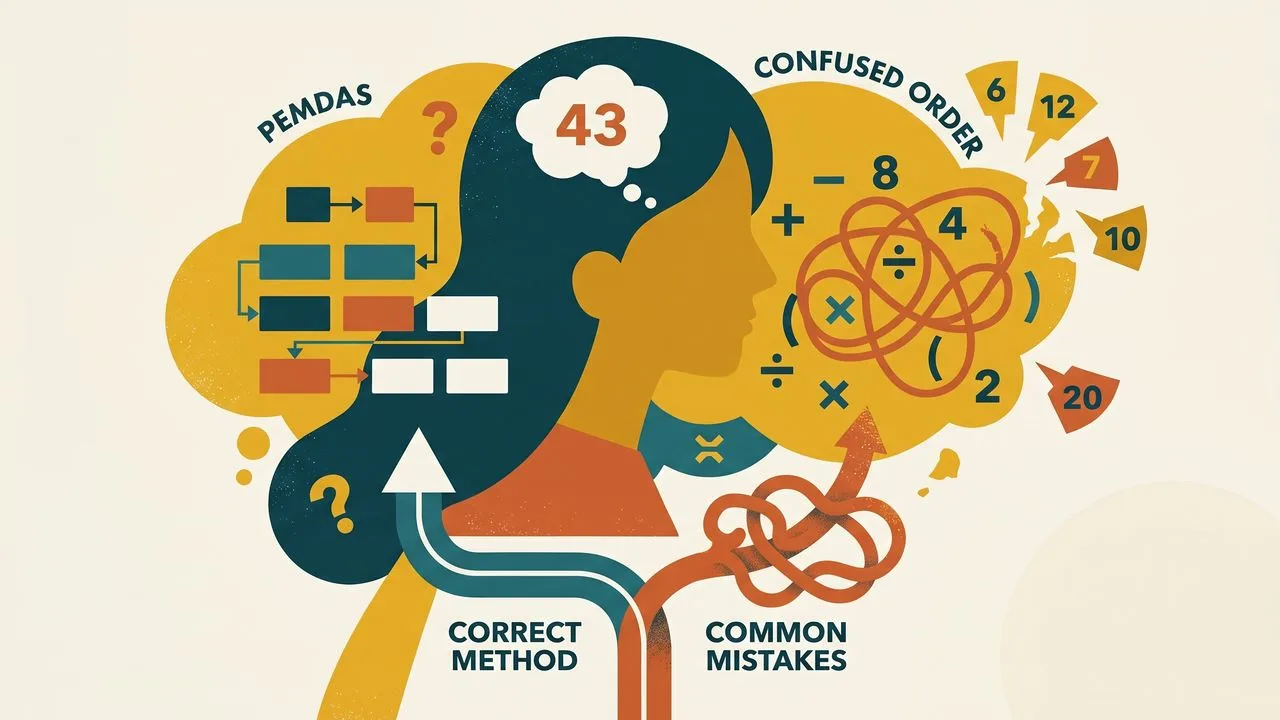
Photo: AI. Mika Sørensen
A Twitter account called Chicago History—presumably in the business of posting about, well, Chicago history—recently went off-script and dropped a math puzzle on its followers. The post now has 3.8 million views. It reads: Sandra was asked her age. She answered, 80 minus 40 divided by 10 × 4. How old is Sandra?
That's it. That's the whole thing. And it has been causing genuine arguments ever since.
Math educator Presh Talwalkar of MindYourDecisions dug into the top 50 replies and sorted them into buckets. The most popular answer—64—was given by 44% of respondents. Which sounds reassuring until you register that 44% is not a majority. Significant numbers of people landed on 79, on 16, or on some other interpretation entirely. More than half the top commenters didn't agree with each other.
So what's actually going on here?
The arithmetic is simple. The convention is not.
If you remember PEMDAS from school—Parentheses, Exponents, Multiplication, Division, Addition, Subtraction—you might think this is settled. And mostly, it is. The sticking point isn't between multiplication and addition. It's between multiplication and division, which sit at the same level of precedence.
The rule, as Talwalkar explains it: when two operations share a precedence tier, you work left to right. Applied to 40 ÷ 10 × 4, that means you handle the division first (40 ÷ 10 = 4), then multiply (4 × 4 = 16), then subtract from 80. Sandra is 64.
This convention isn't new. A 1917 paper in the American Mathematical Monthly is explicit about it: "In case the signs of multiplication and division occur with no signs of addition, subtraction intervening, the operations are to be performed in order from left to right." That paper is over 100 years old. The rule has been on the books since before anyone alive today was in school.
And yet.
The competing rule is also over 100 years old
Here's where things get genuinely interesting, and where Talwalkar earns his keep. Just five years after that 1917 paper codified the left-to-right rule, a 1922 textbook called Shop Mathematics said something different: "When the multiplication sign immediately follows the division sign, multiplication should be performed first."
Under that rule, you'd evaluate 10 × 4 first (= 40), then divide 40 by 40 (= 1), then subtract from 80. Sandra is 79.
The same Shop Mathematics author hedged immediately: "This rule is not always strictly followed. Therefore, it is better to use parentheses in order to avoid ambiguity." Which is almost funny in retrospect—here's a book establishing a rule while simultaneously admitting the rule isn't reliable enough to use without backup notation.
Two authoritative sources from the same era. Two different rules. And a century of students who learned whichever one their particular teacher happened to teach.
This is the part that doesn't get enough airtime in viral math discourse: the people answering 79 aren't making arithmetic errors. They're applying a rule they were genuinely taught, in an actual classroom, probably to pass an actual test. Talwalkar is direct about this: "I truly do believe that some people learned the rule that you need to evaluate multiplication before division. And some people had to do it this way to get good grades in school."
That's not nothing. That's a real educational legacy producing real disagreement in a comment section in 2024.
The calculator argument
Talwalkar's strongest piece of evidence for 64 as the modern consensus: every major calculator returns it. Android, iPhone, Samsung, Bing, Wolfram Alpha—all of them evaluate 80 - 40 ÷ 10 × 4 as 64. Python, JavaScript, Java, C#, and Excel also return 16 for the 40 ÷ 10 × 4 sub-expression (confirming the left-to-right parse), which feeds into the final answer of 64.
His framing of this point is worth sitting with: "Were none of you involved in making calculators and computer programs? It would seem to me this is the strongest evidence that after 100 years mathematicians have finally come up with a consensus."
That's a reasonable inference. The people who build the tools that do math for a living have converged on left-to-right. If there were serious professional disagreement about the convention, you'd expect more calculator variance. You don't find it.
What you do find, if you go looking, is the concept of a binary expression tree—the internal structure a calculator uses to parse and evaluate an expression. A left-to-right parser builds a different tree than a multiplication-first parser, and the trees produce different answers. Knowing which tree your calculator builds isn't just a math trivia question; it's practically relevant if you're writing code and trying to predict what it will do.
Why this matters beyond Sandra's birthday
Talwalkar closes by gesturing at something bigger, and it's worth following him there.
In 1992, 12th-grade American students were given the problem 3³ + 4(8 - 5) ÷ 6 with a calculator and five answer choices. Only 29% got it right. Seventy-one percent of high school seniors—with a calculator in hand, on an unambiguous problem—chose the wrong answer.
In Japan, 40% of engineers reportedly missed 9 - 3 ÷ 1/3 + 1.
These aren't trick questions with viral-bait ambiguity engineered in. They're straightforward applications of a convention that's supposedly been settled for over a century. And a majority of students, and a significant chunk of engineers, are getting them wrong.
There are a few ways to read this. One is that the order of operations is poorly taught—that PEMDAS gets drilled as a mnemonic without the underlying logic being explained. Another is that mathematical notation itself is doing some of the work here: the way we write expressions on a single line, with the ÷ symbol and no spatial hierarchy, creates ambiguity that fraction notation or parentheses would eliminate. A fraction bar makes grouping visually explicit in a way that ÷ simply doesn't.
The Shop Mathematics author figured this out in 1922: use parentheses to avoid ambiguity. We're still apparently not listening.
Sandra's puzzle is, in one reading, a troll. An account called Chicago History posts a math problem, the internet argues, everyone dunks on everyone else. Content achieved.
But the argument it generated is revealing precisely because the people disagreeing aren't all confused—some of them are applying different conventions that were taught to them in good faith. The fact that those conventions have largely converged (the calculators agree, the modern standard is left-to-right) doesn't retroactively un-teach what some teachers taught. It just means the people who learned the older rule are now at odds with the infrastructure.
64 is the correct answer under the modern standard. That's clear. What's less clear is why, more than a century after the convention was committed to paper, 71% of 12th-graders with calculators still can't reliably apply it—and whether the answer to that question lives in how we teach, or in how we write math in the first place.
More Like This

Can Directed Heat Beams Help Reverse Global Warming?
Caltech researcher Yae-Chen Lim thinks we can engineer thermal radiation into directed beams—and aim our waste heat straight into outer space.
This Geometry Puzzle Has Nine Solutions (Here Are Two)
A deceptively simple triangle problem reveals why some mathematical puzzles resist single approaches—and what that tells us about how we solve problems.

Math Intuition vs. Tricks: The Gauss Problem
Is math just a bag of tricks, or is there a deeper way to think? The Gauss problem reveals a fascinating argument for building genuine mathematical intuition.
How Tall Is the Dog? The Viral Math Puzzle Solved
A dog, a pole, two measurements—and three different ways to crack it. Presh Talwalkar's viral puzzle reveals something deeper about how we learn math.
Why Struggling With Math Is the Point
A viral study method reframes math frustration as a feature, not a bug. Here's what the research-adjacent advice gets right—and what it quietly sidesteps.
Computers, Clocks, and Human Calculators
Explore how the Industrial Revolution set the stage for modern computing through clocks, labor division, and human calculators.

Viking Landers and the Unsolved Mars Life Debate
Fifty years after Viking landed on Mars, one experiment's positive result remains unexplained. Here's what the science actually shows—and what we've learned since.

What the Dinosaur Asteroid Actually Did to Earth
New research reframes the Chicxulub impact—not just as a mass extinction event, but as a creative force that may have built the Amazon rainforest.