The Mind-Bending Magic of Banach-Tarski
Explore how the Banach-Tarski paradox challenges our understanding of volume, infinity, and math's quirks.

Written by AI. Mei Zhang
Imagine you're holding an orange, a classic symbol of Vitamin C and morning routines. Now, picture taking that orange, splitting it into five parts, and then voilà! You have two identical oranges. Sounds like a magic trick, right? It's not. It's the Banach-Tarski paradox, a theorem that suggests such shenanigans are mathematically possible, even if they break our reality-meter.
Infinite Hotels and Orange Tricks
To get the vibe of Banach-Tarski, think of it like one of those infinite hotel scenarios you might see in a mind-boggling TikTok math challenge. Picture a hotel with unlimited rooms, all occupied. Yet, somehow, the manager manages to fit in more guests by shuffling everyone up a room. That's infinity playing its tricks—1 + infinity still equals infinity. With Banach-Tarski, the orange, like our hotel, becomes a playground of infinite possibilities, where splitting and rotating can lead to doubling.
The Axiom of Choice: The Real MVP
Enter the Axiom of Choice, the star player behind this paradox. It's like the secret ingredient in your favorite viral TikTok recipe that makes everything work, but not without some controversy. This axiom allows for the creation of non-measurable sets—collections of points that defy conventional volume measurements. You can't just whip them up like a batch of cookies; they're more like a mystical cloud of potential.
From Words to Worlds
One of the video's fascinating detours is into the world of free groups on two generators. This isn't just math jargon—think of it as a complex language game where every word is a unique path, much like navigating the For You Page. These words, or rotations, don't just form a cool puzzle; they actually help map out how our orange can morph into two.
The TikTok Twist
Here's where it gets spicy: the pieces involved in this paradox aren't pieces you can actually slice from an orange. They're mathematical dust particles, selected using the Axiom of Choice, making them as real as the latest dance trend. "These are the non-measurable sets, objects so pathologically constructed that the question, what is their volume, has no consistent answer," the video explains. They're the ultimate in abstract art, where the rules of our universe don't apply.
A Different Universe?
What happens if we say, "No, thanks," to the Axiom of Choice? Well, that's a whole different mathematical universe where every piece has a nice, defined volume. But rejecting this axiom comes at a steep cost, requiring us to assume some pretty hefty infinities exist. It's like choosing between two flavors of weirdness, and there's no universe where something isn't a little strange.
Closing Thoughts
So, what does this all mean? Real oranges aren't going to start multiplying in your kitchen. Banach-Tarski is a reminder that math, much like your favorite TikTok creator, thrives in abstract spaces where anything can happen. The orange in your mind is indeed a lot stranger than the one in your fruit bowl. And maybe that’s the coolest trick of all.
More Like This
Why Apéry's Constant Defies Explanation
Apéry's constant, zeta(3), remains a mathematical enigma, connecting arithmetic, geometry, and quantum physics in unexpected ways.
The Simplest Question Mathematics Still Can't Answer
Fields Medal winner James Maynard explains why prime numbers—the atoms of arithmetic—remain deeply mysterious despite centuries of study.
The Elusive Nature of Mathematics
Exploring math as a cognitive practice, beyond numbers and symbols.
Exploring Infinity: Cantor's Paradoxes & Hilbert's Hotel
Dive into the mind-bending world of infinity with Cantor's paradoxes and Hilbert's Hotel—a journey through mathematics and philosophy.
The Riemann Hypothesis: Math's Greatest Mystery
Explore the Riemann Hypothesis, the $1M question linking prime numbers and quantum physics.
Exploring Infinity: Big, Bigger, and Beyond
Dive into the mind-bending world of infinity with mathematician Joel David Hamkins, as he unpacks the complexities and paradoxes of infinite sets.
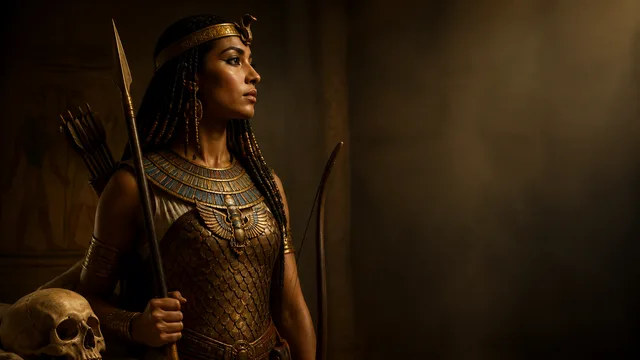
Ancient Egyptian Princesses Were Trained Weapon Users
New skeletal analysis of five Middle Kingdom mummies reveals ancient Egyptian princesses used bows and daggers — and a bias that buried that fact for decades.
SpaceX Starship Flight 13 Aborts at Launch
SpaceX's Starship Flight 13 aborted at the last second when engines failed to ignite. What the scrub reveals about iterative testing, redundancy, and real stakes.