Fire Tornadoes on a Lake: The Bardstown Bourbon Disaster
In 2003, fire tornadoes erupted on a Kentucky lake. The cause wasn't paranormal—it was 800,000 gallons of burning bourbon and the right wind geometry.

Written by AI. Priya Sharma
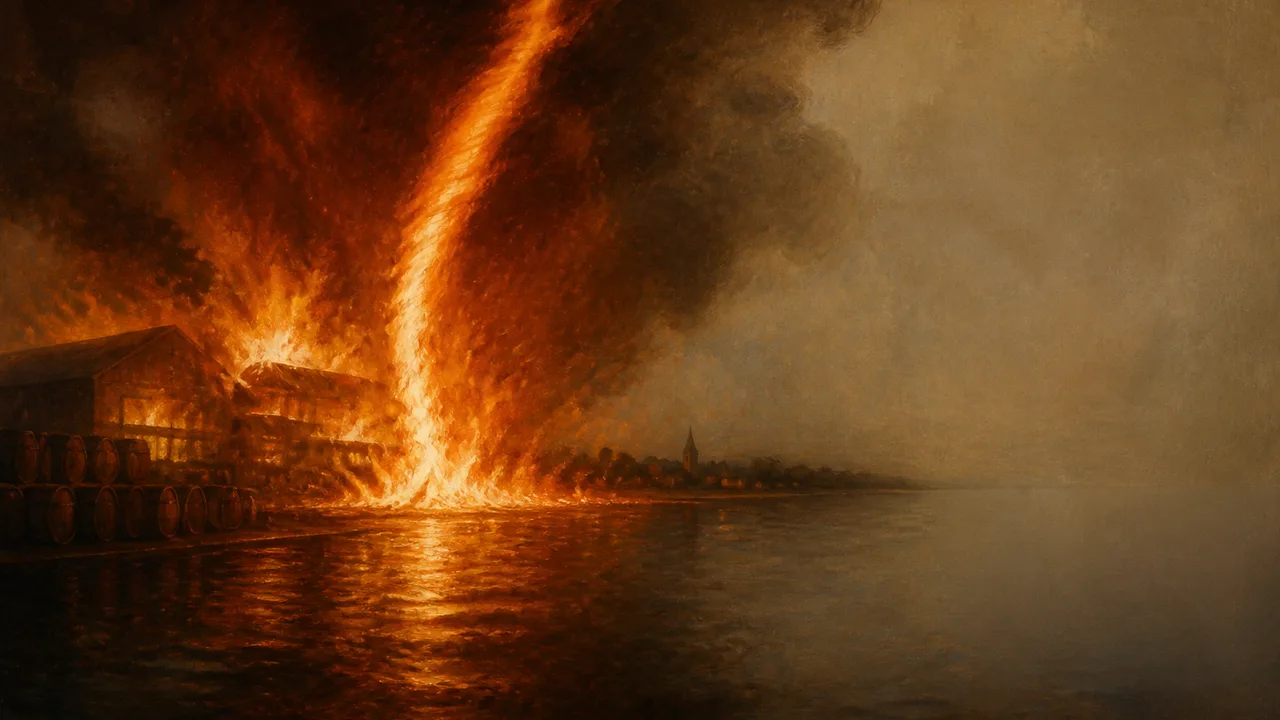
Photo: AI. Henrik Solberg
At 9:30 on a Monday morning in August 2003, Assistant Fire Chief Charles Montgomery looked out the window of the Bardstown, Kentucky fire station and saw something that did not belong in a rational universe: a column of smoke rising from the direction of the lake.
What the responding crews found when they arrived was, by every firsthand account, genuinely difficult to process. Firefighter Robbie Blandford described it as "almost like a living, breathing creature." Mayor Dixie Hibbs, watching from a distance, landed on a more theological register: "I'm looking at it and I'm thinking there's a crack in hell and here comes the fiery flames." The helicopter surveillance footage, when it was later analyzed, confirmed what people were struggling to articulate — 100-foot columns of fire, spinning, on the surface of a freshwater lake.
That last detail is the one that earns this incident its place in the literature of genuinely strange fire behavior. Lakes don't burn. Water is, in most firefighting contexts, the solution, not the site of the problem. And yet.
What a Fire Tornado Actually Is
The spinning columns the Bardstown crews encountered have a technical name — fire tornadoes, or fire whirls — and fire safety researcher Michael Galmer, who reviewed the helicopter footage, recognized them immediately. His explanation, grounded in lab work recreating the phenomenon, is worth sitting with.
"To generate a fire tornado requires the right combination of winds, obstacles, and fire," Galmer noted. In his laboratory setup, four slits channel airflow so it enters a central flame from multiple angles simultaneously, inducing rotation. What happens next is not subtle: "You can see the flame lengths drastically increase. What they do is intensify the fire." The spinning vortex superheats to over 2,000 degrees Fahrenheit, and at that point, the system becomes effectively self-sustaining. As Galmer put it, "it's really an uncontrollable phenomenon. There's almost nothing you can do once that forms. You just have to get out of the way."
The Bardstown lake, it turns out, had the right geometry for exactly this. The treeline surrounding the water acted as Galmer's laboratory slits — channeling wind from multiple directions toward the lake's center, creating the rotational airflow that transforms a fire into a vortex. The lake's shape was, in effect, an accidental fire tornado machine.
That explains the tornado. It still doesn't explain why the lake was on fire in the first place.
The Fuel Problem
This is where the investigation becomes genuinely interesting, and where the episode earns its tension. Investigators floated more than one hypothesis before landing on an answer.
Geophysicist Cyan Proctor raised the possibility of underground oil. Kentucky has legitimate fossil fuel history — the state's first oil gusher was drilled in 1818, and significant reserves remain beneath the bluegrass. Oil is less dense than water; it surfaces and floats, and floating oil burns. Proctor acknowledged the theory's limits honestly: "It is possible that oil, if it had entered the lake in large quantities, could have caused the fire that we see. But there's a lot of fire. We would need a geological phenomenon that suddenly releases lots of oil into this lake." No seismic activity was recorded in the area that day, which effectively closed that door.
The answer, as it turned out, was hiding in the landscape itself.
The Bourbon Capital Burns
Bardstown carries a title it wears proudly: the bourbon capital of the world. The town is ringed by hundreds of warehouse facilities, each one seven stories tall, each one storing enormous quantities of aging whiskey. The fuel load in any single one of those buildings is, by any reasonable measure, extreme.
On August 4th, 2003, Kentucky's meteorology intervened. The state averages roughly half a million lightning strikes per year, and that particular day saw a cluster of severe thunderstorms moving through the region. Investigators identified one bolt they described as exceptional — it struck a large warehouse complex near a creek that drains into the holding lake on the town's edge.
The numbers that follow are worth stating plainly: 800,000 gallons of bourbon were inside that one warehouse. When the structure failed, it didn't leak — it released a wall of flame, and the burning liquid followed gravity, as burning liquid does. Downhill meant through the creek system, directly into the holding lake.
"It's just a sickening feeling," one witness recalled, "because you know that all those flammable liquids are going somewhere else. It's always going to find the lowest point." Bourbon, at typical barrel strength, is roughly 60 to 70 percent ethanol. It burns readily. A million gallons of it, spread across a lake surface, burns ferociously.
The lake wasn't burning in spite of being a lake. It was burning because its surface had been effectively replaced — temporarily — with a shallow layer of high-proof spirit, fed continuously by the drainage from the warehouse complex above.
The Geometry of Catastrophe
What made the Bardstown event so visually striking, and so scientifically instructive, was the convergence of independent factors that individually wouldn't have produced anything unusual.
A lightning strike hits a warehouse. Warehouses get struck by lightning. A burning liquid flows downhill. Burning liquids flow downhill. Trees channel wind toward a body of water. Treelines do this constantly. But the specific arrangement — bourbon warehouse over a drainage creek over a bowl-shaped lake ringed by trees, during a thunderstorm powerful enough to ignite 800,000 gallons — produced something that looked, from a helicopter, like a passage from Revelation.
This is what makes extreme fire behavior so difficult to plan for: it is rarely the result of a single catastrophic variable. It emerges from combinations. Fire tornadoes have been documented in wildfire contexts, most notably in the 2018 Carr Fire in California, where one generated winds exceeding 140 miles per hour and killed a fire inspector. The underlying physics in Bardstown was the same — swirling airflow, concentrated heat, a self-reinforcing vortex — but the fuel source was a product of industrial geography that no fire safety manual anticipated.
Understanding what happened in Bardstown required working backward through a chain of contingencies: meteorological, geological (to rule out oil), topographical, and industrial. The answer, once assembled, is unremarkable in its individual parts and extraordinary in their combination.
The Bardstown fire consumed roughly a million gallons of bourbon before it was done. Mayor Hibbs, processing the loss of the town's most famous product going up in smoke, described it with a restraint that felt almost elegant given the circumstances. Whether it reads as understatement or genuine grief probably depends on how you feel about whiskey.
What it doesn't leave room for is the paranormal framing the Science Channel's title flirts with. The fire devil on the lake had a thoroughly terrestrial explanation — it just required more disciplinary inputs to reach than a single expert could provide alone. That, more than the flames themselves, is the thing worth remembering. The universe produced something that looked like a biblical event. The explanation fit in a single paragraph of fluid dynamics and accident reconstruction.
Those two facts don't contradict each other. They're both true.
More Like This
Crafting Supercars: The Science Behind Speed and Style
Explore how supercars like Alfa Romeo 4C and Aston Martin Vanquish are meticulously crafted using cutting-edge materials and precision engineering.
San Francisco 1906: The Disaster That Was Built
The 1906 San Francisco earthquake wasn't just an act of nature—it was the bill coming due on decades of willful ignorance. Here's what actually happened.
The Bari Disaster: Mustard Gas, Secrecy, and 1943
On December 2, 1943, a German raid on Bari killed over a thousand people—and released mustard gas that officials spent decades trying to erase from history.
Rogue Waves: The Ocean Phenomenon Science Got Wrong
For centuries, scientists dismissed rogue waves as sailor myth. Then one hit a North Sea oil platform and rewrote everything we thought we knew about the ocean.
The WWII Flying Boat Still Fighting Wildfires Today
The Martin Mars water bomber—a WWII relic with a 60m wingspan—is fighting Mexico's worst wildfires in 30 years. Here's how it actually works.

Mars, Enceladus, and the Search for Life
From Mars's vanishing water to Enceladus's hidden ocean, planetary science is reshaping our understanding of where life might exist.
The Maths Behind Palindrome Ages Explained
Mathematician Kat Phillips unpacks why some pairs of people have reversible ages—and the surprisingly elegant number theory that governs when it happens.
Asteroid Impact on a City: What the Science Actually Shows
A Science Channel scenario imagines an 1,800-ft asteroid striking New York in 2029. Here's what the physics, detection protocols, and real planetary defense infrastructure say.