Asteroid Impact on a City: What the Science Actually Shows
A Science Channel scenario imagines an 1,800-ft asteroid striking New York in 2029. Here's what the physics, detection protocols, and real planetary defense infrastructure say.

Written by AI. Priya Sharma
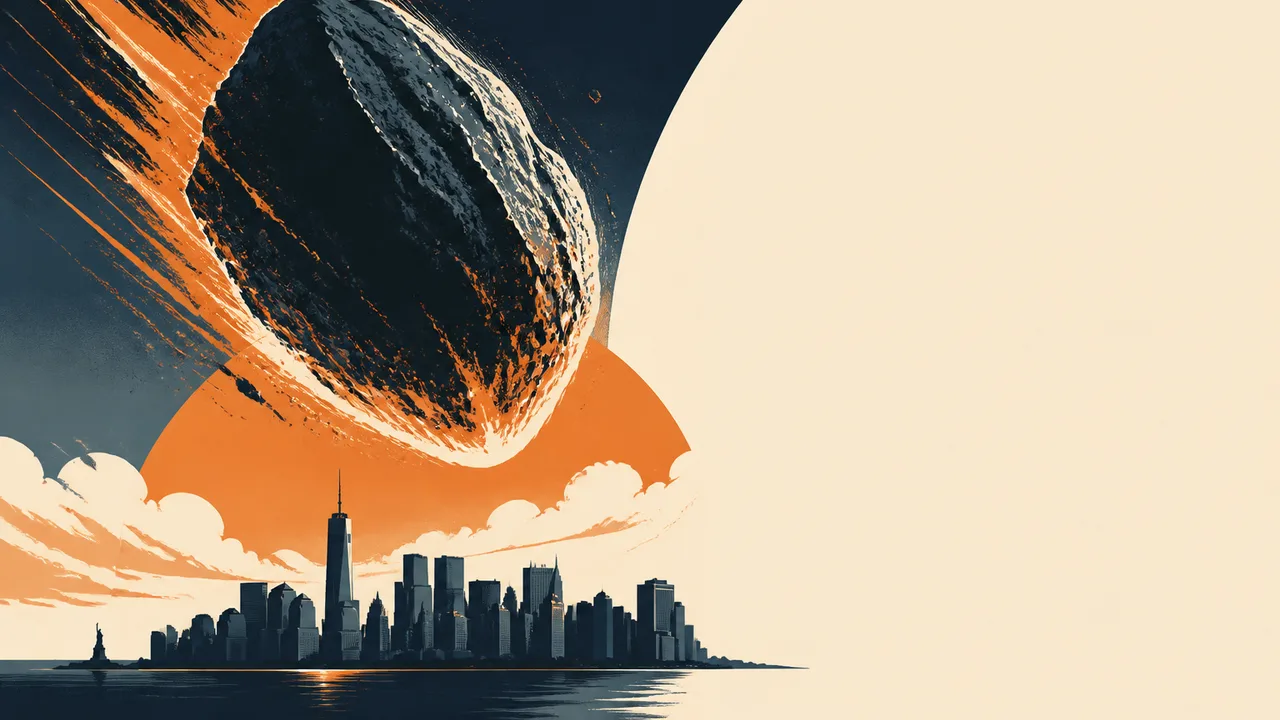
Photo: AI. Mika Sørensen
The scenario is simple enough to summarize and difficult to sit with: a space rock 1,800 feet wide, traveling at roughly 20 kilometers per second, arrives over New York City. The flash would be brighter than the sun. The crater where Central Park once stood would be three to four miles across and 1,600 feet deep. A 500 mph wind radiates outward. A magnitude 7 earthquake rattles communities 100 miles away. One of the scientists in the Science Channel's How the Universe Works segment puts the arithmetic plainly — "It's not easy to say what is going to kill you first. It's probably going to be simply the flash of energy. There's so much heat from this thing that you can be vaporized. If you somehow survive that, then there's going to be the blast wave that will pulverize anything in its path."
The video frames this as a fictional scenario — an asteroid named APEP, discovered in September 2022 and confirmed on a collision course by January 2023, impacting November 4th, 2029. The name is deliberate: APEP was the Egyptian god of chaos. But the underlying science the segment draws on is not speculative. The detection methods, the orbital mechanics, the impact physics, and the international coordination frameworks are all real and operational. The fictional wrapper is there to give the numbers a face. Whether it succeeds at that without also manufacturing false dread is a question worth keeping in mind.
What Detection Actually Looks Like
Greg Leonard, an astronomer with the Catalina Sky Survey operating out of Mount Lemmon Observatory near Tucson, Arizona, describes the detection methodology in the video — and it is genuinely unglamorous work. A series of images taken over 20 minutes. Stars stay fixed; anything else moves. Four points of light track across the frame, and that motion is the tell.
"We are the Watchers of the Skies for the planet," Leonard says. "We literally represent the first line of defense against potentially incoming asteroids. And I want to emphasize the words planetary defense. This is not in the benefit for one nation. This is for the entire planet."
That last sentence is doing real work. By the early 2020s, astronomers had catalogued more than 27,000 near-Earth asteroids — objects whose orbits bring them into Earth's neighborhood, pulled inward after Jupiter's gravity dislodges them from the asteroid belt. The Catalina Sky Survey is one of several programs tasked with finding them. NASA's Planetary Defense Coordination Office, established in 2016, operates in coordination with the European Space Agency's Space Situational Awareness program and a network of observatories worldwide. The infrastructure is genuinely multinational, even if its funding and political priority are uneven.
The video's description of the orbital determination process is accurate: track the object repeatedly over months, narrow the range of possible trajectories, and eventually determine whether any of those trajectories intersect Earth's path at the same moment Earth is there. Orbits, as one scientist in the segment explains, are like roads — two objects can be on intersecting paths without colliding, unless they arrive at the intersection simultaneously. The risk assessment is probabilistic at first, then sharpens with observation.
The Physics of APEP, and Why Size Matters Nonlinearly
At 1,800 feet wide — roughly 550 meters — the fictional APEP qualifies as what planetary scientists call a Potentially Hazardous Asteroid, or PHA. The classification threshold is 140 meters; APEP is nearly four times that. The video states its mass at approximately 112 million metric tons, more than 300 times the weight of the Empire State Building.
The destruction potential scales with size in ways that aren't intuitive. The energy delivered on impact — described in the video as exceeding the equivalent of a thousand Hiroshima nuclear bombs — comes from kinetic energy, and kinetic energy scales with the square of velocity and linearly with mass. At 20 km/s, even a modest increase in diameter translates to a dramatic jump in destructive yield.
The specific damage radii cited in the video — fires within 20 miles, seismic effects at 100 miles — are consistent with published impact modeling. The 2013 Chelyabinsk meteor, which released roughly 30 times the energy of the Hiroshima bomb while being only about 20 meters wide, injured more than 1,500 people and blew out windows across a region. APEP, at 550 meters, would be in a categorically different league.
What the video doesn't dwell on, and what's worth naming explicitly: an object this size would produce global effects beyond the immediate impact zone. Ejecta lofted into the upper atmosphere, pressure waves circling the planet, and potential climate disruption from particulate matter are all within the modeled consequences for impactors of this scale. The crater-and-blast-radius framing, while viscerally effective, undersells the systemic risks.
The Honest Tension in Planetary Defense Narratives
There is something worth examining in how planetary defense is communicated to the public, and this video is a useful case study in both the strengths and the tensions of that communication.
The strengths are real. Translating abstract orbital mechanics into a ticking-clock scenario with a named asteroid and a specific city makes the science tractable for a general audience. It provides a concrete frame for otherwise dry probabilistic risk assessment. And the video is careful, for the most part, to signal that APEP is fictional — a stress-test of systems, not a warning about a known threat.
But the framing also carries risks. When scientists say things like "this is beyond the worst disaster the world would have ever faced" and "there's nothing in our history that would have done this much damage so quickly," the dramatic register can blur the distinction between a real threat and a speculative scenario. Viewers who absorb the emotional content without tracking the fictional frame may reasonably come away with inflated anxiety about imminent impact — which is not what the underlying science supports.
The actual risk picture is more complicated. NASA's Center for Near Earth Object Studies tracks known objects and publishes impact probability estimates. As of now, no known asteroid poses a credible near-term threat to Earth. That's a meaningful statement, but it comes with a qualifier: "known." The survey programs that would detect an APEP-scale object are good, but not complete. The concern among planetary scientists is less about specific known objects and more about the survey gap — the objects that haven't been found yet, particularly those approaching from the direction of the sun where detection is harder.
What Comes After Detection
The video describes planetary defense protocols as a multi-step process: detect, characterize, and then — the part the fictional scenario is presumably building toward — respond. The response options are real, and NASA's DART mission, which successfully altered the orbit of the asteroid Dimorphos in September 2022, demonstrated that kinetic impactors can work. That was not a test on a threatening asteroid; it was a proof of concept. The deflection achieved was small, but the physics scales — the key variable is lead time.
This is where the timeline embedded in the APEP scenario becomes interesting rather than merely dramatic. Seven years between discovery and projected impact is not much. Planetary scientists consistently note that effective deflection requires decades of lead time for an object of significant mass, because the orbital change you can produce with any practical mission is small, and small changes propagate into large trajectory differences only over long time periods. Seven years is a scenario designed to ask: what if we almost ran out of time? It's a legitimate question.
"We had some of the brightest minds, some of the best telescopes, some of the biggest supercomputers working to protect Earth," one scientist in the video says, "collaborating across language barriers, across international borders to protect humanity."
That sentence contains an implicit argument: that planetary defense is a problem whose solution requires coordination at a scale most human institutions aren't built for. It's a reasonable argument. It's also, notably, an argument that the scenario is designed to make — and it's worth holding both the argument's validity and its rhetorical function at the same time.
The actual state of planetary defense in 2024 is one of genuine capability paired with genuine gaps. The survey infrastructure exists. The deflection technology has been demonstrated in principle. The international coordination frameworks are in place but not fully funded or legally formalized. Public awareness, which the video pointedly names as a component of preparedness, remains uneven — most people do not know that a global asteroid detection network exists, let alone how it works or what it could realistically accomplish.
Whether knowing changes anything is the open question the video can't quite answer, because that depends less on the science and more on what societies decide to fund, prioritize, and prepare for — before the four points of light start moving across the frame.
By Priya Sharma, Science & Health Correspondent, BuzzRAG
More Like This
Crafting Supercars: The Science Behind Speed and Style
Explore how supercars like Alfa Romeo 4C and Aston Martin Vanquish are meticulously crafted using cutting-edge materials and precision engineering.
PocketCube Satellites: Earth Observation for $30K
Satellites small enough to hold in your hand can now image Earth at 6–12m resolution. But who controls the data—and who bears the cost of what orbits above us?

Claude Mythos 1: The AI Security Leak Worth Watching
Claude Mythos 1 briefly appeared in Anthropic's UI, then vanished. The security numbers from Project Glasswing are real—and raise harder questions than the hype does.
SETI Is Shifting From Radio Waves to Laser Beams
A new paper by Ben Zuckerman argues SETI's radio-first assumptions are obsolete. Here's what a smarter alien search actually looks like in 2025.
Mars, Enceladus, and the Search for Life
From Mars's vanishing water to Enceladus's hidden ocean, planetary science is reshaping our understanding of where life might exist.
Cosmic Threats to Earth: Asteroids, Solar Storms & Black Holes
From city-destroying asteroids to solar storms that could kill the internet, scientists are mapping the universe's most destructive forces—and our readiness is uneven.
What Was the Pulsating Blob in Raleigh's Sewers?
In 2009, a robotic sewer camera in Raleigh, NC filmed a pulsating blob. Scientists debated mutant tissue, jellyfish, and worms. Here's what the evidence suggests.

The BOSS Great Wall: Anatomy of a Billion-Light-Year Structure
The BOSS Great Wall spans one billion light-years and shouldn't exist—at least not according to gravity alone. Here's what astronomers think is holding it together.