What Was the Pulsating Blob in Raleigh's Sewers?
In 2009, a robotic sewer camera in Raleigh, NC filmed a pulsating blob. Scientists debated mutant tissue, jellyfish, and worms. Here's what the evidence suggests.

Written by AI. Priya Sharma
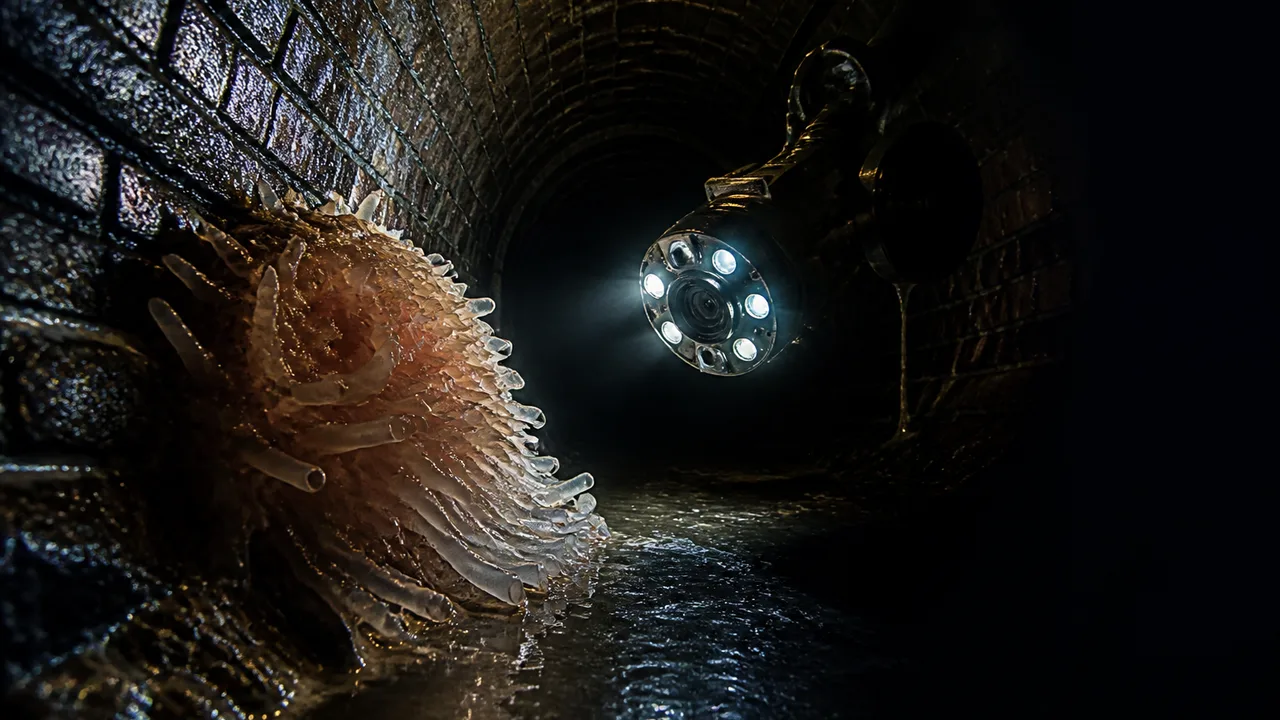
Photo: AI. Castor Belov
On April 27, 2009, a robotic inspection camera was making a routine pass through the sewer network beneath Raleigh, North Carolina — 2,500 miles of pipe serving roughly 560,000 people — when it encountered something that stopped the engineering team cold. The footage showed a pulsating, flesh-colored mass clinging to the pipe wall. It reacted to light. It did not run. It appeared, by all observable measures, to be alive.
What happened next is a useful case study in how humans process biological novelty: first, genuine bewilderment; then, a cascade of theories that reveal as much about our anxieties as about the organism itself.
The Footage and the First Response
Sewer engineer Q Brown, who had more than five years of experience operating these robotic camera systems, described what the team saw without embellishment: "It's slimy. It's just gooey looking. And it's almost like it's got a heartbeat — like it's alive." The creature's response to the robot's light — retraction, contraction, a kind of recoil — distinguished it immediately from the usual residents of the underground. Snakes, rats, lizards, and insects, Brown noted, do the sensible thing when confronted with a rolling robot and a bright light: they flee.
This thing didn't flee. It also appeared indifferent to the hydrogen sulfide and ammonia levels in the pipe — gases that would be acutely toxic to a human in the same space. Whatever it was, it had made itself at home.
Ed Bucken, who oversees Raleigh's sewer system, described his initial search for a precedent: "I was privately hoping that somebody would say, 'Oh yeah, we've seen that all the time.' And we never got that." The absence of a ready explanation is, in science, a starting point. In media coverage of science, it tends to become the story itself.
The Theories, Ranked by Credibility
The Science Channel segment that featured this footage walked through several expert hypotheses, and it's worth holding each one up to the light rather than treating them as equivalent.
The lab-escape theory arrived early and theatrically. A "mysteries investigator" named Lyall Blackburn noted that Raleigh sits in the Research Triangle — a region known for biomedical research — and suggested the blob might be engineered tissue that had been accidentally washed into the sewer system. The argument rested heavily on the creature's pink coloration, which Blackburn proposed could indicate hemoglobin. It's not hard to imagine the narrative appeal: a prestigious research corridor, exotic experiments, a drain that connects laboratory to infrastructure.
What the theory lacks is mechanism. Mammalian tissue cultured in a lab does not survive autonomously in a cold, dark, chemically hostile sewer environment. Biologist Mark Martindale was direct on this point: "Living in a cold, dark, wet sewer — if you came from a mammal — is pretty hard to believe." Maintaining cellular viability, let alone coherent motility, requires temperature regulation, nutrient supply, and waste removal that no sewer pipe provides. The pink-equals-hemoglobin inference is also a significant leap; pigmentation in biological organisms has many sources, and the visual resolution of a robotic sewer camera in 2009 is not a reliable spectrophotometer.
The jellyfish hypothesis came from marine biologist Joseph Ryan, who noted the gelatinous appearance and the tentacle-like protrusions visible in the footage. Cnidarians — the phylum that includes jellyfish, corals, and anemones — do include some hardy species, and the pulsing motion superficially resembles the bell contractions of a medusa. Ryan's framing was appropriately conditional: "If you look at this thing and you're like, 'Okay, what do we have to go on? It's gelatinous. We see its habitat. What animals could fit the bill?' You could say maybe a jellyfish."
Martindale, again, supplied the counter: jellyfish require submersion. Without water supporting their body, surface tension causes the animal to collapse. The footage showed a creature clinging to a pipe wall in what appeared to be partial or absent submersion. If it were a cnidarian, it would likely look considerably more deflated.
The tube worm colony theory, proposed by biotech scientist Tim Wood, is the one that fits the observable evidence most cleanly — and, perhaps not coincidentally, is also the least dramatic.
Wood identified the creature as a mass of tubifex worms, a genus of aquatic oligochaetes well known to anyone who has kept a freshwater aquarium. In the wild, tubifex worms inhabit sediment-rich, low-oxygen, high-pollution environments — conditions that approximate a municipal sewer quite accurately. Individually, they are thin, reddish, and unremarkable. Collectively, they form dense, pulsating aggregations in which the contraction of one worm propagates through its neighbors, producing exactly the coordinated, wave-like movement captured in the Raleigh footage.
Wood's explanation for the colony's unusual location — attached to a pipe wall rather than burrowed in sediment — also held together physically. "When you look at the footage, it appears that they are entering the pipe through what appears to be a crack," he said. "If they got through the crack and into the pipeline, well, there's no soil anymore, so there's no place to go except to hang on to other worms that have escaped — and eventually they would accumulate into that ball."
Tubifex worms are, by any reasonable measure, genuinely impressive organisms. They tolerate heavy metals including mercury and cadmium, survive dissolved oxygen concentrations that would kill most aquatic invertebrates, and have been studied as bioindicators of water quality precisely because their presence signals pollution. Wood's characterization — "an animal that's almost indestructible" — is not far from the scientific literature's assessment.
What the Coverage Gets Right, and Where It Strays
The Science Channel segment navigates this material with mixed results. It deserves credit for actually bringing in credentialed biologists and allowing them to systematically dismantle the more sensational theories. Martindale and Ryan's critiques are substantive, not decorative. The eventual identification of tubifex worms is presented as a genuine resolution rather than a letdown.
Where the coverage strains credulity is in the connective tissue — the narration that lingers on each discredited theory with maximum dramatic effect before reluctantly letting it go. The suggestion that a "mutant tissue" could become "angered" by a surveillance camera is not a scientific hypothesis; it is a horror film plot point, and presenting it in the same frame as peer-reviewed biology does the viewer a quiet disservice.
The Research Triangle angle deserves particular scrutiny. The proximity of research laboratories to a sewer system is not evidence of contamination, in the same way that living near a hospital does not mean your tap water contains surgical instruments. The inference requires several unsupported steps: that a lab was working on something biologically novel, that it was accidentally discarded via drain, that it survived the journey, and that it then thrived in conditions that would destroy most experimental biological material. Each step is possible in a narrow sense; together they constitute speculation at a considerable distance from evidence.
The Actual Interesting Question
Strip away the "mutant tissue" framing and what remains is genuinely worth attention: urban sewer systems are ecosystems, and we inspect them primarily for structural integrity, not biological content. The Raleigh footage surfaced because a robotic camera was scanning for cracks and obstructions — not because anyone was conducting a biological survey.
Tubifex worms in a sewer are not alarming in themselves; they have been a component of urban waterways for as long as there have been urban waterways. But their presence in unusual concentrations, in pipe walls rather than sediment, and in sufficient mass to be mistaken for a single large organism, is at minimum a data point about the condition of those pipes and the water flowing through them. The crack that Wood identified as their entry point is the kind of infrastructure defect that sewer engineers are, in fact, looking for.
Sewer engineer Q Brown's closing remark landed with more resonance than the show perhaps intended: "I have never seen that many worms gather in one spot like that. And I hope in the next five years, me doing this, I don't come across nothing as disgusting as what's in that video."
What he encountered was not a monster. It was a colony of organisms doing exactly what organisms do — finding a niche, tolerating their environment, reproducing. The more durable question the footage raises is not what was living in Raleigh's pipes in 2009, but what has accumulated in the 2,500 miles of pipe that no camera has visited since.
More Like This

Crafting Supercars: The Science Behind Speed and Style
Explore how supercars like Alfa Romeo 4C and Aston Martin Vanquish are meticulously crafted using cutting-edge materials and precision engineering.

The UFO Investigator Who Started at Age Nine
Luigi Vendittelli's grandfather saw something over Montreal in 1965. Nobody believed him. That moment built Canada's most obsessive UFO investigator.

The BOSS Great Wall: Anatomy of a Billion-Light-Year Structure
The BOSS Great Wall spans one billion light-years and shouldn't exist—at least not according to gravity alone. Here's what astronomers think is holding it together.

Mars, Enceladus, and the Search for Life
From Mars's vanishing water to Enceladus's hidden ocean, planetary science is reshaping our understanding of where life might exist.

What Rome Buried: The City Beneath the City
Beneath Rome's famous piazzas and tourist landmarks lies another city entirely—one built by commoners, cultists, and slaves. Here's what's down there.
Why We Still Can't Simulate a Worm's 302 Neurons
Joscha Bach says neuroscience is mapping the telegraph network and calling it civilization. A 302-neuron worm is the uncomfortable proof.
Keeping Organs Alive Outside the Body
New perfusion technologies are extending how long donor organs survive outside the body—freezing, supercooling, and nutrient-pumping techniques that could reshape transplantation.
385-Million-Year-Old Amber Reshapes Plant Evolution
Amber fragments from the Middle Devonian push back the origin of plant resin production by 65 million years, upending assumptions about early plant defenses.