The BOSS Great Wall: Anatomy of a Billion-Light-Year Structure
The BOSS Great Wall spans one billion light-years and shouldn't exist—at least not according to gravity alone. Here's what astronomers think is holding it together.

Written by AI. Priya Sharma
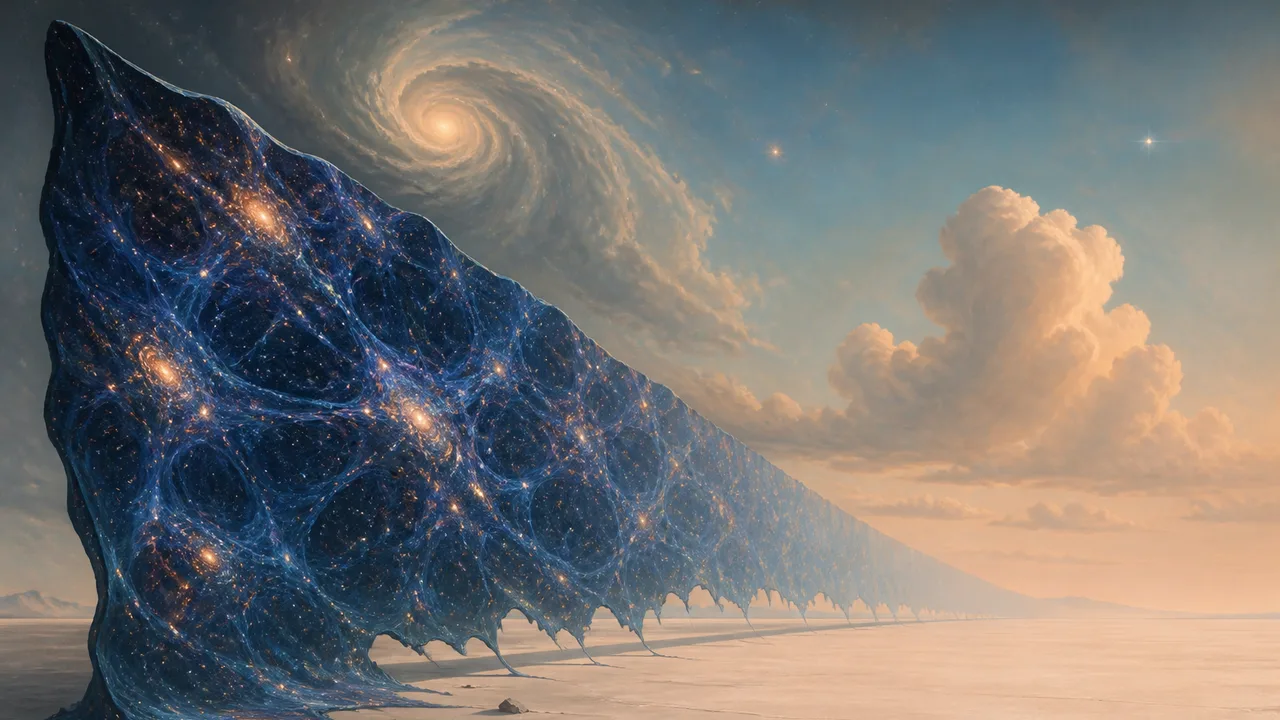
Photo: AI. Iolanthe Fenwick
Consider the problem of scale for a moment. The Milky Way — our galaxy, the one containing every star visible to the naked eye, roughly 400 billion of them — is about 100,000 light-years wide. It belongs to a local neighborhood of about 30 galaxies called the Local Group. That Local Group sits inside a supercluster roughly 100 million light-years across. And that supercluster is one of four that together compose the BOSS Great Wall: a single coherent cosmic structure stretching more than one billion light-years from end to end.
The numbers stop parsing at some point. That is, I think, the honest experience of engaging with cosmology at this scale. What remains useful is the question the BOSS Great Wall poses to astronomers — and it is a genuinely uncomfortable one.
A Structure That Shouldn't Be
The Great Wall was identified through the Baryon Oscillation Spectroscopic Survey, the acronym behind the "BOSS" designation. It sits roughly six billion light-years from Earth — too distant for current telescopes to resolve its internal geometry in any detail — and its composition is what you would expect at cosmic scales: four superclusters, two of them dense elongated tubes each exceeding 500 million light-years in length, and two smaller companions each still massing more than a thousand times the Milky Way.
Identifying its structure was the tractable part. Explaining how it got that way is where the physics gets uncomfortable.
The standard account of large-scale structure formation runs roughly as follows: the Big Bang produced a hot, dense plasma; slight density variations in that plasma became the seeds of gravitational attraction; over billions of years, gravity amplified those variations, pulling gas into stars, stars into galaxies, galaxies into clusters, and clusters into the superclusters and filaments that tile the observable universe today. The narrative is tidy and, up to a point, well-supported by observation.
The BOSS Great Wall strains that narrative. When cosmologists run simulations of structure formation — computational models that evolve the universe forward from the Big Bang — they find that gravity, working with the matter we can directly detect, produces supercluster-scale structures that are too diffuse. The simulations match reality only when the gravitational input is artificially boosted. As the Science Channel documentary puts it: "When scientists simulate the formation of superclusters, these mega structures end up loose as gravity isn't strong enough. Only when they boost the gravity beyond the expected level does matter assemble fast enough to form the superclusters that we see today."
That is not a minor calibration problem. That is the simulation telling you something fundamental is missing.
The Inflation Prologue
Before engaging with the missing gravity, it is worth pausing on the origin story the documentary presents for the Great Wall, because it is one of the more striking ideas in contemporary cosmology.
The inflationary period — a phase of exponential expansion thought to have occurred approximately 10⁻³⁵ seconds after the Big Bang — is posited to have done something counterintuitive to the early universe's density variations. In ordinary circumstances, regions with slightly more matter than average and regions with slightly less would equilibrate over time: the denser region would pull material from the sparser one until the difference smoothed out. Inflation prevented this by expanding space faster than those variations could communicate with each other. Quantum-scale density fluctuations were effectively frozen in place, then stretched to cosmic scales as the universe expanded.
The documentary frames this succinctly: "The inflation of the universe ripped them apart and they became frozen in place. Tiny fluctuations at the moment of the universe's creation unlock the genesis of the largest structure in the cosmos."
This is the theoretical machinery connecting a subatomic fluctuation roughly 13.8 billion years ago to a structure one billion light-years across today. The inflationary model has considerable predictive power — it correctly anticipated specific features of the cosmic microwave background radiation — but inflation itself remains a theoretical framework without direct empirical confirmation. The seeds it supposedly planted are inferred backward from what we observe, not observed directly. That lineage matters when assessing how confident we should be in the Great Wall's origin story.
The Dark Matter Inference
Back to the missing gravity. The leading candidate for the shortfall is dark matter — matter that interacts gravitationally but not electromagnetically, meaning it neither emits nor absorbs light and is therefore invisible to conventional telescopes.
The observational evidence for dark matter is indirect but genuinely robust. Gravitational lensing is among the cleanest lines of evidence: when light from a distant galaxy passes close to a massive foreground cluster, the cluster's gravity bends the light's path. The degree of bending is predictable from the cluster's visible mass. In many cases, the observed bending substantially exceeds that prediction, implying additional, unseen mass in and around the cluster. As the documentary notes: "Sometimes something weird happens. The light that comes from behind galaxies bends far more than astronomers expect. There must be an invisible material with huge mass and gravity around these galaxies."
Current estimates place dark matter at roughly five times the mass of all ordinary ("baryonic") matter in the universe. If accurate, that ratio would supply the gravitational supplement the simulations require. The structure of the BOSS Great Wall, on this account, is not primarily the architecture of stars and gas — it is the architecture of something we cannot see, with luminous matter tracing its skeleton.
It is worth being precise about the epistemic status here. Dark matter is not an observation; it is an inference from observations. It is an inference that has proven extraordinarily durable — it resolves multiple independent anomalies, from galaxy rotation curves to the large-scale structure of the cosmic web — but no dark matter particle has been directly detected. Decades of increasingly sensitive experiments have returned null results for the leading candidate particles. The inference is strong; the particle physics is unresolved.
This does not make the dark matter explanation wrong. It makes it the best current account of a genuine anomaly, which is a different thing and a meaningful distinction.
The Extrapolation Principle
One methodological move in the documentary is worth highlighting, because it illustrates how astronomers work at scales they cannot directly observe. Since the Great Wall's distance precludes detailed resolution, researchers study the local universe — our own supercluster, nearby galaxy clusters — and extrapolate. As one narrator puts it: "Despite its ridiculous size and forbidding distance, the Great Wall is made of the same things we see around us. We can learn about that and then extrapolate that to understand how the Great Wall itself behaves."
This is a defensible and widely used approach in astrophysics. It rests on the assumption of physical universality — that the same laws apply in our cosmic neighborhood as six billion light-years away. That assumption is well-tested over substantial ranges of scale and distance. It is not a guarantee against surprise.
The Great Wall itself is arguably evidence that the extrapolation sometimes runs ahead of expectation. Nine out of ten galaxies, we are told, reside inside a supercluster. The universe at large scales is not a smooth distribution of matter but an intricate web of filaments, walls, and voids — cosmic architecture on a scale that neither Newton nor Einstein anticipated when the theoretical frameworks underlying our models were first developed.
What the Great Wall Is Actually Asking
The BOSS Great Wall is the largest single structure astronomers have identified. That designation may not hold. Survey astronomy is continuously mapping larger volumes of the universe, and the history of large-scale structure discovery is one of repeated upward revisions. What looks like an edge of a structure often turns out to be a section of something larger still.
More than a record-holder, the Great Wall is a test case for the completeness of the standard cosmological model. That model — built on ordinary matter, dark matter, dark energy, and inflation — has extraordinary predictive success. It also has the quiet embarrassment that its two largest components, dark matter and dark energy, remain without confirmed particle-physics explanations after decades of searching.
The Great Wall does not refute the standard model. It pressures it. It asks whether the gravity we can account for, amplified by whatever dark matter turns out to be, is actually sufficient to build something this large in the time available since the Big Bang — or whether cosmology's inventory of the universe still has items missing.
That question does not have a clean answer yet. Given the track record of cosmology's anomalies producing new physics, that seems worth watching carefully.
More Like This
Crafting Supercars: The Science Behind Speed and Style
Explore how supercars like Alfa Romeo 4C and Aston Martin Vanquish are meticulously crafted using cutting-edge materials and precision engineering.

James Webb Challenges Dark Matter Beliefs
James Webb Telescope data questions the Bullet Cluster's role as dark matter proof, suggesting complex galaxy interactions.
Cosmic Threats to Earth: Asteroids, Solar Storms & Black Holes
From city-destroying asteroids to solar storms that could kill the internet, scientists are mapping the universe's most destructive forces—and our readiness is uneven.
When Black Holes Collide: Energy, Mass, and Mystery
What really happens when two supermassive black holes merge? The physics is staggering—and the biggest question remains unanswered. Here's what we know.
Rethinking Inflation and the FLRW Model
Explore the complexities and challenges of cosmological models, including inflation theory and the FLRW model.
Einstein's Biggest Blunder Was Actually Right
Einstein invented the cosmological constant to keep the universe static—then ditched it. Decades later, it came roaring back. Here's what dark energy means for everything we think we know.

AHA Says 5 Cups of Coffee a Day Is Safe for Your Heart
The American Heart Association says up to 5 cups of coffee daily is safe and may lower heart disease risk. Here's what that actually means—and what it doesn't.
Primordial Black Holes as Dark Matter Candidates
After decades of failed WIMP searches, physicists are turning to primordial black holes as a serious dark matter candidate. Here's what the evidence actually shows.