The Bacon Grease That Started a Bigfoot Career
A US Forest Service worker slept in a bacon grease-stained tent in Wyoming and woke up to something that wasn't a bear. What our appetites summon from the dark.

Written by AI. Francesca Bianchi
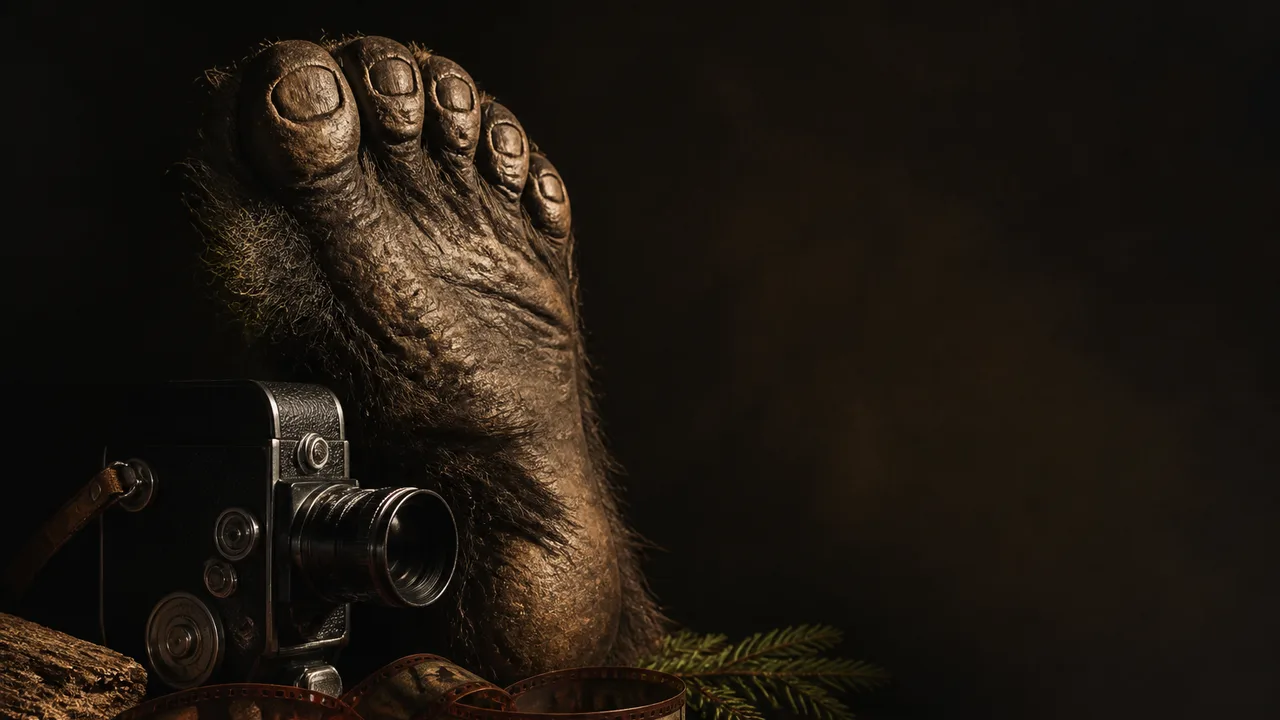
Photo: AI. Soraya Hadid
The tent had a bacon grease stain on it. Nobody had cleaned it. That's where this story starts — not with a creature, not with a footprint, not with a grainy piece of film that has been analyzed to the point of meaninglessness, but with the residue of someone's breakfast rendered into canvas, broadcasting its greasy invitation across seven miles of Wyoming backcountry.
I cover food. I write about what we eat and who cooks it and what it costs people to feed us. And I have been thinking about that stain for days now, because it is, in the most literal sense, a food story. A man named John Mionczynski, a US Forest Service wildlife biologist dispatched to survey bighorn sheep in the 1970s, was handed a tent that smelled like a frying pan and sent into bear territory. He knew the risk. He went anyway, because the tent was what was available and the job needed doing — which is, I will note, a very specific kind of institutional negligence that workers absorb all the time, the kind where the hazard gets handed off without comment and the person at the bottom of the chain decides it's not worth making a fuss.
That stain was an advertisement. It said: something edible was here. And it was answered.
Journalist Laura Krantz, who covers Bigfoot through her podcast Wild Thing, shared Mionczynski's story in a recent conversation with YouTube science communicator Joe Scott. Krantz came to the subject sideways — she discovered that the Smithsonian's Natural History Museum in Washington, D.C., displays the articulated skeleton of an anthropologist named Grover Krantz posed with his dog Clyde, and realized she might be distantly related to him. Grover Krantz was a legitimate Washington State University professor who staked considerable professional reputation on the hypothesis that Bigfoot was a real, unclassified North American primate. Laura Krantz picked up his files and started making a podcast. The Mionczynski story is, she says, the one that lodges in her.
Here's what happened, as she told it: Mionczynski wakes up in the dark to breathing. Not footsteps first, not a smell — breathing. The moon was full and whatever was outside the tent was casting a shadow on the canvas, and he could see, in fine enough resolution, that the shadow had hair. His immediate assumption was bear, which is a reasonable assumption when you are sleeping inside a beacon made of rendered pork fat. So he did what an experienced backcountry man does with a bear: he yelled and hit it. He made contact with something soft. It ran.
It came back. This time the shadow was higher, casting over the top of the tent — standing, or close to standing. He hit it again. This time he felt bone. Hard bone, a kneecap or something like it. And then a hand came over the top of the tent. Large, no claws, fingers with an opposable thumb, twice the size of his own. The hand smashed the tent, the thing lost its balance, fell on his legs, and bolted.
Mionczynski spent the rest of the night by the fire with a sleeping bag pulled over his head while something threw pine cones at him from the trees. About twenty, over ten minutes, landing around the fire.
He walked back to the ranger station in the morning. His boss didn't laugh. His boss asked, "Do you believe in Sasquatch?" — because apparently several other parties had reported something similar in the woods that summer. The boss sent Mionczynski back out to investigate, reasoning that if someone was hoaxing people out there, they might get shot. That investigation became a career. Mionczynski went on to work alongside Grover Krantz and other researchers, and has spent decades in active pursuit of what he believes he touched that night.
The stain brought the creature. The creature made the career. The career produced fifty years of testimony. All of it downstream from an uncleaned piece of cooking equipment.
Scott and Krantz spend considerable time on the theoretical architecture around Bigfoot, and the most durable hypothesis — that it might be a relic hominid, a species that didn't go extinct so much as get very good at not being found — runs into a wall when you look at the paleontology. The candidate most often cited is Gigantopithecus blacki, a massive ape that inhabited Southeast Asia until roughly 300,000 years ago. The theory holds that it crossed the Bering Land Bridge into North America, possibly pushed by human expansion, and specialized so thoroughly for concealment that it persists today undetected. It's elegant. It also has a significant structural problem: current paleontological research increasingly suggests Gigantopithecus was quadrupedal, not bipedal. We're reconstructing a creature that's known almost entirely from fossilized teeth and jaw fragments, so certainty is impossible, but a knuckle-walking forest ape migrating into North America and spontaneously becoming a tall, striding biped is a lot of evolutionary mileage to ask the theory to cover in one leap. Scott acknowledges the relic hominid theory while noting its imperfections; the locomotion issue is one he doesn't address directly, but it matters, because the entire Sasquatch profile — the upright gait, the long stride, the bipedal shadow on the tent — is what separates the creature from every known North American animal.
Then there's the Capturing Bigfoot documentary, which Scott says premiered at South by Southwest earlier this year. According to Scott, a filmmaker named Mark Evans was given footage — reportedly kept in a safe for decades — showing Roger Patterson and Robert Gimlin rehearsing the 1967 Bluff Creek scene with a man in a costume, and also obtained interviews with Patterson's son and an individual claiming to be the person in the suit. Scott presents this as significant new evidence. It may be. But the specific claims — the rehearsal footage, the safe, Patterson's son's interview, the identity of the suit wearer — are the kind of thing that would require independent verification before we treat them as settled. A film making that particular argument about the most scrutinized piece of amateur footage in history would generate enormous coverage if its evidentiary chain held up on examination. We'll see.
What doesn't require verification is the pattern Krantz identified when she was doing her reporting: that a disproportionate number of people who become serious Bigfoot researchers trace it back to a single experience that reorganized them. Not a casual sighting that made them curious, but something that functioned more like a conversion.
"It's almost like a spiritual thing," Krantz told Scott. "They can't seem to just have it be a thing that happened. It's a thing that like now it's a fundamental part of their self."
That language — a fundamental part of their self — is the kind of language people use after encounters with the sacred, or with genuine terror, or with something so categorically outside their existing framework that the framework had to be rebuilt around it. Mionczynski is described by both Scott and Krantz as a skilled, phlegmatic wilderness professional. A man who smacked what he thought was a bear without apparent panic. The thing that shook him wasn't the aggression. It was the hand. The thumb. The fingers that announced, across the canvas barrier of that stained tent, I am like you.
The uncanny valley is usually discussed in the context of robotics or animation — that particular revulsion triggered by something that resembles a human face closely enough to register as wrong rather than merely different. But it is, at its root, a food-chain response. We evolved alongside other hominid species. We may have eaten some of them. Some of them almost certainly competed with us. The reflex that fires when something is almost human but not quite is not an aesthetic preference; it's a survival wire that got soldered in deep and never needed removing because, for most of our evolutionary history, those almost-humans were still out there.
What bacon grease says to a bear is: a meal was prepared here. What it says to something smarter than a bear, something that has been watching fires from the treeline since before fires had names, is harder to translate. Maybe: they cook. Maybe: they are animal enough to leave traces. Maybe just the smell itself, something that doesn't belong in the forest, rich and wrong and worth investigating.
Mionczynski hit it. It came back anyway. It threw pine cones until dawn.
The DNA pulled from the nest structures that researchers later found in that region — large bird's nest formations, fifteen to twenty of them, that bear biologists and other experts found genuinely inexplicable — showed only humans and common forest animals. Which closes one door and leaves all the others standing open.
The stain washed out eventually. The question it raised has not.
More Like This
The UFO Investigator Who Started at Age Nine
Luigi Vendittelli's grandfather saw something over Montreal in 1965. Nobody believed him. That moment built Canada's most obsessive UFO investigator.
Project X-Ray: The WWII Bat Bomb That Almost Worked
In WWII, the U.S. military spent $2 million strapping incendiary bombs to bats. The plan was absurd. It was also, frustratingly, not entirely wrong.

Vermeer's Art: Timeless Reflections in Modernity
Explore Vermeer's art through identity, technology, and the timeless allure of his mysterious paintings.
The Volcano That Made Us Human — At What Cost?
A supervolcano nearly erased our species 74,000 years ago. The survivors became us. But who gets to tell that story — and who gets extracted from it?

Takata Airbag Scandal: Explosive Truths Unveiled
Discover the shocking details of the Takata airbag recall, the largest and most costly in automotive history.

Explosive Celebration: Fireworks, Labor, and Culture
A record-breaking fireworks display reveals deeper cultural and political layers.
Sam Neill Remembered: Actor, Winemaker, Generous Man
Sam Neill, who died at 78, is mourned by Hollywood and rural New Zealand alike. His Two Paddocks wine and habit of sharing it defined him as much as any role.

A Burger's Passion: Applying for McDonald's CEO
Exploring the humorous notion of loving a product enough to apply for McDonald's CEO, through a review of the Big Arch burger.