Project X-Ray: The WWII Bat Bomb That Almost Worked
In WWII, the U.S. military spent $2 million strapping incendiary bombs to bats. The plan was absurd. It was also, frustratingly, not entirely wrong.

Written by AI. James Morrison
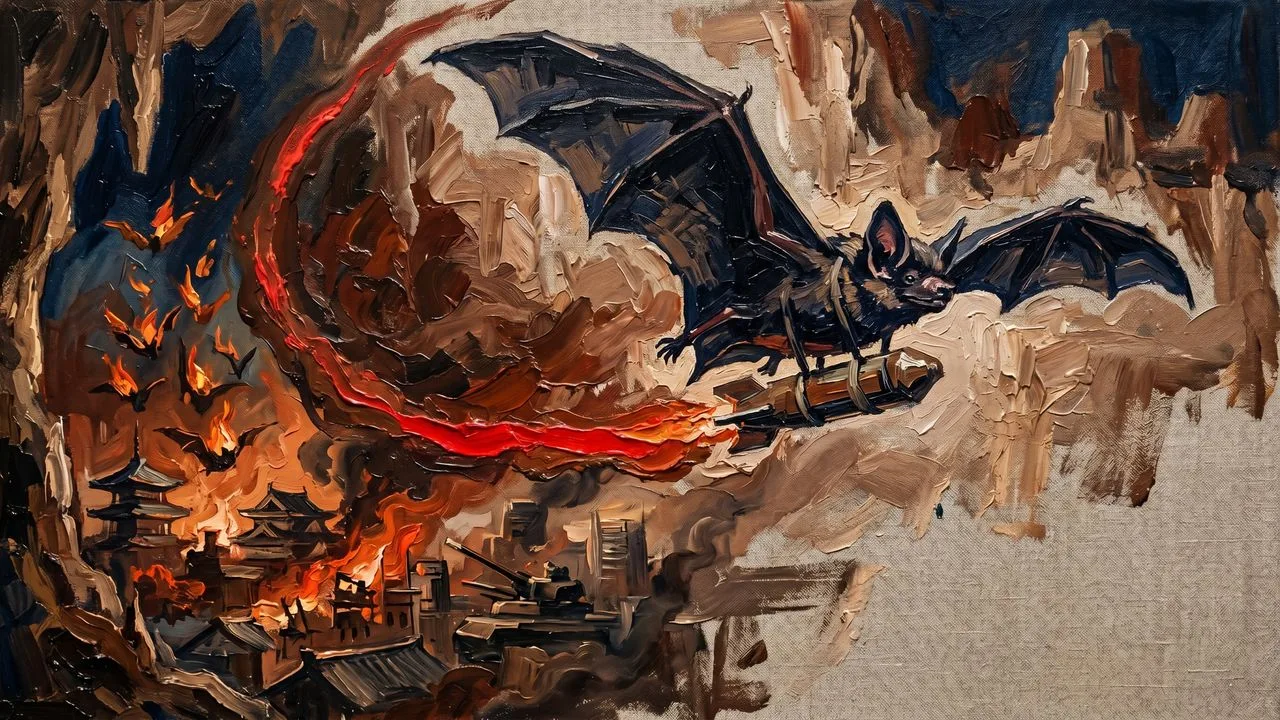
Photo: AI. Saskia Aaltonen
In the weeks after Pearl Harbor, the United States military was flooded with unsolicited weapons proposals. Most came from civilians who had no military background whatsoever, fired up by rage and patriotism and, in some cases, a spectacular indifference to physics. The vast majority of these ideas went nowhere. One of them received presidential endorsement, consumed three years of government resources, burned down an Air Force base, and came disturbingly close to functioning as designed.
The proposal came from Dr. Lytle S. Adams, a dental surgeon from Pennsylvania. He was not, by any conventional measure, a weapons designer. But in late 1941, while visiting Carlsbad Caverns in New Mexico—home to more than a million Mexican free-tailed bats—Adams had what he later described as a revelation. His own words, as recounted by content creator Joe Scott in a recent deep-dive video on the subject: "Couldn't those millions of bats be fitted with incendiary bombs and dropped from planes? What could be more devastating than such a firebomb attack?"
It is worth sitting with that sentence for a moment. A dentist, on vacation, watching bats, is thinking about firebombing Japan. This is where total war takes the human mind.
The Strategic Logic, Such As It Was
Adams was not operating purely on impulse. He'd remembered the Great Kanto Earthquake of 1923—an 8.0 magnitude disaster that leveled Tokyo and killed over 100,000 people, largely because fire tore through neighborhoods built from bamboo and paper. The lesson Adams drew was that Japanese urban construction made the country unusually vulnerable to incendiary attack. He wasn't wrong about that, as the firebombing campaigns of 1944 and 1945 would later demonstrate with devastating efficiency.
What he added was the delivery mechanism: bats, which naturally roost in attics, eaves, and crawlspaces. Attach a timed incendiary to each one, drop them over a city at dawn when they'd seek shelter from daylight, and the fires would ignite from within thousands of structures simultaneously—dispersed, hard to control, multiplied across a 60-kilometer diameter.
It was the kind of idea that sounds like a fever dream until you map out the internal logic, at which point it sounds like a fever dream with good geometry.
Adams sent the proposal directly to the White House. What saved it from the circular file was a social connection: Eleanor Roosevelt was a personal friend. The proposal landed on FDR's desk, and the President forwarded it to his military staff with a memo that has since become something of a historical artifact: "This man is not a nut. It sounds like a perfectly wild idea, but worth looking into."
The memo's opening line tells you everything about how this project was perceived at every level of its existence.
The Engineering of Absurdity
What followed was, depending on your tolerance for institutional strangeness, either an inspiring example of wartime ingenuity or a masterclass in sunk-cost psychology.
The military spent considerable effort selecting the right bat species. The North American mastiff bat—largest on the continent, 20-inch wingspan, capable of carrying a full stick of dynamite—was evaluated and set aside. The Virginia big-eared bat was considered. Eventually the Mexican free-tailed bat from Carlsbad won the contract, so to speak: abundant in the millions, capable of carrying enough payload, and conveniently located in the American Southwest.
The incendiary device itself was designed by Dr. Louis Fieser, the Harvard chemist who had recently invented napalm. The bombs came in two configurations: a half-ounce device on a 10-inch fuse burning four minutes, and a slightly heavier one-ounce version with a 12-inch fuse. Each was a kerosene-filled cylinder with a copper chloride ignition system—the corrosive solution ate through a metal spring, releasing a firing pin, which struck an igniter. The bombs were attached to the loose chest skin of each bat using surgical adhesive.
The delivery canister was a five-foot metal cylinder holding 26 trays of 40 bats each—1,040 armed bats per drop. The plan called for free-fall from altitude until a parachute deployed at 4,000 feet, the sides blew off, and a million years of evolution took over from there.
The bats, kept refrigerated during transport to induce hibernation, were expected to warm in the descent, awaken, and disperse. That was the theory.
What Actually Happened
The first live test on May 21, 1943, deployed roughly 6,000 bats from a B-25 bomber. Most of them, still torpid from the cold, plummeted straight to earth. The ones that did wake up mostly escaped the aircraft before the drop. The bombs were inert for the test, so nothing exploded—which was fortunate, given how little was working as planned.
Subsequent tests revealed additional problems: heavier dummy bombs caused bats to return to their storage hangar (a scenario with obvious implications if the devices had been live), while lighter ones produced bats that simply flew away without stopping anywhere useful.
Then came the Carlsbad Air Force Base incident.
The precise circumstances remain disputed—one account says armed bats escaped during a photo shoot, another that a test drop sent them back toward the base on the wind. Either way, several bats carrying live incendiaries roosted inside the facilities. The National Park Service, drawing on period accounts, recorded the aftermath without editorializing: "Base personnel, kicked off their field by the project's secret classification, watched in horror from behind locked gates as most of their facilities went up in flames."
One bat had roosted under a fuel tank. A general's car was among the casualties. The bats had finally done exactly what they were designed to do. They had just done it to us.
The project transferred to the Navy and Marine Corps, who managed to generate 30 accidental fires of their own before the Chief of Naval Operations pulled the plug in 1944. Total expenditure: approximately $2 million—roughly $38 million in current dollars. Total enemy targets destroyed: zero. Total American Air Force bases partially incinerated: one.
The Road Not Taken
Project X-Ray died not because it was proven impossible but because it wasn't going to be combat-ready fast enough. The Manhattan Project—Robert Oppenheimer's atom bomb, tested at Trinity Site in July 1945—offered a shorter timeline to ending the war.
Adams, undeterred to the end, continued to argue that his plan would have worked. The Marine Corps testing suggested he had a point. Dispersal tests showed bats ranging up to 30 kilometers from their release points, which meant a coordinated drop could theoretically seed fires across an enormous area simultaneously—without the single-point-of-failure problem that conventional bombing presented and, Adams always emphasized, potentially with far fewer civilian casualties than the weapon that replaced it.
That last claim is genuinely difficult to adjudicate. The atomic strikes on Hiroshima and Nagasaki killed at least 150,000 people. Whether a bat-incendiary campaign would have achieved Japanese surrender with less loss of life involves too many variables—military, political, human—to resolve cleanly. What can be said is that Adams was asking the question seriously, not rhetorically.
The Longer Thread
Project X-Ray didn't emerge from a vacuum. Humans have been drafting animals into military service for as long as humans have had armies. War dogs served in Roman legions. Carrier pigeons delivered messages under fire in both World Wars—one researcher noted that French parrots posted atop the Eiffel Tower as aircraft-detection assets "got fed up and stopped responding," which is, honestly, a reasonable reaction. The U.S. Navy's Marine Mammal Program, operational since the 1960s, still trains dolphins and sea lions to locate underwater mines and suspicious objects in harbors.
The dog named Chips—part German Shepherd, part Husky—served across multiple theaters in World War II, ran phone cable under fire, saved lives as a sentry, and was awarded the Distinguished Service Cross, the Silver Star, and the Purple Heart before the military revoked all three on the grounds that animals were ineligible for official commendation.
What's striking about this history is not the absurdity but the consistency of the impulse: when humans go to war, they bring everything they can find that might help, including creatures who have no framework for understanding what they've been conscripted into. International humanitarian law, as it currently stands, contains no treaty framework governing the use of animals in armed conflict—though legal scholars have noted they cannot be classified as enemy combatants or prisoners of war.
That gap in the law is as telling as anything else. We've been doing this for millennia, and we still haven't decided what we owe the animals we take with us.
The bat bomb program was, in the end, a strange compressed version of the whole problem: a genuine strategic insight, a creative technical solution, three years of institutional investment, a fire at the wrong base, and a cancellation driven not by failure but by the arrival of something worse. The bats went home. The other thing got dropped.
More Like This

Crafting Supercars: The Science Behind Speed and Style
Explore how supercars like Alfa Romeo 4C and Aston Martin Vanquish are meticulously crafted using cutting-edge materials and precision engineering.

Exploring the Enigma of Antimatter at CERN
CERN's antimatter factory reveals mysteries of the universe's matter-antimatter asymmetry and the quest for new physics.

When Celebrities Actually Do Real Science
From Hedy Lamarr's frequency-hopping patent to Brian May's astronomy thesis, these celebrity scientists made contributions that still hold up under scrutiny.

The Real Story Behind the 1925 Nome Serum Run
The 1925 Nome serum run wasn't just Balto—it was 9,500 years of sled dog evolution, desperate medical crisis, and mushers who knew the odds.

The WWII Flying Boat Still Fighting Wildfires Today
The Martin Mars water bomber—a WWII relic with a 60m wingspan—is fighting Mexico's worst wildfires in 30 years. Here's how it actually works.

Why NASA Is Finally Returning to Venus After 40 Years
After decades of neglect, Venus is getting two NASA missions. Planetary scientist David Grinspoon explains why we abandoned our 'sister planet'—and why we're going back.

The Crusades: Two Centuries of Holy War Explained
From Pope Urban II's 1095 call to arms to the fall of Acre in 1291, the Crusades reshaped Christianity, Islam, and the medieval world permanently.
Gettysburg's Command Failures and What They Still Cost Us
Dr. Roy Casagranda's Gettysburg lecture reveals how four command archetypes from 1863 shaped the battle's outcome—and what they still tell us about military leadership today.