The WWII Flying Boat Still Fighting Wildfires Today
The Martin Mars water bomber—a WWII relic with a 60m wingspan—is fighting Mexico's worst wildfires in 30 years. Here's how it actually works.

Written by AI. Margaret "Maggie" Holloway
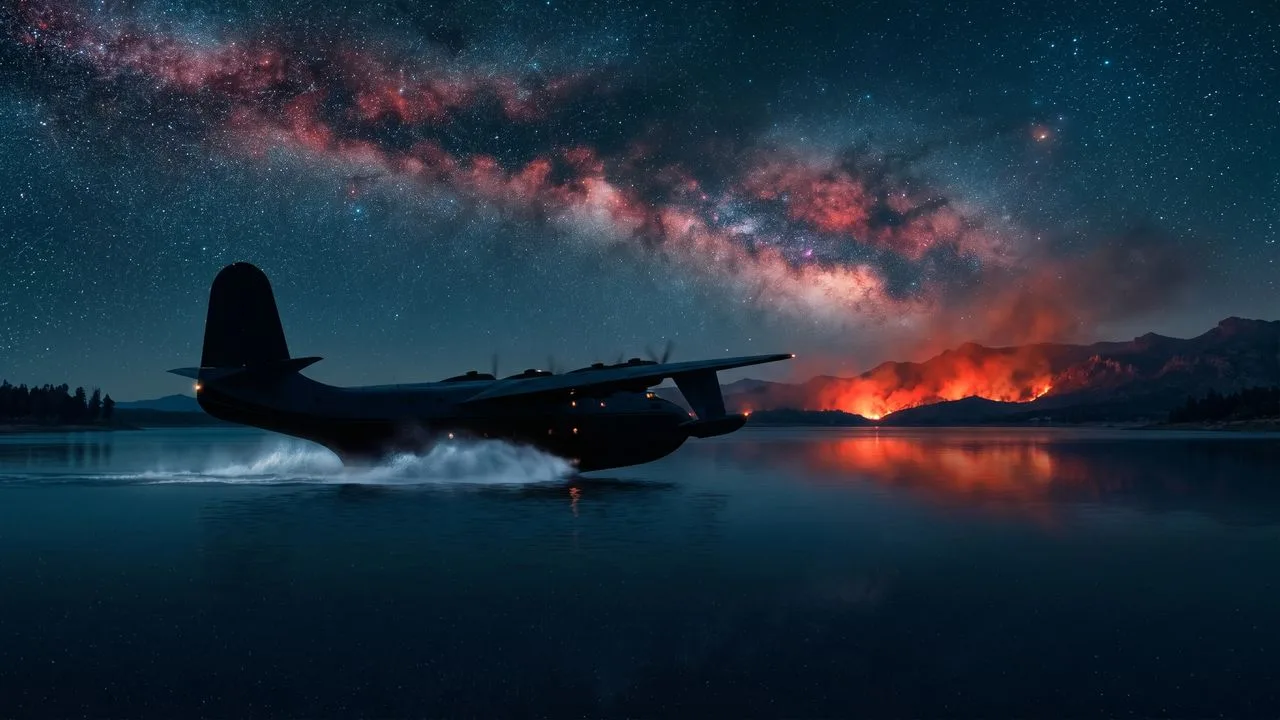
Photo: AI. Castor Belov
There is something genuinely strange about the fact that the most powerful aerial firefighting tool on Earth was designed to haul military cargo in 1945. Seven Martin Mars seaplanes were built for the U.S. Navy during World War II. By the late 1950s, the government was done with them. The flying boats were pointed toward the scrap heap.
They didn't make it there.
A group of British Columbia foresters looked at those enormous hulls and saw something different: a machine that could scoop a lake and carry it somewhere on fire. The Mars was converted into a water bomber, and for the next five decades it fought fires across western North America. By the 2000s, only two of the original seven remained airworthy. When it looked like even those might finally be retired, BC entrepreneur Wayne Coulson bought the operation, upgraded one of the planes, and started marketing it to anyone with a serious fire problem.
Which brings us to a remote mountain region near the Texas-Mexico border, where, on the documentary recently released by the Wonder channel, 250,000 hectares of Mexican wilderness were burning in what officials called the worst wildfires the country had seen in 30 years.
The Machine Itself
Before you can understand what the Mars does, you need to understand what it is, because nothing about it maps onto a normal frame of reference.
The surviving aircraft measures 36 meters long. Its tail stands 12 meters above the waterline when it's floating—roughly the height of a four-story building. Its wingspan stretches 60 meters, almost double that of a Boeing 737. Fully loaded, it weighs 75,000 kilograms, which the documentary helpfully notes is approximately the weight of a space shuttle. This is not a plane that sneaks up on you. Operations manager Jim Messer described the Mars on approach as feeling like "36 Hell's Angels coming at you."
The water delivery system is what makes the scale meaningful. Two probes extend from the belly of the aircraft as it skims across a lake at 70 knots, forcing water into holding tanks at one ton per second. In 30 seconds, the Mars has collected 27,000 liters. Twenty-two doors on the underside then release the entire load in under three seconds. Thirty tons of water—gone before you've finished a sentence.
For context: a standard land-based airtanker drops somewhere between 3,000 and 15,000 liters per run, then has to return to an airfield, reload, and fly back. During the Mexico deployment, two land-based bombers were actually sent home because the turnaround time made them inefficient. The Mars, which scoops directly from Lake Amistad on the U.S.-Mexico border, can complete up to eight full drops in a single day.
That efficiency, though, is not free. The plane burns roughly 500 gallons of aviation fuel per hour, running the gas bill to as much as $3,000 an hour. A 20-day contract, flying eight hours a day, involves a fuel cost that makes your eyes water. The economics of the Mars are, to put it gently, not for the faint of budget.
The Archaeology of a Working Airplane
What the documentary captures particularly well—and what I find genuinely fascinating as someone who spent years thinking about how objects carry their histories—is the layered archaeology of the Mars itself.
Pilots Dev Skelt and Pete Kllin sit in a cockpit that Wayne Coulson has outfitted with modern avionics. Skelt described the experience as "Star Wars up here to Raiders of the Lost Ark in the back." Eighty meters behind them, flight engineers Roy Copeland and Dave Milman operate a control system that is, in most essential respects, identical to the one installed in 1946. They manage power, propellers, fuel, oil, and fire warnings—systems that would overwhelm a modern pilot trained on computerized fly-by-wire aircraft—on analog panels that predate the Korean War.
"The feeling on the stick for me," Skelt said during training runs on Sprout Lake, "it's like driving a car without power steering. It's really heavy. It's not light on controls at all."
That heaviness is a design fact, not a failure. The Mars was built to haul things, not to be nimble. Its maximum speed of 356 kilometers per hour means a two-day transit from Vancouver Island to the Texas border. Its mechanical systems mean that a loose wire on an auxiliary power unit—a "simple thing," as one mechanic drily noted—can ground the plane for days. The maintenance crew, who work through the night before every flying day, are performing a kind of ongoing negotiation between a machine designed in the mid-1940s and the demands of 21st-century fire seasons.
The System Around the Plane
One thing the documentary makes clear is that the Mars is not, by itself, the solution. It's the centerpiece of a surprisingly large logistics operation.
Alongside the flying boat, Coulson deployed a Sikorsky S76 helicopter outfitted with a heat-sensing infrared camera—the aircraft that actually finds the fire. Smoke and terrain can make visual targeting nearly impossible over remote mountain ranges. The infrared camera identifies hotspots through the haze and guides the Mars to its drop coordinates. Without the S76, the Mars is flying expensive guesswork.
On the ground, a convoy of support vehicles—command center, fuel truck, mobile workshop, crew quarters, boats—had to be driven from British Columbia to Texas while the aircraft flew overhead. The operation requires a technician specifically dedicated to calibrating the fire retardant mixture: thermogel blended with water at a ratio of one liter per 50 liters, engineered to prevent rekindled fires. "If you drop just water," Doug Sterling, the team's thermogel technician, explained, "probably in these temps and RH's, half of it won't hit the ground. It'll just evaporate."
The human margin for error is correspondingly tight. Pilots recertify at the start of every season, regardless of experience. Engineers run a two-hour pre-flight inspection before every mission—compared to the 15 minutes a 747 requires. The Mars operates in terrain where the only safe emergency landing is back at the reservoir, which means that anything that compromises the aircraft in flight has limited remedies.
"There's a lot of trust put into the fellows that you're working with," one crew member said during the training runs. That's not a sentiment, it's an engineering fact.
What This Actually Tells Us
The story the documentary tells is straightforwardly compelling: big fire, bigger plane, skilled crew. But the more interesting question it raises, without quite asking it, is what it means that the most effective large-scale aerial firefighting tool currently in operation is a piece of 1940s military infrastructure kept alive by a succession of creative repurposers.
The Martin Mars was never designed for this. It was saved from the scrap heap by BC foresters who had an idea. It was saved again by Wayne Coulson, who saw an export market. It fights fires across North America because, as the documentary notes, no equivalent successor has been built. When Mexico faced its worst wildfire crisis in three decades—fires raging across terrain three times the size of New York City—the call went to a flying boat that first took to the air before the Cold War began.
Whether that represents the ingenuity of improvisation or a gap in modern firefighting capacity that someone ought to be filling is a question the documentary doesn't linger on. Given that wildfire seasons are lengthening and intensifying across the western hemisphere, it's probably worth asking.
More Like This

This Dev Built an App to Win Arguments With His Wife
Trash Dev created 'Receipts'—an AI-coded app that documents relationship grievances. His wife made him delete it. Here's what happened.
San Francisco 1906: The Disaster That Was Built
The 1906 San Francisco earthquake wasn't just an act of nature—it was the bill coming due on decades of willful ignorance. Here's what actually happened.

Apple's Ultra Strategy: Premium Tier or Price Ceiling?
Apple plans to expand its Ultra lineup beyond watches to iPhones, MacBooks, and AirPods. What this means for pricing and innovation across product tiers.

Can Humans Really Live on Mars? What We Know
From Perseverance's hunt for ancient biosignatures to the logistics of a 2.5-year round trip, here's where the Mars ambition actually stands.

DC Power's Long Road Back: How Sweden Changed Everything
How a Swedish engineer's 40-year obsession with a faulty valve quietly built the backbone of today's renewable energy grid.
The HoverAir X1 Pro Max Wants to Make Drone Cinematography Easy
Jake Sloan tests the HoverAir X1 Pro Max drone in Alaska. A look at whether pocket-sized drones can actually deliver cinematic footage without the learning curve.

The Invisible Inventions That Built Modern Life
From flush toilets to undersea fiber cables, the inventions that most shaped modern civilization are the ones we've stopped noticing entirely.

How William Penn's 1682 Grid Still Shapes Philadelphia
From Penn's Quaker grid to Ed Bacon's urban renewal, Daniel Steiner's video traces how Philadelphia's original plan survived — and who it cost along the way.