San Francisco 1906: The Disaster That Was Built
The 1906 San Francisco earthquake wasn't just an act of nature—it was the bill coming due on decades of willful ignorance. Here's what actually happened.
Written by AI. David Oyelaran
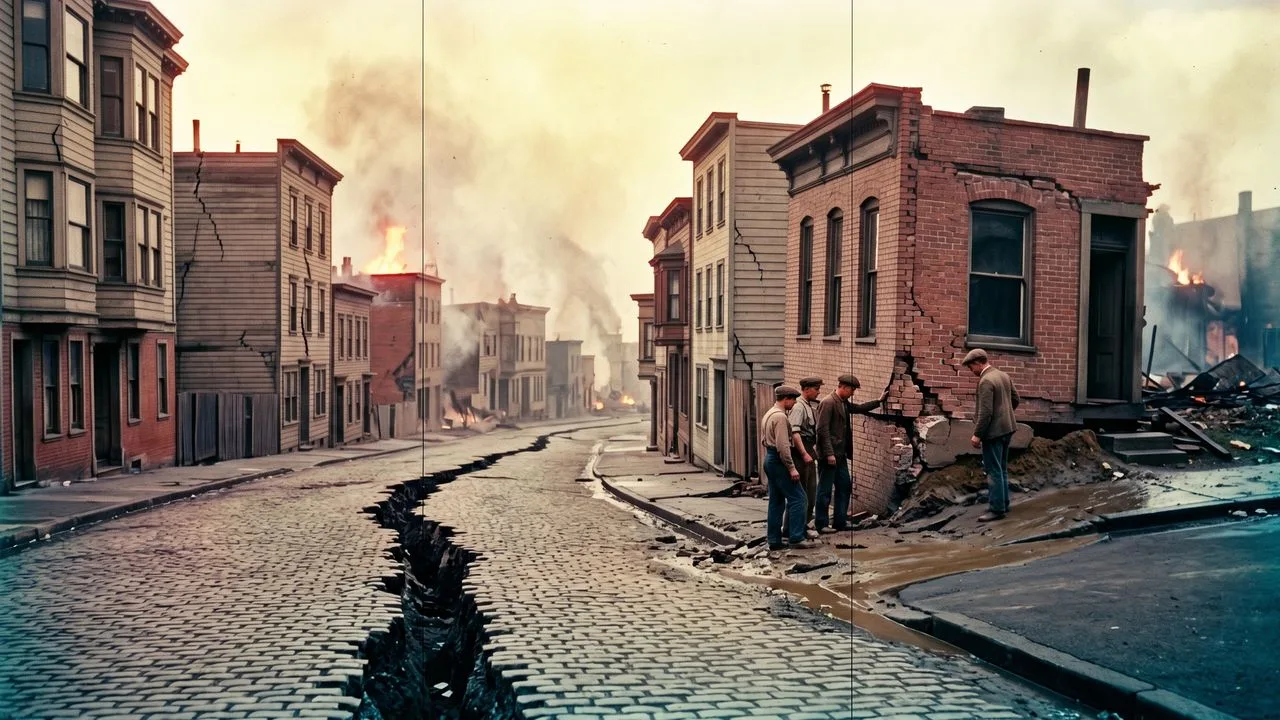
Photo: AI. Nikolai Brandt
The earth moved for 45 to 60 seconds. Depending on who was counting—and where they were standing—it felt like an eternity or like a single violent breath. Either way, by 5:13 a.m. on April 18th, 1906, San Francisco had already become a different city. What followed over the next three days would finish what those seconds started.
The History Channel's Mega Disasters: San Francisco Earthquake uses the 1906 catastrophe as its opening episode, and it's a fitting choice—not just because the death toll was staggering or because the fires burned for days, but because the disaster illuminates something that keeps recurring in how cities grow and who pays the price when they fail. The episode layers geology, urban history, and eyewitness testimony into a portrait of a catastrophe that, the experts make clear, was partly authored long before the fault slipped.
The Ground Beneath the City Was Never What It Seemed
San Francisco sits at the boundary of two tectonic plates—the Pacific and the North American—which meet, as one geologist notes in the episode, "almost exactly under the city." Eight active faults thread the Bay Area. This wasn't a secret. An 1868 earthquake, roughly a 7.0 by modern measurements, had already rattled the peninsula and killed five people. It was called "the big one"—until 1906 made that label look naive.
What's striking, watching the documentary, is how the city's vulnerability wasn't just geological. It was engineered. After the Gold Rush of 1849, San Francisco burned down six times in two years. The response each time was functionally the same: bulldoze the debris into the bay, cover it with dirt, build again. This created an expanding shoreline of landfill—what engineers call "made ground"—that was fundamentally unstable. The city didn't just grow on shaky earth. It manufactured shaky earth and then built on top of it.
When the 1906 quake hit, this came due in a process called liquefaction. Made ground, once shaken, loses its structural integrity—the water and sediment mix until the ground behaves like a liquid. Buildings sink. The Valencia Hotel, built on what had been a lake, didn't just collapse—it sank, its lower floors pancaking into the earth. Residents on the top floors could walk out onto the roof and step onto relatively solid ground. The people on the floors below them were simply gone.
The difference in survival, the episode makes plain, tracked almost exactly with geography and class. Up on Knob Hill—where the railroad barons had their mansions and the Fairmont Hotel was ironically scheduled to open on the very morning of the quake—residents built on bedrock felt the shaking but mostly survived it. Down in South of Market, where tenement hotels crowded the landfill, the ground became the disaster before the fire even arrived.
The Fires Were the Second Disaster. The First Was Dennis Sullivan.
Here's what the documentary returns to, almost obsessively: Fire Chief Dennis Sullivan saw this coming.
Sullivan had spent years lobbying for an independent saltwater firefighting system—tanks on the city's hills, steam pumps on the waterfront, fireboats in the bay—designed specifically to function if the main water infrastructure failed. He understood that the existing gravity-fed hydrant system ran on pipes that would rupture in a major earthquake, leaving firefighters with nothing. He was right about all of it.
"Eugene Schmitz, the mayor, and the political boss, Abe Ruef, were too busy robbing the city blind to pay any attention to Dennis Sullivan. He was a thorn in their side."
Sullivan's proposals were ignored. And then, when the earthquake hit at 5:12 a.m., a chimney from the adjacent California Hotel crashed through his fire station on Bush Street. He fell three stories, landed on a boiler, fractured ribs, and was scalded over 60% of his body. By the time 60 simultaneous fires were burning across the city—ruptured gas lines igniting woodframe construction like it was designed to burn—the one person who had both the vision and the authority to coordinate a response was dying.
Firefighters pulled up to hydrant after hydrant and found them dry. They dropped hoses into sewers. They did everything they could. But the quake had shattered two of the three main water lines feeding the city, and there was no backup system because the backup system had been rejected by men who were busy stealing.
This is the part of the story that the documentary handles with the most precision, and it's worth sitting with. The fires that destroyed San Francisco weren't solely an act of nature. They were partly the consequence of a specific political failure, a specific corruption, a specific decision to silence the person most qualified to speak.
The Soldiers, the "Gray Zone," and Who Gets Shot
The episode doesn't skip past the military occupation, and it's right not to.
Brigadier General Funston had himself shaken out of bed by the quake. Doubting the police could handle what was coming, he marched 1,700 troops into San Francisco by 8:00 a.m. The orders were blunt: no drinking, and any suspected looter should be shot on sight. What followed was something the documentary describes with a notable lack of sentimentality.
"Martial law was never declared. There was the belief that it had been declared, and therefore the law that existed at the time was sort of a gray zone."
Within hours, soldiers began looting—liquor stores first, then clothing, sporting goods, shoes. Photographs from the period show them picking through shoe boxes looking for the right sizes. Meanwhile, the shoot-on-sight orders remained in effect for civilians, with innocents reportedly killed alongside actual looters. The "gray zone" the documentary names is a familiar shape: authority asserted without legal basis, enforcement applied unevenly, the weight of it falling predictably on those least able to push back.
200,000 people were left homeless. The official death toll was suppressed—city leaders, eager to attract investment and reassure the outside world, downplayed the numbers. Historians now estimate the dead at somewhere between 3,000 and as many as 6,000, with Chinese residents of Chinatown significantly undercounted in the official figures. The story of who gets recorded in a disaster, and who doesn't, is its own kind of history.
What the Ground Is Still Holding
The documentary was produced around the centennial of the 1906 earthquake, and its experts are not subtle about the implication. The San Andreas fault hasn't stopped moving. The strain that's been accumulating since 1906—150 inches by one estimate, released so far only in fragments like the 1989 Loma Prieta quake—has to go somewhere eventually.
"If the same earthquake were to happen now, the damage and destruction would be even greater."
San Francisco's population is larger. Its density is higher. The made ground is still there, still underneath the city, still subject to the same physics. Building codes have improved significantly since 1906, and emergency planning is far more sophisticated. But the fundamental geographical fact—a major city built at the collision point of two tectonic plates, partly on landfill—hasn't changed. Neither has the political challenge of convincing people to invest seriously in preventing a disaster that hasn't happened yet.
Sullivan couldn't do it. The question the documentary leaves open, quietly, is whether anyone can.
More Like This
WW1 Trench Life: What the Western Front Was Really Like
From Pals' Battalions to the Vickers gun, a new documentary unpacks the grim machinery of survival on the WW1 Western Front in unflinching detail.
Opus 4.7 Drops Amid Molotov Cocktails and AI Fear
Anthropic's Opus 4.7 launches as a 20-year-old throws a Molotov cocktail at Sam Altman's house. The AI world is splitting in two—and it's getting violent.
Exploring Mercury's Mysteries: From Alchemy to Modern Science
Discover the unique properties of mercury, its historical significance, and intriguing experiments in Andrew Szydlo's lecture.
Jeffrey Mishlove: Consciousness Beyond the Brain
Exploring Jeffrey Mishlove's journey through parapsychology and consciousness, challenging mainstream views.
Space Developments: Tech Triumphs and Challenges
Exploring recent space missions, tech innovations, and their broader impacts on humanity's cosmic ambitions.
Unveiling the Trench Effect: Lessons from King's Cross
Explore the King's Cross fire, the trench effect, and vital fire safety reforms reshaping public infrastructure.
Homer's Odyssey and What Mortality Means Today
Homer's Odyssey is more than epic adventure — it's a philosophical argument for why a finite life matters, and why immortality might be the real curse.
DNA Names a Revolutionary War Teen Soldier After 245 Years
Genetic genealogy has identified Private John Pumphrey, a Maryland teen who died at the Battle of Camden in 1780 — one of America's oldest John Doe cases.