When Celebrities Actually Do Real Science
From Hedy Lamarr's frequency-hopping patent to Brian May's astronomy thesis, these celebrity scientists made contributions that still hold up under scrutiny.

Written by AI. Damon Wright
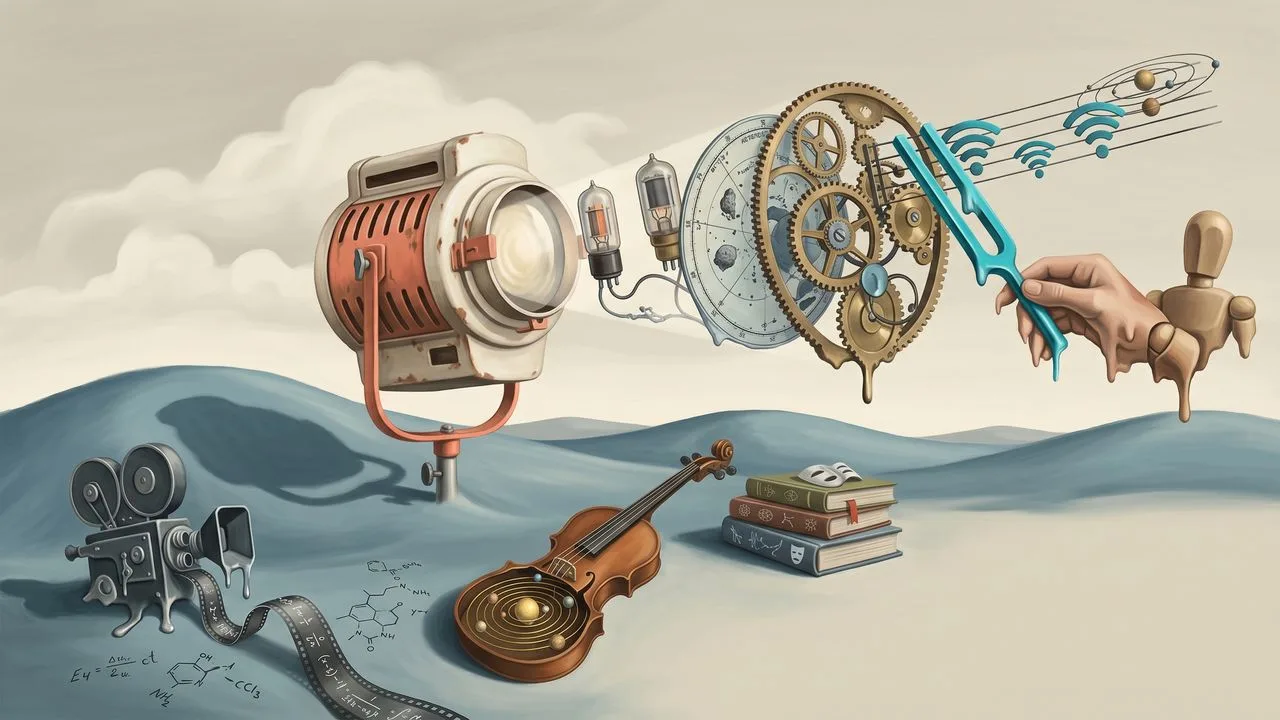
Photo: AI. Iolanthe Fenwick
I cover an industry where people get famous first and credentialed never. Where a manager with a GED negotiates a seven-figure deal and a Harvard grad gets taken to the cleaners on their first contract. Fame and expertise have almost nothing to do with each other in music—or in Hollywood, for that matter. So when I say some of these celebrity science stories genuinely stopped me cold, that's not a low bar. That's a real reaction.
Joe Scott's recent video on celebrity scientists is the kind of thing that works because the cases he picks aren't soft. He's not citing celebrities who "love astronomy" or "have an interest in medicine." He's pulling documented, peer-reviewed, patent-on-file contributions. The gap between those two categories is enormous, and it matters.
The Cases That Actually Hold Up
Start with Hedy Lamarr, because it's still the most striking one. The actress born Hedwig Eva Maria Kiesler co-invented a frequency-hopping spread spectrum communication system with composer George Antheil in the early 1940s. The Navy initially passed on it. They did eventually deploy frequency-hopping technology—though the precise timeline of how their work fed into military applications is murkier than popular tellings suggest. What's documented and unambiguous: the underlying principle became foundational to GPS, cellular networks, Bluetooth, and Wi-Fi. The patent they held expired in 1959 before generating any commercial royalties for the inventors—though notably, the U.S. Navy reportedly deployed frequency-hopping technology as early as the Cuban Missile Crisis in 1962, which complicates the "decades before anyone noticed" framing you'll sometimes see. The military recognized its value. Lamarr and Antheil just never got paid for it.
The image Scott reaches for—a torpedo signal jumping across 88 pre-planned radio frequencies like keys on a piano—captures how an artist arrived at an engineering solution. Not metaphorically. Antheil had literally worked with synchronized player pianos. The piano keyboard was the conceptual blueprint. That's worth sitting with: the abstraction that unlocked the invention came from musical structure, not from engineering training.
Danica McKellar is probably the least-known case on Scott's list and arguably the most technically substantive. Between her years on The Wonder Years and her later career, she went to UCLA and co-developed what's formally known as the Chayes-McKellar-Winn theorem—a proof about percolation in Gibbs states for ferromagnetic Ashkin-Teller models on Z². That's not a science fair. That's a named theorem in mathematical physics, published and cited in subsequent academic literature. The gap between "celebrity with a science interest" and "has a theorem named after her" is roughly the same as the gap between "I play guitar" and "I toured arenas."
Brian May finished his PhD in astronomical research at Imperial College London—specifically on interplanetary dust and the velocity of zodiacal dust clouds—after a 36-year gap during which he happened to become one of the most recognizable guitarists on the planet. His thesis work sits in the subfield of observational astronomy rather than astrophysics proper, a distinction that probably matters more to his Imperial College committee than to anyone else, but worth noting if you're going to cite him as "Dr. Brian May, astrophysicist." He subsequently worked with NASA's OSIRIS-REx mission on imaging analysis of asteroid Bennu. The degree is real. The NASA collaboration is real. The precision of how you label it is the only thing worth quarreling with.
Dexter Holland from The Offspring earned a PhD in molecular biology from USC in 2017—valedictorian of his high school, biological sciences major in the mid-'80s, put the degree on hold when the band took off, came back decades later and published a thesis on identifying microRNA sequences within HIV that help the virus evade detection in the human body. That's not a vanity degree. That's work that sits inside a legitimate research conversation about HIV/host interactions.
The cases with more asterisks: Natalie Portman co-authored research as a high school student under her real name, Natalie Hershlag, exploring methods of producing hydrogen from sugar—the work was submitted to the Intel Science Talent Search. Whether that represents a genuinely novel scientific method or an impressive student research project is a meaningful distinction that gets blurred in the retelling. Both can be true simultaneously: impressive for a high schooler, and not quite the same as peer-reviewed original research by a working scientist. Portman has never claimed otherwise. The hype around it sometimes does.
Zeppo Marx co-invented a cardiac monitor wristwatch that could detect irregular heartbeats and trigger an alarm—a legitimate piece of medical engineering that Scott correctly frames as a precursor to what smartwatches now do. The patent date cited is 1969, though it's worth knowing that patent filing dates and grant dates often differ by years, and the precise anchor matters if you're calculating how far ahead of the Apple Watch this actually was.
The Beatrix Potter Problem
The one in Scott's video that I keep coming back to isn't the flashiest. Beatrix Potter—yes, Peter Rabbit—was doing serious mycological research in the 1890s. She painted detailed watercolor studies of fungal specimens, investigated spore germination, and wrote up her findings. The Linnean Society rejected her paper. The video attributes this to her ideas being "too radical" and the fact that she was a woman. Both were probably factors, and the outcome is the same either way: work that was later considered foundational to the field got buried at the gate.
I'm not going to romanticize institutional bias—it's not romantic, it's just a door that stays closed. But the structural thing Scott's getting at is real: the gatekeeping mechanisms of formal science have historically been calibrated to filter out people who didn't look like the expected profile of a researcher. Potter didn't have credentials, didn't have institutional affiliation, and was a woman in Victorian England. Three strikes before she opened her mouth.
Where Scott's Bigger Argument Gets Complicated
The video pivots from these individual cases into a broader argument about STEAM education—the case for integrating arts into STEM curricula. He cites a 2018 paper from the Journal of Microbiology and Biology Education and mentions a 2013 Johns Hopkins study that reportedly found arts-integrated learning programs achieved a "105% long-term content retention rate." That specific figure is doing a lot of work in the argument, and it's the kind of claim that warrants direct verification before you run with it—a retention measurement exceeding 100% is methodologically unusual enough that the methodology matters. I can't independently verify it from the video alone, and I'd encourage skepticism until you can find the primary source.
The broader point—that visual and performing arts training helps people communicate complex ideas and think laterally—doesn't require a contested statistic to stand. The cases in the video make it empirically: an actress whose musical instincts produced a communication system that defines modern wireless technology. A guitarist whose childhood habit of building things from scratch translated into serious astronomical research decades later. Scott quotes Einstein's 1929 Saturday Evening Post interview: "I'm enough of the artist to draw freely upon my imagination. Imagination is more important than knowledge. Knowledge is limited. Imagination encircles the world."
That quote gets strip-mined for motivational posters, but the full context is interesting: Einstein's framing isn't about elevating intuition over rigor. He's describing where rigorous questions come from in the first place. The imagination isn't the destination. It's what gets you out of bed to go find out.
I cover an industry where the people who understand both sides of the table—the creative side and the business side—almost always do better than the ones who only understand one. The artists who know what their streaming royalty calculations actually mean. The executives who can recognize a genuinely original sound versus something formulaic. The ability to move between registers isn't a personality quirk. It's a professional advantage, and it's learnable.
Lamarr had no engineering degree. What she had was a mind that refused to stay in its assigned lane. The question Scott's video implicitly raises—and doesn't fully answer—is whether that kind of thinking is what we're selecting for when we build educational systems, or whether we're still rewarding people for staying in theirs.
More Like This
Exploring Mercury's Mysteries: From Alchemy to Modern Science
Discover the unique properties of mercury, its historical significance, and intriguing experiments in Andrew Szydlo's lecture.
Engineering an LED Supernova: A Nuclear Approach
A nuclear engineer evaluates a DIY LED project, highlighting heat management, design intricacies, and nuclear parallels.
Space Developments: Tech Triumphs and Challenges
Exploring recent space missions, tech innovations, and their broader impacts on humanity's cosmic ambitions.
Unlocking New Skills After 50: The 'Pillar & Playground' Approach
Explore how the 'Pillar & Playground' method helps those over 50 learn efficiently, leveraging crystallized intelligence and cognitive flexibility.
When AI Writes Code, What's Left for Developers to Do?
ThePrimeagen spent 6 months questioning his value as a developer. His answer challenges assumptions about what matters in an AI-assisted world.
YouTube Creators Face AI Flood: What Actually Works Now
As AI-generated content floods YouTube, the vidIQ team argues success still requires taste, craft, and judgment—whether you use AI tools or not.
How UTA Is Rebuilding the Creator Economy Deal
UTA's Ali Berman and Raina Penchansky explain how they build creator businesses—from brand deals to physical products and navigating AI threats.
Hidden Movie Remakes: Unmasking Cinematic Clones
Exploring hidden movie remakes that remix classic films, offering fresh perspectives while echoing their predecessors.