The Volcano That Made Us Human — At What Cost?
A supervolcano nearly erased our species 74,000 years ago. The survivors became us. But who gets to tell that story — and who gets extracted from it?

Written by AI. Sofia Ramirez
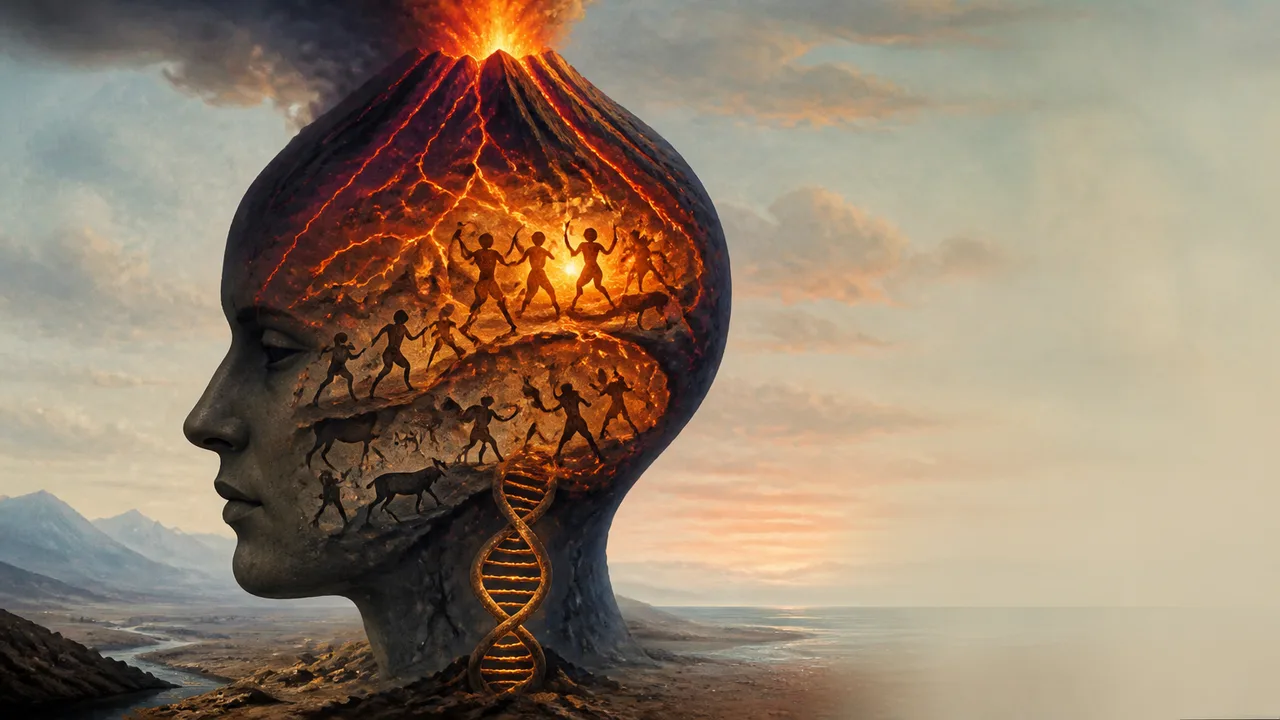
Photo: AI. Iolanthe Fenwick
The San people of the Kalahari Desert have been living in southern Africa for longer than any other population on Earth. Their genetic lineage stretches back to before the rest of humanity differentiated — before the migrations, before the branching, before the diaspora that carried human beings to every habitable corner of the planet. Scientists who study human origins have known this for decades. What they've done with that knowledge is worth examining closely.
In the documentary Naked Science explores in this film, geneticist Dr. Spencer Wells travels to the Kalahari to meet the San, takes blood samples, studies their DNA, and concludes warmly that it's "a great privilege to come and meet my distant relatives." The San are framed as a living key to our collective past — the closest thing to a face we can put on the survivors of a near-extinction event 74,000 years ago. Then the documentary moves on. The science is extracted. The San remain.
I want to sit with that for a moment before we get to the volcanos, because the discomfort it produces is actually central to what this film is ostensibly about: what makes us human. And one answer, if you follow the evidence all the way down, is the capacity to build systems that determine whose history gets to be history and whose gets to be data.
Lucy walked so we could talk
The film's central argument is organized around three ancient species, each auditioning for the role of First Human. Australopithecus afarensis — nicknamed Lucy after "Lucy in the Sky with Diamonds," the 1967 Beatles song playing in the archaeologists' camp when her bones were pulled from Ethiopian rock in 1974 — walked upright nearly 3.2 million years ago. Her brain was chimpanzee-sized, but her pelvis was undeniably ours. She survived, the film tells us, on instinct rather than intellect.
I keep coming back to Lucy as an individual. She probably lived in a small group. She almost certainly had attachments — to members of her band, to particular trees, to particular water sources. She was prey. Leopards left twin puncture marks in the skulls of her relatives; the distance between the holes matches the distance between a leopard's canine teeth exactly. Whatever Lucy felt when a big cat materialized out of the grass, it wasn't nothing. She just didn't have words for it yet.
Homo erectus, arriving about 1.8 million years ago, got closer. His brain was two-thirds our size — still only about two pints of cognitive horsepower — but he made tools that required, as experimental archaeologist Professor Nick Toth demonstrates in the film, "thousands of decisions" per stone. He likely carried fire from natural brushfires rather than starting it himself, but he kept it alive, fed it, used it to cook meat, and probably used it to fend off the leopards. The documentary notes that Homo erectus walked the Earth for nearly two million years — seventeen times longer than Homo sapiens has existed so far, a fact that lands with appropriate humility if you let it.
(The film places Homo erectus's extinction at around 50,000 years ago, though this figure is contested — some fossil evidence suggests isolated populations in Southeast Asia persisted until 40,000 years ago, making him and early modern humans probable contemporaries in certain regions.)
Then early Homo sapiens — anatomically modern but behaviorally still rough around the edges, appearing roughly 200,000 years ago. They had our brain size. They did not yet have our minds.
What catastrophe teaches
Something changed around 60,000 years ago. Cave paintings. Elaborate burials. Tool-making that goes beyond function into something that looks, unmistakably, like style. Language — real language, syntactic and recursive, capable of describing things that don't exist yet.
The documentary's proposed explanation is Mount Toba, a supervolcano that erupted in what is now Sumatra approximately 74,000 years ago. The eruption was among the largest in the last two million years. A volcanic winter followed. Africa dried out. The savannas that Homo sapiens had adapted to live on contracted and fragmented. Food and water became scarce across a continent.
What happened to the human population during this period is one of the genuinely contested questions in paleoanthropology. Dr. Spencer Wells, whose work on global genetic diversity anchors the film's third act, suggests the population may have dropped as low as "one or two thousand individuals." That estimate represents the outer edge of the debate, not the consensus — many geneticists now put the effective population size during the bottleneck at somewhere between 10,000 and 30,000 individuals. Still catastrophically small. Still enough to reshape everything that came after.
The survivors, whoever they were in number, were the ones who adapted. What the film describes as "the great leap" — the sudden emergence of art, language, creativity — may have been driven by the pressure of scarcity forcing a cognitive revolution among the people who made it through.
This is, I'll admit, the moment in the film where my historian's brain started firing in directions the documentary doesn't follow.
The Dust Bowl migration of the 1930s produced Woody Guthrie. The Great Migration of Black Americans fleeing Jim Crow terror produced the Chicago Blues, jazz, and eventually nearly every popular music form that followed. The Irish diaspora after the Famine transformed labor organizing on two continents. Catastrophic displacement and desperate scarcity have, repeatedly across recorded history, been the conditions under which marginalized communities developed radical new forms of solidarity, communication, and culture — not because suffering is generative in some romantic sense, but because the stakes of not innovating were extinction. The people who survived Toba weren't special in some pre-ordained way. They were the ones who, under unimaginable pressure, figured out how to share information, coordinate across distance, and imagine futures that didn't yet exist.
Creativity under duress. We keep rediscovering this lesson, and we keep attributing it only to the famous instances.
The genetics problem
Here is where the film's science gets both genuinely exciting and genuinely complicated. Wells's genetic work points toward a common ancestor — a man whose Y-chromosome variants underlie every male human alive today — whom he associates with the bottleneck survivors around 60,000 years ago. But the framing requires some care: what geneticists call "Y-chromosomal Adam" is not actually the same figure as a Toba bottleneck survivor. Estimates of when Y-chromosomal Adam lived vary considerably depending on methodology and dataset, ranging from roughly 100,000 to 340,000 years ago. The idea that we all descend from a single man who walked out of the bottleneck 60,000 years ago is a compelling narrative simplification — but the underlying genetics is messier and more interesting than that.
What the genetics does support — robustly, across multiple research programs — is that the San people carry the oldest branches of the human family tree. Their DNA contains variations not found in the rest of humanity. They have been here, in some form, longer than anyone.
Which is what makes the documentary's treatment of them so uncomfortable to watch with a historian's eye. The San have spent centuries being dispossessed. Their land was taken by European colonizers and, later, by post-apartheid governments that continued many of the same practices under different justifications. They have been studied, photographed, and displayed — literally, in some of the darker chapters of scientific history — as examples of "primitive" humanity. And here is a Western geneticist, accompanied by film crews, arriving to take their blood and describe their faces as containing "the traces of the many peoples of the world," as though they exist primarily as a genetic archive for everyone else's self-understanding.
The science Wells is doing is real. The genetic connections are real. The discomfort is also real, and the documentary's failure to name it is a choice — whether conscious or not.
In 2006, the San communities of South Africa and Botswana began formally asserting intellectual property rights over their traditional knowledge. In 2017, a coalition of San leaders issued the San Code of Research Ethics, requiring researchers to obtain community consent, share findings in accessible forms, and ensure that communities benefit from research conducted on their members. It's a direct response to exactly the dynamic this film exemplifies: science that takes from indigenous communities while returning nothing but citations.
That context isn't a footnote. It's the present-tense version of the story the documentary is telling.
The people who survived Toba — however many of them there were, crouched in shrinking green patches of a drying continent — didn't know they were saving the species. They were just trying to get through the week. They were hungry and frightened and losing people they knew. They almost certainly had words for grief by then. They probably had songs.
Their descendants, the San, are still here. They are still fighting — in courts, in international forums, against governments and corporations and researchers — for the right to remain on the land that their ancestors survived on when the sky went dark and the rains stopped coming.
If you want to know what made us human, that persistence is at least as good an answer as a volcanic winter.
More Like This
Attila the Hun: Scourge of God or Economic Strategist?
Attila never sacked Rome—yet he's history's ultimate barbarian. The real story is stranger, and more familiar, than the legend.
The WWII Flying Boat Still Fighting Wildfires Today
The Martin Mars water bomber—a WWII relic with a 60m wingspan—is fighting Mexico's worst wildfires in 30 years. Here's how it actually works.
Unknown Humans Are Hidden Inside Your DNA
New genetics research reveals only 1.5–7% of our DNA is uniquely human. The rest? Ancient relatives—including species we haven't even named yet.
Yellowstone Supervolcano: What the Ash Record Tells Us
The Yellowstone supervolcano's past eruptions left a record written in bone and ash. What that record says about our future is harder to read than it looks.
What Rocks Know That Scientists Forgot
Earth scientist Anjana Khatwa argues indigenous knowledge and geology tell the same stories. Mei Zhang on why that matters—and who decides which stories count.
Is Our Evolutionary Past Becoming Our Downfall?
Exploring how rapid modern changes might be misaligning with our evolutionary adaptations.
The Anaconda Plan Was Right. People Paid for It.
Winfield Scott's Anaconda Plan was strategically vindicated — but the years it took to work were paid for in hunger, death, and bondage by ordinary people.
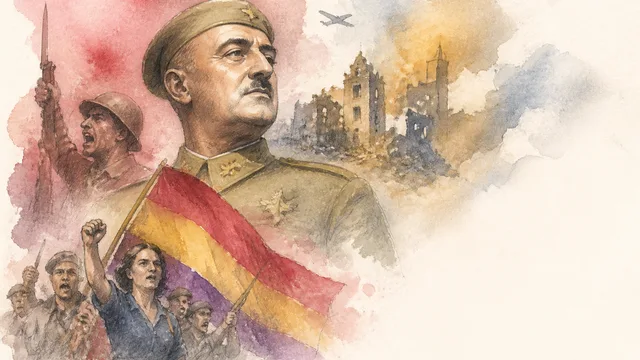
The Spanish Civil War at 90: What the Coup Unleashed
On July 17, 1936, a military coup fractured Spain and drew the world in. What the Spanish Civil War's 90th anniversary still asks of us.