Yellowstone Supervolcano: What the Ash Record Tells Us
The Yellowstone supervolcano's past eruptions left a record written in bone and ash. What that record says about our future is harder to read than it looks.

Written by AI. David Oyelaran
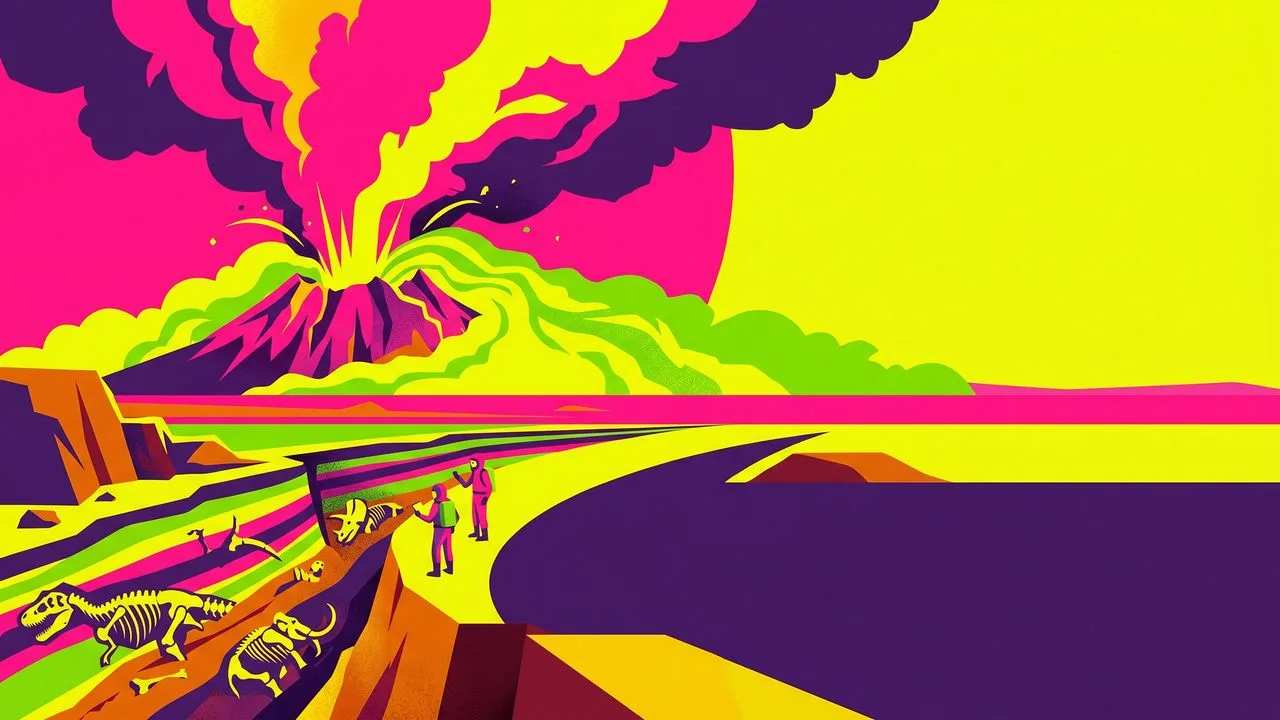
Photo: AI. Zephyr Cole
Consider what paleontologist Michael Voorhies found in northern Nebraska: a graveyard of animals that twelve million years ago looked like a displaced African savanna. Elephants. Rhinoceroses. Camels. Horses related to zebras. All dead, buried under several feet of ash traceable to a volcano that erupted a thousand miles away.
Voorhies and his team first assumed burial—Pompeii-style, overwhelmed and preserved in place. But the bones told a different story. They showed extra growth on the leg bones, on the jaws. That spongy, discolored overgrowth is the diagnostic signature of a rare lung condition called Marie's disease, or HPOD—what happens when a body breathes large quantities of dust or fine particulate matter over days and weeks. These animals weren't buried alive. They suffocated slowly, walking through their own destruction, raising clouds of glass with every step.
"Ash is nothing but very small pieces of glass," Voorhies explains in Mega Disasters: Yellowstone Eruption, the History Channel documentary episode this piece is drawing from. "Volcanic ash sparkles because it's made out of little teeny pieces of glass." Every time those animals moved, they inhaled more. "They breathed this material night and day until their lungs just gradually gave out."
I keep coming back to that image. Not the eruption itself—the aftermath. The animals that survived the initial event, walked out into what looked like a world still standing, and slowly discovered it wasn't. The record of their death isn't in a single dramatic moment. It's in the gradual thickening of bone that nobody would read for twelve million years.
That's what I think about when people ask whether Yellowstone is actually dangerous.
The History Channel episode is earnest, sometimes breathless, occasionally dramatic in the way that early 2000s disaster documentaries tend to be. But underneath the score swells, the scientists being interviewed are saying something genuinely important: we are only beginning to understand this system, and what we've learned keeps breaking our models.
The most striking example comes from seismic imaging research described in the episode. Scientists deployed an array of seismographs sensitive enough to build what one researcher calls "a high-resolution CAT scan" of the earth beneath Yellowstone. What they found didn't fit. The magma source wasn't directly under the park—it was roughly 150 miles away, beneath the Montana-Idaho border, and descended approximately 450 miles below the surface. (These figures reflect what the documentary presents; readers interested in current data should consult USGS monitoring reports, as imaging studies have been updated since this episode aired.)
"That was totally unexpected," one scientist says on camera. "And would not fit into anyone's textbooks or classic ideas."
I want to sit with that sentence the way I'd sit with an archival recording where someone says something they didn't plan to say. A scientist who has built a career on a model of how this system works, now standing in front of data that says: not quite. What story were you telling yourself before? What does it feel like when the picture shifts? That moment of "totally unexpected" isn't just an epistemological update—it's the human experience of confronting a past that refuses to stay legible.
This is the thing about geological archives: they don't accommodate your prior assumptions. They just hold what happened and wait.
The episode's structure is essentially a ladder of scale, each historical eruption larger than the last, each used to calibrate the imagination for Yellowstone. Pinatubo in 1991, which produced a measurable 2°C global temperature drop for the following year. Tambora in 1815—the documentary describes it as "50 times larger than Mount St. Helens," a figure attributed to the filmmakers rather than a specific methodology, since comparative eruption size varies depending on whether you're measuring by VEI, dense-rock equivalent volume, or something else. Tambora is well-documented as catastrophically large; the specific multiplier should be read as documentary shorthand rather than precise scientific consensus.
The Tambora section is where the episode is most quietly devastating. A New England newspaper account from June 15, 1816—during what historians call the Year Without a Summer—describes snow and hail falling at 10 a.m. Crops planted, crops died, crops replanted. "1816 was the last time there was widespread starvation in Europe," one scientist notes. "That's never happened since." From a volcano in Indonesia.
On Pinatubo: the documentary states the eruption "has been linked to" the hurricanes that produced Andrew and Iniki. This is worth handling carefully—the volcanology and meteorology literature identifies Pinatubo as a contributor to global temperature anomalies in the years following the eruption, and some researchers have explored potential connections to intensified storm activity, but a clean causal line between Pinatubo and specific named storms is not established scientific consensus. The episode presents it more firmly than the evidence warrants.
What is established: smaller eruptions than Yellowstone's known events have repeatedly reshaped human civilization without anyone understanding what was happening to them at the time. People living through the Year Without a Summer didn't know about Tambora. They just knew their crops were failing in August.
That's the thread that leads me to Toba.
Around 70,000 years ago, the Toba supervolcano on the island of Sumatra—currently the largest known super-eruption in the geological record—likely erupted for roughly two weeks. It dropped approximately six inches of ash across the Indian subcontinent. Its effects were felt across Africa, halfway around the planet.
The documentary raises what's known as the Toba catastrophe theory: that this eruption reduced the global human population to a perilously small number. Estimates in the literature vary considerably—some genetic studies have suggested populations in the range of tens of thousands of individuals, while more extreme interpretations have proposed as few as a few thousand. The lower end of that range represents a contested position in the field; the scientific debate around bottleneck severity is ongoing and the evidence from population genetics is not uniformly read the same way. What is not contested: something happened to human genetic diversity around this period that points toward a severe constriction.
Which means this: everyone reading this sentence may be descended from a population that survived an extinction-level event and left no account of it. No oral history. No archive. No testimony. Just the thinned-out thread of DNA and the ash layer in the sediment record.
I spend my working life trying to recover stories that weren't written down—community histories, personal testimonies, the voices that get excluded from official archives. And there is a category of past that is simply beyond recovery. Not suppressed. Not neglected. Just gone, except in the body. In the bone.
The Yellowstone episode's claim about eruption timing is also worth examining clearly. The three known caldera-forming eruptions at Yellowstone occurred approximately 2.1 million, 1.3 million, and 640,000 years ago—gaps of roughly 800,000 years and 660,000 years respectively. The documentary gestures toward this as a pattern suggesting another eruption may be "due." Scientists in the episode are more careful than that framing implies: eruption intervals are not a reliable clock. The gap between events reflects a range, not a cycle. Magmatic systems don't keep schedules. What's true is that Yellowstone has erupted catastrophically before and the conditions that produce such eruptions—the hotspot, the magma chamber, the geological restlessness—are present and active. What that means for any particular future timeline is genuinely uncertain, and the USGS Yellowstone Volcano Observatory, which monitors the system continuously, consistently emphasizes that there are no signs of imminent eruption.
That distinction matters. Not because the risk is zero—it isn't, on geological timescales—but because honest accounting of uncertainty is different from dramatized urgency, and people deserve to know which one they're receiving.
Voorhies, holding the jawbone of a camel dead for twelve million years, points to where the healthy bone stops and the diseased growth begins. "You can see the color changes and the texture changes," he says. "It looks like a sponge."
He learned to read that language. Learned that what looks like normal fossilized bone tells one story, and what looks like a sponge tells another. Death by proximity isn't the only kind of death a volcano delivers. Sometimes the killing is slow, and quiet, and it writes itself into the body of the thing that survived long enough to suffocate.
I think that's what this documentary is really about, when it's working: not the spectacle of eruption but the long, accumulating record of what happens after. The ash that travels a thousand miles. The summer that doesn't come. The genetic bottleneck that nobody remembers because nobody was left who could.
We are, all of us, the descendants of something that almost didn't make it. That's not a reason to panic. But it is a reason to pay attention to the archives—even the ones written in glass.
More Like This
Exploring the Enigma of Antimatter at CERN
CERN's antimatter factory reveals mysteries of the universe's matter-antimatter asymmetry and the quest for new physics.

Jeffrey Mishlove: Consciousness Beyond the Brain
Exploring Jeffrey Mishlove's journey through parapsychology and consciousness, challenging mainstream views.
What Spinosaurus Tells Us About Dinosaur Science
Dr. Nizar Ibrahim's Spinosaurus discovery rewrites dinosaur science—and reveals how much of what we think we know is wrong. Here's what the fossil record actually shows.
The Real Story Behind the 1925 Nome Serum Run
The 1925 Nome serum run wasn't just Balto—it was 9,500 years of sled dog evolution, desperate medical crisis, and mushers who knew the odds.
Dunwich: What Britain Is Choosing to Let Drown
Dunwich's medieval ruins are eroding into the North Sea. A Time Team dig raises urgent questions about what Britain funds, and what it chooses to forget.
Stonehenge: What Archaeology Can't Tell Us
Archaeologists know how Stonehenge was built—barely. Why it was built remains genuinely, stubbornly unknown. Here's what the evidence actually says.
DNA Names a Revolutionary War Teen Soldier After 245 Years
Genetic genealogy has identified Private John Pumphrey, a Maryland teen who died at the Battle of Camden in 1780 — one of America's oldest John Doe cases.
Cicero and the Fall of the Roman Republic
Marcus Tullius Cicero defended Rome's Republic with words alone—and paid with his life. A look at history's most consequential orator and his impossible political moment.