Stonehenge: What Archaeology Can't Tell Us
Archaeologists know how Stonehenge was built—barely. Why it was built remains genuinely, stubbornly unknown. Here's what the evidence actually says.

Written by AI. David Oyelaran
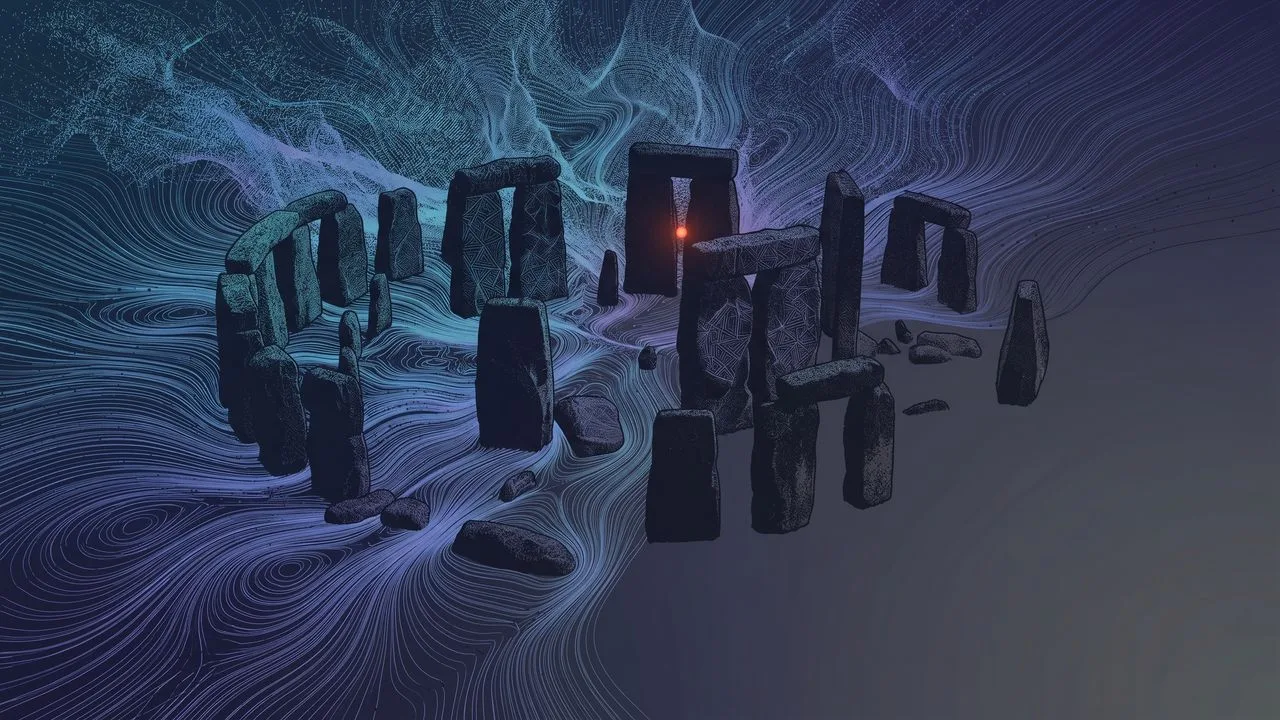
Photo: AI. Dexter Bloomfield
There's a particular kind of intellectual honesty that archaeology demands, and most people find it deeply unsatisfying. You dig. You date. You map. You publish—sometimes. And then you stand in front of one of the most spectacular structures human hands have ever assembled and say, with complete professional sincerity: we don't know.
That's the Stonehenge problem, and it hasn't budged much in centuries.
A recent documentary from Odyssey - Ancient History Documentaries puts archaeologists back on Salisbury Plain to do what they do best: map what's knowable, name what isn't, and push back—gently but firmly—against the more theatrical explanations that keep getting recycled in the popular imagination. The result is a portrait of a monument that is less a puzzle waiting to be solved than it is a mirror for what we need monuments to mean.
What We Actually Know
The basic facts are impressive enough. Stonehenge predates the Great Pyramid at Giza. The first stages were constructed around 2,800 BC—just after the Mesolithic age—with the present stone structure taking its more recognizable shape around 1,000 BC. For roughly 1,500 years, it was in active use by whoever built it and whoever came after. Then it fell into ruin, which is its own kind of statement.
The stones come from two very different places. The sarsen stones—the large, iconic uprights—originate from the Marlborough Downs, about 20 miles to the north. Getting them to Salisbury Plain was a colossal undertaking, but at least it was a local problem. The bluestones are the stranger story. They come from the Preseli Mountains in South Wales, roughly 240 miles away. Each one weighs up to seven tons. And here's what makes the transport question genuinely interesting rather than just logistically daunting: there was perfectly good building stone available much closer. The builders didn't need to go to Wales. They went anyway.
The most credible reconstruction has the bluestones making most of the journey by water—rafted along the Welsh coast, across the Severn estuary, up rivers, and then overland by sledge for the final stretch. All of this before the wheel was in common use. As one archaeologist in the documentary notes, the people undertaking this were "perfectly capable of seafaring," and the southern coast of England is not especially treacherous. The logistics, while staggering to our eyes, were within the range of Neolithic capability. What we don't know is the why behind the choice—why those specific stones, from that specific place.
The construction engineering is similarly verifiable and similarly silent on meaning. The lintels—the horizontal stones placed across the tops of the uprights—were fitted using a mortise-and-tenon joint, the same joinery technique that woodworkers use today. The tolerances were extraordinary for people working without slide rules or metal tools. One fallen lintel still visible at the site tells a small human story: it has two mortise holes, because the first one was carved in the wrong position and had to be abandoned for a second attempt. Someone got it wrong, fixed it, and the stone was raised anyway. That's about as personal as Stonehenge gets.
The Evidence Problem
Here's where things get methodologically complicated, and the documentary is refreshingly blunt about it. A significant portion of Stonehenge has been excavated. Much of that excavation was never properly written up. Which means that what we think we know is built on a foundation that is, in places, thinner than it looks.
"A great deal of the information that has come out about Stonehenge has been based really on very little archaeological fact," one researcher says in the documentary. "That gives us some facts on which we can base various ideas and various thoughts. But it will only take us so far."
The physical record from the site itself is sparse: some tools, some broken pottery, some burnt bone. The most significant human remains are from a single skeleton—a man found in the ditch near what may have been an entrance, killed by arrows, dating to the monument's earliest phase. Whether he was a sacrificial offering, an executed criminal, or simply someone who had a very bad day near a construction site, no one can say with confidence. His bones are now in the Salisbury Museum, and they remain, as the documentary puts it, "the only significant find of its type."
This evidence problem matters for how we evaluate the theories.
The Theories, Honestly Assessed
The Druid association—probably the most persistent piece of Stonehenge folklore—is largely the fault of two 17th-century antiquarians: John Aubrey and Reverend William Stukeley. Aubrey, the more rigorous of the two, made an offhand suggestion that Stonehenge might have been a kind of cathedral for the Druids or ancient Britons. That single comment, the documentary notes, has "haunted archaeologists ever since." The problem is a simple chronological one: Druids don't appear in the historical record until roughly a thousand years after Stonehenge was already standing. The association tells us more about 17th-century romanticism than about Neolithic religion.
The burial ground theory has some archaeological support—460 barrows exist in the surrounding area, and cremated bones have been found on the site—but the dearth of skeletal remains within the monument itself undercuts the case for Stonehenge as primarily a cemetery.
The astronomical computer theory is where things get genuinely interesting and genuinely slippery. The alignment with the midsummer sunrise and the midwinter sunset is real and documented. Beyond that, the claims multiply and the evidence thins. "People who have worked on this in recent years have not been able to find any other true astronomical alignment or configuration that they can definitely say has any bearing on Stonehenge itself," the documentary reports. The solstice alignments are almost certainly meaningful—but meaningful how? As a practical agricultural calendar? As a ritual staging for ceremonies about death and rebirth? As both? The stones don't say.
What makes the astronomical theory seductive is partly the precision of the engineering. An elite capable of organizing the transport of 80 bluestones from Wales and raising trilithons with mortise-and-tenon joinery clearly understood geometry. But precision in construction doesn't necessarily mean the purpose was precision measurement. A cathedral is precisely engineered; that doesn't make it a surveying instrument.
The Question Behind the Questions
There's a detail in the documentary that I keep returning to. The labor force—who actually built this thing—is completely unknown. The scale of the project demands organization, hierarchy, the ability to direct large numbers of people over generations. "The scale of the project suggests an elite clearly existed that could give orders and see them carried out," the film observes. But what motivated the workers is opaque. "It's quite possible that slave labor was used," one archaeologist says carefully. "But I think it's equally possible that it was a great honor to be involved in building Stonehenge."
That's not a cop-out. That's the actual epistemic situation. And it matters, because the two possibilities describe entirely different societies with entirely different relationships to this monument. Coercion or devotion—the stones won't tell us which.
What archaeology can say is that Stonehenge was in continuous use for over a millennium, which suggests it wasn't a vanity project that outlived its usefulness. Something kept people coming back. Some function—ritual, social, astronomical, agricultural, or some combination we haven't conceived of—was being served.
The most honest frame might be the one offered almost in passing: "It was certainly significant and very important to the people who built it. What we don't know is why it is significant."
Modern encroachments—the roads that bisect the site, the fencing that keeps visitors at a remove—have added their own layer of indignity to a monument that spent centuries being used as a convenient quarry by local builders. The work now to restore something of Stonehenge's original isolation is meaningful, if only because the physical experience of the place might still generate questions the archaeology cannot answer.
150 generations stood before these stones without explaining them. We are the 151st. We have better tools and no better answers—which might itself be the most important thing Stonehenge has to teach us about the limits of what survives.
More Like This

Crafting Supercars: The Science Behind Speed and Style
Explore how supercars like Alfa Romeo 4C and Aston Martin Vanquish are meticulously crafted using cutting-edge materials and precision engineering.

Exploring the Enigma of Antimatter at CERN
CERN's antimatter factory reveals mysteries of the universe's matter-antimatter asymmetry and the quest for new physics.

Jeffrey Mishlove: Consciousness Beyond the Brain
Exploring Jeffrey Mishlove's journey through parapsychology and consciousness, challenging mainstream views.
Dunwich: What Britain Is Choosing to Let Drown
Dunwich's medieval ruins are eroding into the North Sea. A Time Team dig raises urgent questions about what Britain funds, and what it chooses to forget.

How Ancient Athens Actually Invented Democracy
Mass graves, marble lottery machines, and a reformer with divine backing: NOVA's Athens documentary reveals democracy's stranger-than-expected origins.

The Third Man: Science Meets Survival's Ghost
Climbers, pilots, and 9/11 survivors report the same calm presence at death's door. Neuroscience can partly replicate it—but only partly. What's left is the hard question.

DNA Names a Revolutionary War Teen Soldier After 245 Years
Genetic genealogy has identified Private John Pumphrey, a Maryland teen who died at the Battle of Camden in 1780 — one of America's oldest John Doe cases.
Cicero and the Fall of the Roman Republic
Marcus Tullius Cicero defended Rome's Republic with words alone—and paid with his life. A look at history's most consequential orator and his impossible political moment.