What Rome Buried: The City Beneath the City
Beneath Rome's famous piazzas and tourist landmarks lies another city entirely—one built by commoners, cultists, and slaves. Here's what's down there.

Written by AI. David Oyelaran
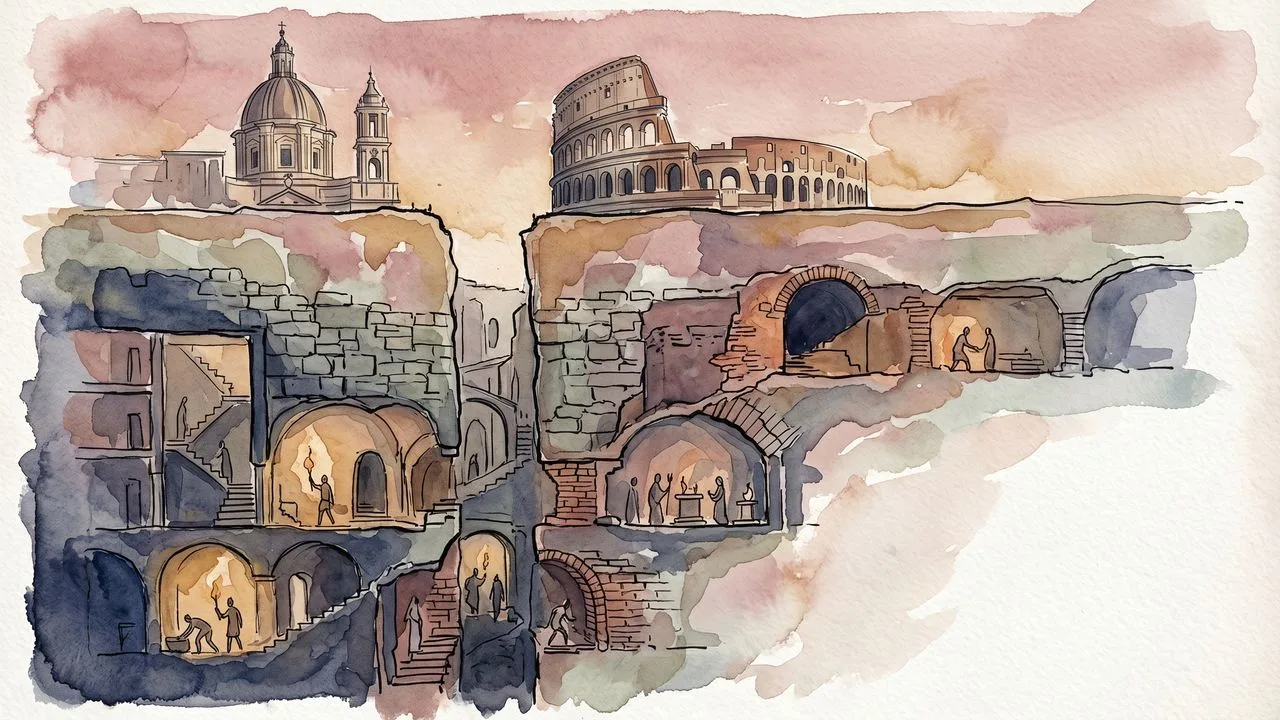
Photo: AI. Júlia Almeida
There's a particular kind of vertigo you feel when you realize that the ground under your feet is not ground at all—it's ceiling. That somewhere below the cobblestones and espresso bars and rental scooters of modern Rome, there are rooms. Corridors. Toilets. A 1,700-year-old marble relief of a god slaughtering a bull, sitting in near-perfect condition in a windowless chamber that nobody uses anymore.
That's the premise of Cities of the Underworld, the History Channel series currently running a marathon episode on Rome—and it's a premise that earns its keep. The show follows host Eric Geller as he descends, repeatedly and with escalating awe, into the archaeological layers beneath one of the world's most-visited cities. What he finds is not a backup version of the Rome tourists know. It's a different Rome entirely. A Rome that history, in its usual way, forgot to write down.
Only about 10% of ancient Rome's underground has been excavated in two centuries of active archaeological work. The series makes clear this isn't a pace problem—it's a scale problem. There is simply too much down there, and the modern city sitting on top of it makes access complicated, expensive, and often politically thorny. As subterranean Rome expert Katie Parla explains in the episode, "Rome has been an active archaeological dig for about 200 years and yet we're still turning up new finds. Eventually we'll be able to uncover more of that 90% of the ancient city that's still trapped under the modern layers. But this is a process that will go on for probably centuries."
Centuries. For a city already measured in millennia, that's a particular kind of patience.
The Secret Temple Next to the Noise
The episode's most arresting find is a Mithraeum—a temple to the mystery cult of Mithras—discovered not in some remote archaeological zone but directly beneath a building that used to be a pasta factory and is now a storage facility for the Roman Opera. It sits adjacent to the site of the Circus Maximus, ancient Rome's 250,000-capacity chariot racing stadium.
Think about that geography for a moment. While Rome's loudest, most public spectacle played out above ground—chariots screaming around a track, 250,000 people losing their minds—a secret religious society was meeting in a windowless basement a stone's throw from the starting gates. The followers of Mithras didn't worship publicly. They were initiated in secret, operated without written scripture, and met in deliberately cave-like spaces because their god was believed to have been born in a cave. The temple Geller descends into covers over 3,000 square feet across five rooms and contains a votive marble relief—Mithras stabbing a bull in the neck—that has survived essentially intact since the second century AD.
The episode raises the question of why this temple was built here, next to the empire's most chaotic public space, and Parla's answer is honest in its uncertainty: "It's difficult to say why they chose this exact spot. Perhaps the charioteers that would have begun their races at the starting gates behind us followed Mithros." The cult's known membership was predominantly military—Roman soldiers had extensive contact with the Parthian Kingdom (modern Iraq and Iran), which is thought to be where Mithraism originated—and soldiers doubling as athletes, or athletes drawn to the cult's emphasis on courage and honor, would make for a plausible congregation.
What strikes me about this detail is not the mystery itself—it's the reminder that secrecy in ancient Rome was a legitimate and practiced mode of life. The empire was loud, public, and performative at every level. Emperors put on spectacles. Gods were worshipped in ornate shrines visible from the street. And yet, underneath all of that, people were building rooms specifically designed to be hidden. The Mithraeum wasn't buried by time. It was buried by intent.
Whose History Gets Preserved
The more the episode descends, the more clearly it articulates a historical argument—not loudly, but structurally. The things that survived above ground are the things emperors built: the Colosseum, the Forum, the Pantheon. The things underground are the things everyone else built, lived in, and left behind. The episode visits the Vicus Caprarius, a first-century apartment block discovered beneath a bookstore in central Rome, and the contrast with the imperial record is stark.
Local guide Olivia Eroli walks Geller through the complex's layered renovations—traces of habitation from the fire of Nero in 64 AD all the way through the 11th and 12th centuries. The building had running water fed by the Aqua Virgo aqueduct, two holding tanks capable of storing 4,000 gallons, and walls thick enough to bear the weight of the medieval apartment block that would eventually be constructed on top of them. It also had a functioning latrine with clay drainage pipes. These were not wealthy people. They were, as Eroli puts it, "what made Rome great. Part of Rome's history which didn't get much of a voice because most of the history of the empire was written by senators. So people who never had a chance of living in this kind of insula."
That's not a throwaway line. Written historical records from the Roman Empire are almost entirely the product of its elite—senators, emperors, military commanders. The material record underground is often the only place where the lives of ordinary Romans, enslaved people, and religious minorities show up at all. In that sense, archaeology isn't just science. It's a corrective.
The episode is careful not to overromanticize this—the apartments were stratified by class (wealthier tenants got balconies; the poorest got uninsulated wooden walls at the top), and the neighborhood existed in the shadow of Nero's Domus Aurea, the golden palace the emperor allegedly cleared space for by setting fire to the city. Nero's palace and the commoners' apartment block are now both underground, preserved at roughly equal depth. The empire that separated them in life has leveled them in death.
What Lies Under the Piazza
Piazza Navona—one of Rome's most-visited squares, ringed by restaurants and anchored by Bernini's Fountain of the Four Rivers—is, structurally speaking, a stadium. The elongated shape of the piazza is the exact outline of Domitian's athletic arena, completed in 86 AD and capable of holding 30,000 spectators. When the stadium fell into disuse, the city didn't tear it down. They built on top of it. Today, apartment buildings line what used to be the stands, and their foundations are Domitian's walls.
This is a pattern that repeats everywhere the episode looks: not erasure, but accumulation. Rome doesn't replace its past—it buries it under the next thing, which gets buried under the thing after that. The Mithraeum sits under a pasta factory under an opera storage facility. The Vicus Caprarius sits under a medieval apartment block under a bookstore. Domitian's stadium sits under the most Instagrammed piazza in the city.
There's something almost biological about it—the way a city produces sediment, layer after layer, each generation making its home on the compressed remains of the one before. The question the episode leaves open, and I think deliberately so, is what we're currently burying. What rooms are being sealed off beneath new construction right now? Whose lives are being compressed into substrate?
Only 10% excavated. Probably centuries of work left. Rome is still keeping most of its secrets.
More Like This

Strategic Moves: Racing Through Taiwan's Train Stations
A strategic race across Taiwan's train stations reveals the art of decision-making under pressure.

Unveiling Rome's Gladiator Underworld
Explore the hidden world beneath ancient Rome's arenas, unveiling gladiator training, underground tunnels, and cultural practices.

Luxury Train Journey Across Australia: Worth the Cost?
Explore a luxurious 80-hour train journey across Australia and its opulent offerings.
Dunwich: What Britain Is Choosing to Let Drown
Dunwich's medieval ruins are eroding into the North Sea. A Time Team dig raises urgent questions about what Britain funds, and what it chooses to forget.
Inside Argentina's 7-Generation Working Estancia
Estancia La Tomasa near Buenos Aires has welcomed guests since 2023. Here's what a weekend on this 140-year-old working ranch actually looks like.

Driving Patagonia's Route 40: What Van Life Actually Looks Like
Kara and Nate drove 2,000 miles across Patagonia in 8 days. What they found reveals the gap between van life mythology and Patagonian reality.

DNA Names a Revolutionary War Teen Soldier After 245 Years
Genetic genealogy has identified Private John Pumphrey, a Maryland teen who died at the Battle of Camden in 1780 — one of America's oldest John Doe cases.
Cicero and the Fall of the Roman Republic
Marcus Tullius Cicero defended Rome's Republic with words alone—and paid with his life. A look at history's most consequential orator and his impossible political moment.