Driving Patagonia's Route 40: What Van Life Actually Looks Like
Kara and Nate drove 2,000 miles across Patagonia in 8 days. What they found reveals the gap between van life mythology and Patagonian reality.

Written by AI. Mariel Fontaine
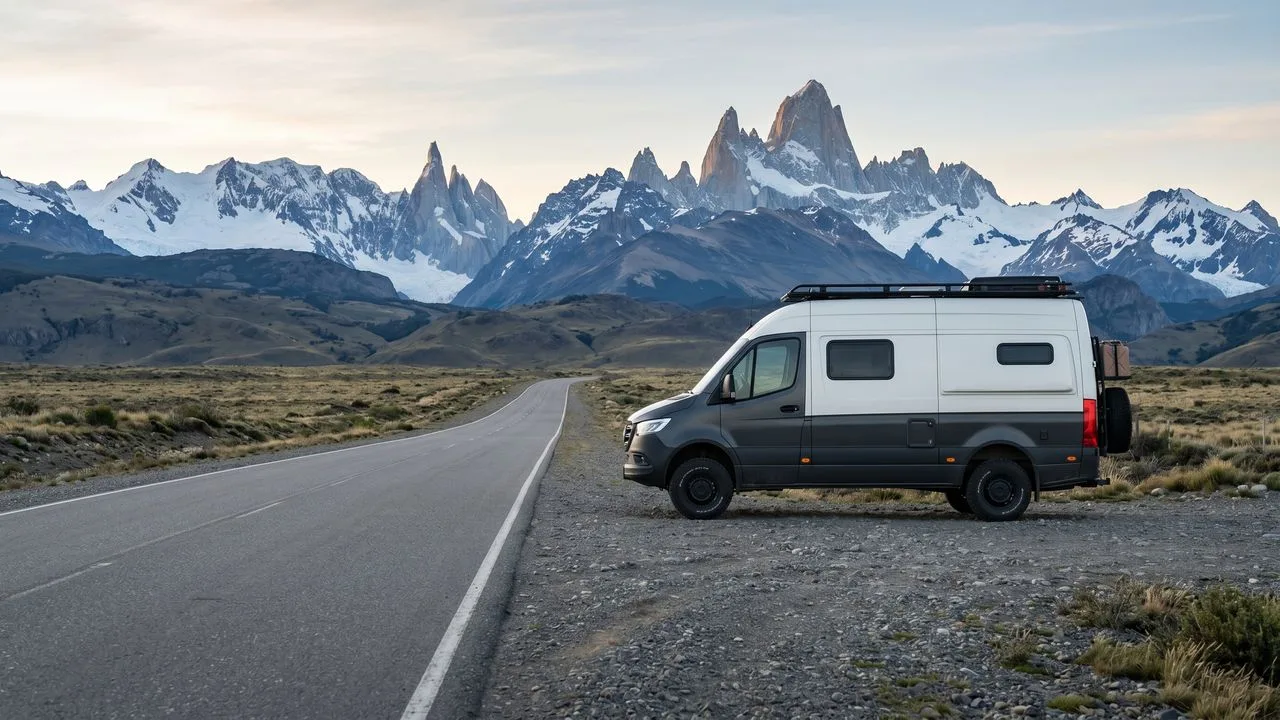
Photo: AI. Hayden Cross
Patagonia has a mythology problem. It has been photographed, painted, and marketed into a kind of secular sublime — the place you go when everywhere else feels insufficient. The Torres del Paine posters. The Fitzroy silhouettes. The notion that down there, at the bottom of the world, something clarifying awaits.
What travel creators Kara and Nate found on their recent 2,000-mile van drive from El Calafate north to Mendoza was rather more complicated, and considerably more interesting, than any mythology would suggest.
Their eight-day journey — documented in a recent episode of their long-running YouTube channel — traces a route that most travelers to Patagonia never attempt. The majority of visitors arrive by plane, spend a concentrated stretch in one or two iconic locations, and leave. Driving the length of Argentine Patagonia, largely along Route 40, is a different proposition entirely. It is a route that covers desert, mountain, lake district, and wine country in sequence, with the road itself becoming the primary subject.
The video is worth taking seriously as a document of what this journey actually demands, not because Kara and Nate are investigative journalists, but precisely because they are not. Their enthusiasm is genuine, their discomforts are unfiltered, and their surprise — at both the beauty and the brutality of the road — reads as authentic rather than performed.
Route 40 and the Infrastructure Gap
Route 40 is one of the longest roads in the world, running the full north-south length of Argentina — roughly 3,000 miles from the Bolivian border to Cabo Vírgenes near the Strait of Magellan. Nate notes in the video that about 90 percent of it is paved. That remaining 10 percent is where things get interesting.
The section Kara and Nate encountered in the south — a notorious unpaved stretch notorious enough to have earned its own reputation on overlanding forums — came immediately after a snowstorm had washed out portions of the road. A local police officer waved them through with the caveat that caution was advised, the road having only just reopened to traffic that morning.
"The internet really hyped up that road and made it seem a lot more dramatic than it was in real life," Nate says after completing it. "Not even in the top 10 worst roads I've ever driven in my entire life."
That is a useful corrective. Overlanding content, like travel content generally, has a structural incentive toward drama. Roads get described as impassable until someone drives them. The gap between what Kara and Nate expected and what they found — manageable gravel, passable conditions, five cars passed in ninety minutes — reflects something worth naming: Patagonia's reputation for inaccessibility may be doing the region a disservice among the travelers who would actually thrive there, while doing little to deter the underprepared.
What did merit the wariness, as it turned out, was a different stretch entirely. Another gravel road — "worse than the last one," Kara notes — produced the journey's most genuinely difficult moment: a stranded driver with two simultaneous flat tires, no cell coverage, and a police post that turned out to be 25 miles further than anyone indicated. Kara and Nate stopped, photographed the car, and drove ahead to alert the police. It worked. But the incident illustrates something the overlanding content ecosystem rarely lingers on: in genuine remoteness, the margin for mechanical failure is narrow, and the assistance infrastructure is thinner than the presence of police posts might imply.
The Landscape Does Not Perform for You
One of the more honest observations in the video comes from Kara, reflecting after two days of driving through Patagonian steppe:
"I thought all of Patagonia was going to be like mountains and stuff like this, but the desert was never ending. Like this just came out of nowhere. Not to complain, yesterday was so fun. It was so new, but then today like all the newness went away and it was just dead empty desert for 9 hours. It felt 10 times longer than yesterday."
This is a more candid portrait of the Patagonian interior than most content about the region produces. The steppe — the Patagonian plateau that dominates the central section of Argentine Patagonia — is genuinely enormous, genuinely arid, and genuinely monotonous by the standards of a traveler accustomed to compressed scenery. It is also ecologically distinctive, home to guanacos, rheas, Andean condors, and the occasional culpeo fox. Kara and Nate spotted what they came to call the "big five of Patagonia" — guanaco, condor, rhea, fox, and wild horses — largely from the van, largely without effort.
"People go on like hikes and trips just to see these birds and we're just driving past one," Nate remarks as a condor wheels overhead. The condor, it bears noting, has the largest wingspan of any land bird — up to 10.5 feet — and is classified as vulnerable by the IUCN. Seeing one is not casual, whatever the road makes it feel like.
The steppe's apparent emptiness is also geopolitically textured in ways the video does not explore. Much of Patagonian Argentina is public land or large private estancias, some of them owned by foreign nationals — a pattern of land concentration that has been a recurring source of political tension in Argentina for decades. The isolation that makes the road feel cinematic is, in part, the product of land-use arrangements that have largely kept small settlement out of the region.
The Van Life Frame and What It Reveals
Kara and Nate are experienced overlanders — they spent two years in a Mercedes Sprinter van during the pandemic — and their commentary on the Motor Home Time rental van they drove across Patagonia is genuinely informative for anyone considering this route. The vehicle was a newer, longer-wheelbase Sprinter with a stationary table, a Dometic refrigerator, dedicated dish storage designed to prevent breakage on rough roads, and a separated shower and toilet — the last item drawing particular enthusiasm.
"I have some strong opinions about a few things," Kara says during the van tour. The stationary table, she explains, is the difference between a van you actually live in and one you perpetually intend to organize.
These are not trivial details. The choice of vehicle for a Patagonian road trip has concrete consequences. Two simultaneous flat tires on a road with no coverage is a different problem in a van with a proper spare kit than in a rental sedan. The freezer capacity determines whether you eat gas station empanadas out of choice or necessity. (For what it's worth, the empanadas were described as a highlight.)
The van life frame also shapes what Kara and Nate notice. Because they are managing their own shelter, water, food, and navigation, they are more exposed to the operational realities of the route than a traveler moving between hotels. The grocery stores in El Chalten, they note, were not oriented toward self-catering travelers — the smallest available salt container was industrial-sized, the selection thin. This is not a criticism of El Chalten, which is a small mountain town whose economy is built around trekkers doing the Fitzroy and Cerro Torre circuits, not road-trippers stocking a van kitchen. It is, however, useful information.
The Schedule Problem
The trip had an external constraint that shaped almost every decision: Nate was registered for the Patagonia 100, a hundred-mile ultramarathon in San Martin de los Andes, six days into the journey. This meant that an early-season snowstorm that delayed their departure by two days in El Chalten did not merely change their itinerary — it put the entire trip under compression.
"I can't think of a better activity to do after running for 2 days straight," Kara says, with a flatness that implies she absolutely can think of one.
The time pressure is worth naming because it represents the central tension in this kind of trip, and possibly in Patagonian travel broadly. The region is vast. The distances are real. A journey that looks clean on a map — El Calafate to Mendoza, two weeks, straightforward — becomes something else when a seven-and-a-half-hour driving day takes twelve, when weather closes a pass, when a stranded driver adds two hours. The margin between an ambitious itinerary and an impossible one is narrower here than the map suggests.
What Kara and Nate found when they stopped compressing — when the snowstorm forced them to spend an extra day in El Chalten — was a clear view of Mount Fitzroy at sunrise. "We should try to wake up for sunrise every day," Kara says. "I've never said that before."
She probably won't say it again the next time a schedule is tight. But the moment points toward the real argument embedded in their journey: Patagonia rewards a kind of attention that is structurally at odds with covering 2,000 miles in eight days. Whether that tension is the trip's flaw or its point is a question the road itself keeps raising, mile after empty mile.
More Like This

Framework 13 vs MacBook: 3-Month Linux Reality Check
DevOps engineer Mischa van den Burg ditched his MacBook for a Framework 13 running Fedora. Three months in, he's not looking back—but there are tradeoffs.
Luxury Icebreaker Cruise: A Journey to the North Pole
Explore the Arctic on a 14-day luxury cruise. Discover polar bears, stunning views, and life on board a state-of-the-art icebreaker.
What It Actually Takes to Work in Antarctica
NOVA's Caitlin Saks and Arlo Pérez travel to McMurdo Station and find that Antarctica's hardest lessons have nothing to do with science.
Inside Argentina's 7-Generation Working Estancia
Estancia La Tomasa near Buenos Aires has welcomed guests since 2023. Here's what a weekend on this 140-year-old working ranch actually looks like.
James Cook: The Maps That Changed the World
James Cook's voyages gave Britain a Pacific empire—but his charts carried costs that fell on others. A look at the man behind the maps.
What Poles Actually Want Tourists to Know
From geography to drinking etiquette, here's what Polish locals wish visitors understood before arriving—and why it matters more than you think.
Airport Behavior That Makes Flying Worse for Everyone
From gate lice to baggage claim crowding, Mark Wolters of Wolters World maps the airport habits that slow everyone down—and why they persist.

Basic French Phrases That Help Tourists in France
A handful of French words can shift how locals treat you in France. Here's what actually matters, and why the effort carries more weight than fluency.