Solar Flares, Earth's Magnetosphere, and StormWall
Recent X-class solar flares and CMEs have prompted serious discussion about Earth's space weather vulnerability—and a theoretical plasma shield called StormWall.

Written by AI. Nadia Marchetti
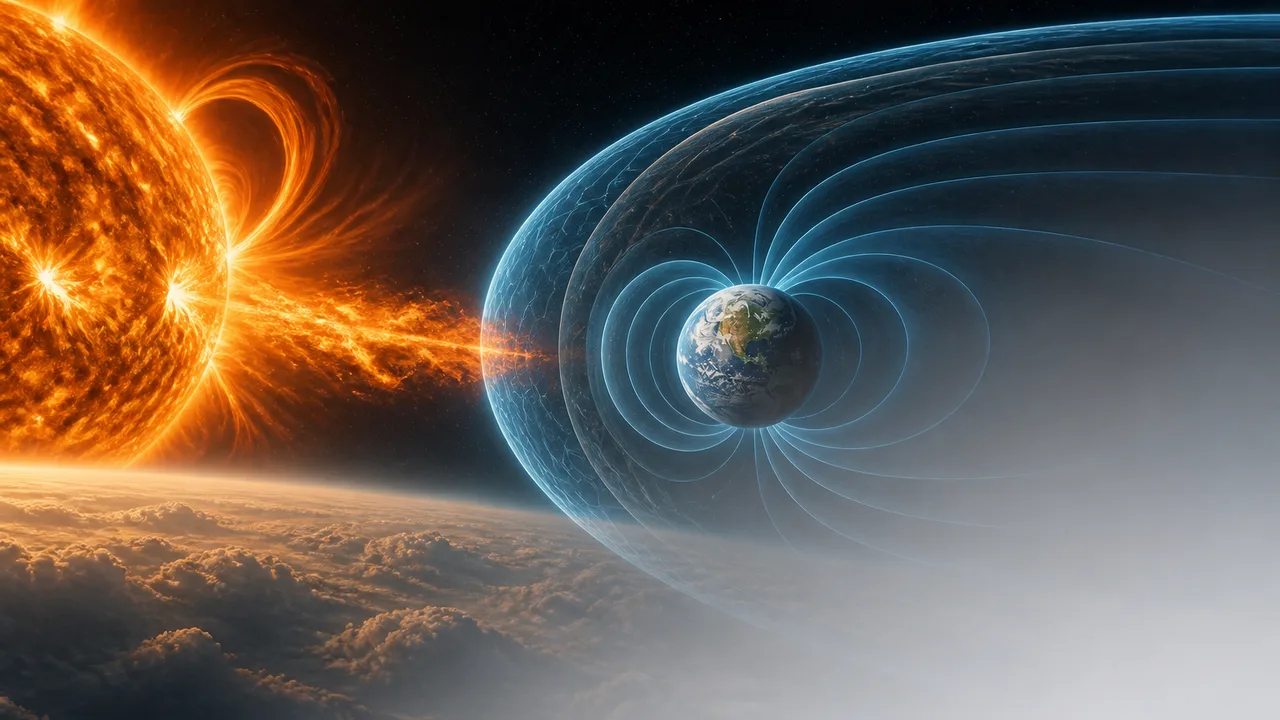
Photo: AI. Hayden Cross
The northern lights showing up over Alabama gets people's attention. What tends to get less attention is the infrastructure conversation that runs underneath the aurora photos.
When NASA recently observed a strong X-class solar flare and NOAA's Space Weather Prediction Center began tracking multiple coronal mass ejections moving toward Earth, most coverage landed predictably on the spectacle angle: where can you see the auroras? That's a reasonable story. It's just not the whole one.
A NASA Space News breakdown of the event makes a useful distinction that mainstream coverage often collapses: a solar flare and a coronal mass ejection are related but different problems. The flare is a radiation burst — it moves at light speed, gets here in minutes, and can disrupt radio signals. The CME is the slower-moving cloud of magnetized solar plasma that follows, sometimes hours or days later. It's the CME that geomagnetic storm watches are really about. And in this case, forecasters weren't watching a single CME. They were watching several, some of which could merge in transit.
That compounding effect matters. As the video puts it: "If a faster eruption catches up with a slower one, the final impact can become harder to predict." Harder to predict means less warning time, which means less runway for operators of satellites, power grids, and navigation systems to take protective action.
The Variable Nobody Can See Coming
Here's the counterintuitive thing about solar storm severity: size isn't destiny. A CME can be impressively large and hit Earth with a relatively modest effect. A smaller one can punch well above its weight. What determines the difference is largely the orientation of the magnetic field embedded in the solar material — and that's something forecasters can't reliably measure until the cloud is almost on top of us.
The mechanism is called magnetic reconnection. When the CME's magnetic field aligns in the opposite direction to Earth's own field at the point of contact, the two can link up and transfer energy far more efficiently into the magnetosphere. Think of it as finding the unlocked door rather than hitting a wall. The result is a more disturbed magnetosphere, auroras pushed further from the poles, increased radiation exposure for satellites, degraded GPS accuracy, and elevated risk of geomagnetically-induced currents in power grid infrastructure.
"Some of the most important details are only confirmed when the solar material gets much closer to Earth," the video notes. That's not a criticism of space weather science — it's an honest description of a physics constraint. Earth has an upstream monitor (NASA's ACE and DSCOVR satellites sit at the L1 Lagrange point, about 1.5 million kilometers sunward), but by the time those sensors register the CME's magnetic field orientation, the cloud is roughly 15 to 60 minutes out. For complex grid operations or sensitive satellite maneuvers, that is a genuinely tight margin.
The video is careful not to frame the recent activity as a worst-case scenario, which is the right call. But the point it's building toward is valid regardless of this particular storm's severity: modern civilization has built its critical systems on assumptions of solar stability that the sun doesn't always honor.
StormWall: Interesting Idea, Wide-Open Questions
This is where the conversation shifts from what's happening to what some researchers think could eventually happen — and it's worth being precise about where that line is.
A paper published in the journal Space Weather (DOI: 10.1029/2025SW004846) outlines a concept the video calls StormWall. The premise: rather than just forecasting storms and hoping infrastructure holds, deploy spacecraft near Earth's magnetosphere that would release material into space. Sunlight would ionize that material into plasma. That plasma wouldn't form a literal barrier — the name is somewhat misleading — but it could add mass near the magnetopause, the boundary where the solar wind meets Earth's magnetic field, making the energy transfer during magnetic reconnection less efficient.
The simulations suggest this could reduce the intensity of a major geomagnetic storm by more than half. That's a significant number, if it holds up outside of models.
"If less solar energy enters the magnetosphere, the storm could be weakened before it causes its full effect."
But the paper and the video both acknowledge this is the easy part of the conversation. The hard part is everything else. How much material would need to be released, and how often? What's the deployment lead time, and can forecasting get precise enough to hit that window? What are the effects on operational satellites in the region where the plasma is released? And then the question that sits above all the engineering ones: who decides?
A system that artificially modifies the near-Earth space environment would represent an intervention that affects every nation's infrastructure, whether they consented to it or not. Space weather doesn't respect borders, and neither would StormWall. The governance architecture for something like this doesn't exist yet. The international frameworks for geoengineering the atmosphere are already contested and incomplete; near-Earth space adds another layer of complexity, with more actors (commercial satellite operators, military space assets, sovereign space agencies) and less precedent.
The video frames StormWall as a sign of where the conversation is heading rather than an immediate solution, which strikes me as the honest framing. This isn't a proposal with a funding line and a launch date. It's a serious scientific concept that probes a real problem, and the fact that it has made it into a peer-reviewed journal is meaningful — but meaningful in the sense of "worth examining carefully," not "problem solved."
The Forecast Problem Isn't Going Away
There's an uncomfortable asymmetry in how we currently handle space weather risk. For any given storm, the most destructive scenarios require a specific combination of factors — a large CME, an unfavorable magnetic orientation, striking during a period of elevated technological dependence, at a moment when grid operators haven't had sufficient warning. That combination is genuinely rare. But rare doesn't mean never, and the planet's exposure has grown considerably since the last time a truly severe storm hit.
The 1989 Quebec geomagnetic storm knocked out the Hydro-Québec power grid in about 90 seconds, leaving six million people without electricity for up to nine hours. The 1859 Carrington Event, the largest recorded geomagnetic storm in modern history, did to telegraph infrastructure what a comparable storm would do to satellite constellations, internet cables, and power grids today — at a scale that's genuinely difficult to model.
The video raises the right uncomfortable question: "The real question is not just how well we can predict solar storms. It is whether prediction alone will be enough when the next truly severe storm arrives."
Space weather forecasting has improved considerably over the past two decades. There are more satellites watching the sun, better models, faster data pipelines. But the fundamental constraint — that the most critical variable (CME magnetic orientation) can't be reliably measured until the object is nearly here — hasn't changed. Prediction buys time, and time is valuable. Whether it's sufficient depends on which systems need how much lead time, and those numbers aren't uniform.
That's what makes StormWall interesting as a concept, even in its early theoretical state. It represents a different philosophy: instead of improving prediction, improve resilience upstream. Whether the engineering is feasible at the required scale, whether the governance is achievable at the required speed, and whether the intervention produces side effects worse than the storms it mitigates — those are genuinely open questions.
What isn't open is the underlying premise: Earth's technological civilization is meaningfully exposed to solar weather events it cannot fully predict, and that exposure grows as infrastructure density and interdependency increase. Whether the right response is better forecasting, hardened infrastructure, international coordination, or something like StormWall — probably some combination of all of it — is a decision that benefits from being made before the next Carrington-scale event, not after.
The sun isn't waiting for us to sort this out.
More Like This
Did Our Universe Bounce Into Existence Inside a Black Hole?
A new preprint proposes the Big Bang was actually a bounce inside a black hole. Here's what the model claims, what it can't yet prove, and why it won't leave me alone.
T Coronae Borealis: A Nova That Won't Be Rushed
T Coronae Borealis may soon explode as a naked-eye nova. Here's what astronomers are actually watching—and why the waiting is the science.
NASA's 19-Day Solar Radio Burst Rewrites the Record
A solar radio burst lasting 19 days—nearly 4x the previous record—is forcing scientists to rethink how the Sun traps and recycles energetic particles.
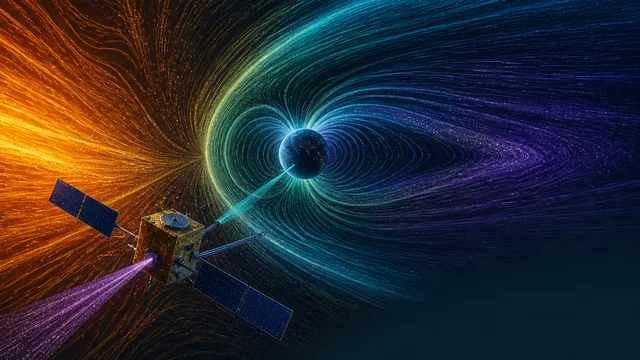
SMILE Spacecraft: X-Raying Earth's Magnetic Shield
ESA and China's SMILE spacecraft launched May 2026 to image Earth's magnetosphere in X-rays—here's why that perspective shift matters for space weather science.
Giant Spinning Wheels Are Preventing Grid Blackouts
How 40-ton flywheels are stabilizing renewable energy grids—and why tech from space laser programs is now running port cranes in Rotterdam.
Mapping the Universe: Discovery, Hierarchy, and Dark Energy
How cosmology's greatest breakthroughs were shaped by institutional power, anonymous labor, and the recurring human failure to act on what the evidence clearly shows.
Jared Isaacman on the Moon, Mars, and Life in Space
NASA Administrator Jared Isaacman lays out plans for a 2028 lunar base, nuclear propulsion to Mars, and what he actually thinks about life beyond Earth.
Euclid Space Telescope Maps the Dark Universe
The Euclid Space Telescope is rewriting cosmology—mapping dark matter, finding ghost galaxies, and forcing scientists to rethink what the universe is made of.