Mapping the Universe: Discovery, Hierarchy, and Dark Energy
How cosmology's greatest breakthroughs were shaped by institutional power, anonymous labor, and the recurring human failure to act on what the evidence clearly shows.

Written by AI. James Morrison
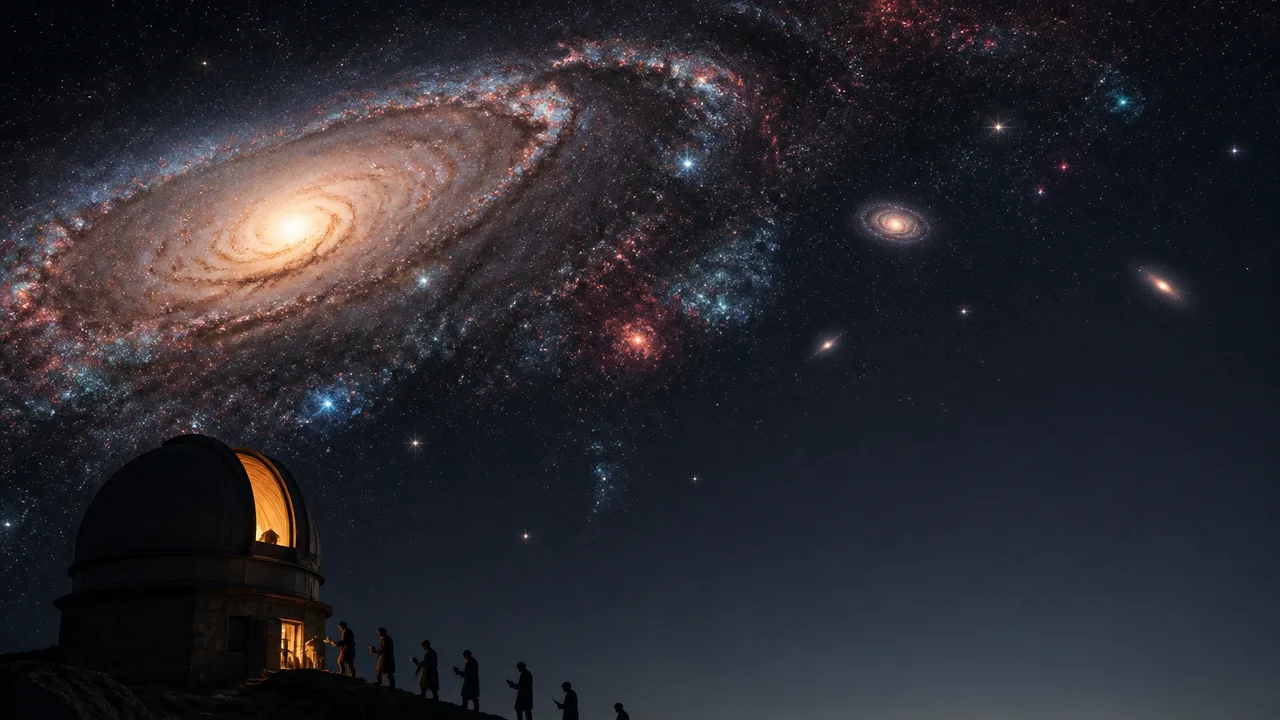
Photo: AI. Castor Belov
In April 1920, two of America's leading astronomers stood before the National Academy of Sciences in Washington and presented opposing intelligence assessments about the nature of the cosmos. Harlow Shapley argued that the Milky Way was the whole of the universe — that the mysterious spiral nebulae scattered across the sky were objects contained within our own galaxy. Heber Curtis argued the opposite: that those nebulae were independent island universes, galaxies in their own right, unimaginably distant. The event is remembered in astronomy as the Great Debate. What it looked like, structurally, was a formal briefing to command — two staff officers presenting contradictory assessments of the same operational terrain, each with charts, each with evidence, each convinced the other had misread the ground.
Neither was entirely right. And the debate was not resolved by either man winning the argument. It was resolved three years later when Edwin Hubble, working at the Mount Wilson Observatory with the Hooker telescope, identified a Cepheid variable star in what was then called the Andromeda Nebula. He ran the numbers using a method he had not himself devised, confirmed that Andromeda was millions of light-years beyond the Milky Way's furthest boundary, and rendered the Shapley-Curtis argument moot. Field intelligence had made the staff debate irrelevant. That is how these things tend to go.
Wonder's new documentary Does The Universe Have an Edge? covers this terrain with real narrative sweep, tracing humanity's expanding picture of the cosmos from the 16th century to the present crisis of dark energy. It is good science communication. What I find myself wanting to annotate, watching it, is everything the institutional lens reveals that the scientific lens alone does not.
The Diagram That Took Four Years
Start at the beginning of the modern story: 1572, when a supernova — now catalogued as SN 1572, also called Tycho's Star, a Type Ia event of exceptional luminosity — became visible in daylight skies over Europe. The settled cosmological model held that stars were fixed in a thin rotating shell surrounding Earth. A new light appearing in that shell, then fading, was either a theological event or an inexplicable one. Thomas Digges, a member of Parliament for the Oxfordshire constituency of Wallingford and an amateur astronomer of serious ability, began to study it.
What Digges eventually concluded was that the shell was an illusion. Stars were not arranged at uniform distance. They extended outward into infinite space. Four years after the supernova's appearance, in 1576, he published this conclusion — not as a standalone work, but as an appendix to a reprint of his father's almanac. The publication was titled A Perfit Description of the Caelestiall Orbes, and it contained a diagram that modified Copernicus's solar system model by scattering the outer stars into unbounded space rather than fixing them to a shell. It was, as the documentary notes, the moment Europeans began to think of the cosmos as "a world without end."
The irony that the foundational act of modern cosmology was published as a footnote to an almanac about weather forecasting is the kind of detail a historian learns to recognize. Important work finds its way out through whatever aperture the institution permits.
The Rank Structure of Science
Digges had the right ideas and the wrong tools. So did William Herschel, who in 1785 produced a remarkable map of the Milky Way using reflecting telescopes he and his sister Caroline built themselves in Bath — grinding the metal mirrors by hand, in a workshop whose floor still bears the scorch marks of spilled molten metal. Herschel could see the disc structure of our galaxy. He could not measure the distances to the nebulae floating beyond it, and without distance measurement, the question of whether those nebulae were nearby gas clouds or distant galaxies could not be resolved.
The instrument that eventually cracked the distance problem was not a telescope. It was an insight belonging to a woman named Henrietta Leavitt.
Leavitt worked at the Harvard College Observatory in the early 20th century as one of a cohort of women hired to analyze photographic plates — cataloguing stars, measuring brightnesses, recording data. The group was known, without particular embarrassment, as "computers." The title was accurate in the mechanical sense and designed to be limiting in every other sense. These women were classified as clerical workers. They were paid accordingly. They were not permitted to operate the observatory's telescopes.
What Leavitt discovered, working from those plates, was that a class of pulsating stars called Cepheid variables had a precise and measurable relationship between their pulse rate and their intrinsic luminosity. A Cepheid that blinks slowly is genuinely brighter than one that blinks quickly. This means that if you observe two Cepheids with the same pulse rate, any difference in their apparent brightness is entirely a function of distance. You can calculate exactly how far away each one is. Leavitt had constructed a cosmic ruler from photographic plates she was never authorized to point a telescope at.
The documentary describes her as "one of the great unsung heroes of science." That framing is kind but imprecise. Leavitt was not unsung because her work was obscure. She was structurally positioned, by institutional design, in a role defined as incapable of producing discovery. The Harvard Observatory's command structure had specifically classified her function as clerical — which is to say, it had drawn a line between the people authorized to think and the people authorized to measure, and placed her firmly on the wrong side of it. She made the discovery anyway, from inside that constraint, and then watched the instrument she had built be deployed by men with telescope access to answer questions she had no institutional standing to pursue.
Hubble used Leavitt's period-luminosity relationship to confirm Andromeda's distance and settle the Great Debate. He received the credit that history tends to award to the person who holds the observation at the decisive moment. Leavitt died in 1921, before the full implications of her work were understood. When a Swedish mathematician later attempted to nominate her for the Nobel Prize, he was informed she had already died — the Prize is not awarded posthumously.
What Einstein Refused to Believe
Hubble's observation did more than settle an astronomical debate. It confirmed what Einstein's own equations had been predicting and what Einstein had been actively suppressing.
The general theory of relativity, published in 1915, described gravity not as a force acting across space but as the curvature of space itself — mass bending the geometry of the medium it occupies, and objects following the simplest available path through that bent geometry. The mathematics underpinning this came from Carl Friedrich Gauss and Bernhard Riemann, who had spent decades developing non-Euclidean geometry — curved-space mathematics that had no obvious application when they formulated it and turned out to describe the physical structure of the universe. As the documentary observes: "mathematicians pottering around asking, 'Could there be a geometry different from Euclid's?' ... And then when the moment is ripe, Einstein comes along and says, 'That's what I need. That's real physics.'"
The equations of general relativity, applied to the universe as a whole, produced a disturbing prediction: the universe was not static. It was expanding. Einstein found this so implausible that he introduced an additional term into his equations — the cosmological constant — specifically to force a stable, unchanging universe. When Hubble's redshift data showed that all distant galaxies were receding, and that the farther away they were the faster they were moving, Einstein traveled to Mount Wilson to examine the evidence himself. He subsequently called the cosmological constant the greatest blunder of his scientific career.
The lesson here is not that Einstein was vain or stubborn, though he was both. The lesson is that the resistance to unwelcome findings is not a failure of intelligence. It is a feature of how institutions — including the informal institution of scientific consensus — process information that contradicts its foundational assumptions. Einstein's cosmological constant was a patch applied to preserve a preferred conclusion. We have seen that maneuver before, in different theaters.
The Evidence We Are Not Acting On
Hubble's expanding universe, traced backward, implied a beginning — a point of origin from which everything has been moving outward for approximately 13.8 billion years, per current Planck mission estimates. The cosmic microwave background radiation, the stretched remnant of the light emitted when the universe first became transparent, confirmed it. The Big Bang is as well-evidenced a conclusion as cosmology possesses.
What is less settled, and more consequential, is what has been happening to the expansion rate. In 1998, two independent teams of astronomers measuring distant supernovae expected to find that gravity was gradually slowing the universe's expansion. Instead, they found it was accelerating. Something is pushing the fabric of space apart at an increasing rate. We call it dark energy because we do not know what it is — only that it constitutes roughly 68 percent of the total energy content of the universe and that its effects, at civilizational timescales, are catastrophic.
If the acceleration continues, galaxies beyond our local cluster will eventually recede faster than light can cross the expanding gap between us. They will disappear from the observable universe entirely. Some 100 billion years from now, any civilization still resident in the Milky Way will look out into a dark and apparently empty cosmos, with no evidence that anything else has ever existed. The entire record of cosmological history — the evidence that allowed us to reconstruct the Big Bang, map the cosmic web, understand the scale of reality — will have vanished beyond an unreachable horizon.
We are alive at what may be the only moment in the universe's history when the evidence is still visible. The galaxies are still there. The cosmic microwave background is still detectable. The record is still open.
And we are spending a fraction of what it would cost to read it properly. Global civilian space science funding runs to roughly $8–10 billion annually across all spacefaring nations combined — less than what several countries spend monthly on fuel subsidies. The James Webb Space Telescope, the most powerful observational instrument in human history, had its budget cut, delayed, and nearly cancelled across a span of decades before finally launching in 2021, a quarter-century behind its original schedule.
The evidence is in. The window is finite. The institutional response is, so far, roughly commensurate with our collective ability to think past the next budget cycle.
Digges published his infinite universe in an almanac footnote because that was the only aperture available to him. We have larger apertures now. The question worth sitting with is whether we have the institutional will to use them before the record closes.
More Like This
JWST's Latest Discoveries Are Breaking Cosmology
JWST is finding galaxies too big, too bright, and too early. From dark stars to interstellar comets, here's what the data is actually telling us.
Einstein's Biggest Blunder Was Actually Right
Einstein invented the cosmological constant to keep the universe static—then ditched it. Decades later, it came roaring back. Here's what dark energy means for everything we think we know.
Did a Catholic Priest's Faith Corrupt the Big Bang?
Three cosmologists unpack whether Georges Lemaître's faith compromised his science—and why the real threat to cosmology is political, not theological.
Who Owns the Sky? The Human Cost of Giant Telescopes
From Mauna Kea protests to the Columbia Seven, the race to build the world's biggest telescopes carries human costs science documentaries rarely pause to name.
Audie Murphy: Soldier, Icon, and Haunted Man
Audie Murphy was America's most decorated WWII soldier. His battlefield heroism and Hollywood fame masked a man deeply scarred by combat and survivor's guilt.

The Crusades: Two Centuries of Holy War Explained
From Pope Urban II's 1095 call to arms to the fall of Acre in 1291, the Crusades reshaped Christianity, Islam, and the medieval world permanently.