Who Owns the Sky? The Human Cost of Giant Telescopes
From Mauna Kea protests to the Columbia Seven, the race to build the world's biggest telescopes carries human costs science documentaries rarely pause to name.

Written by AI. Sofia Ramirez
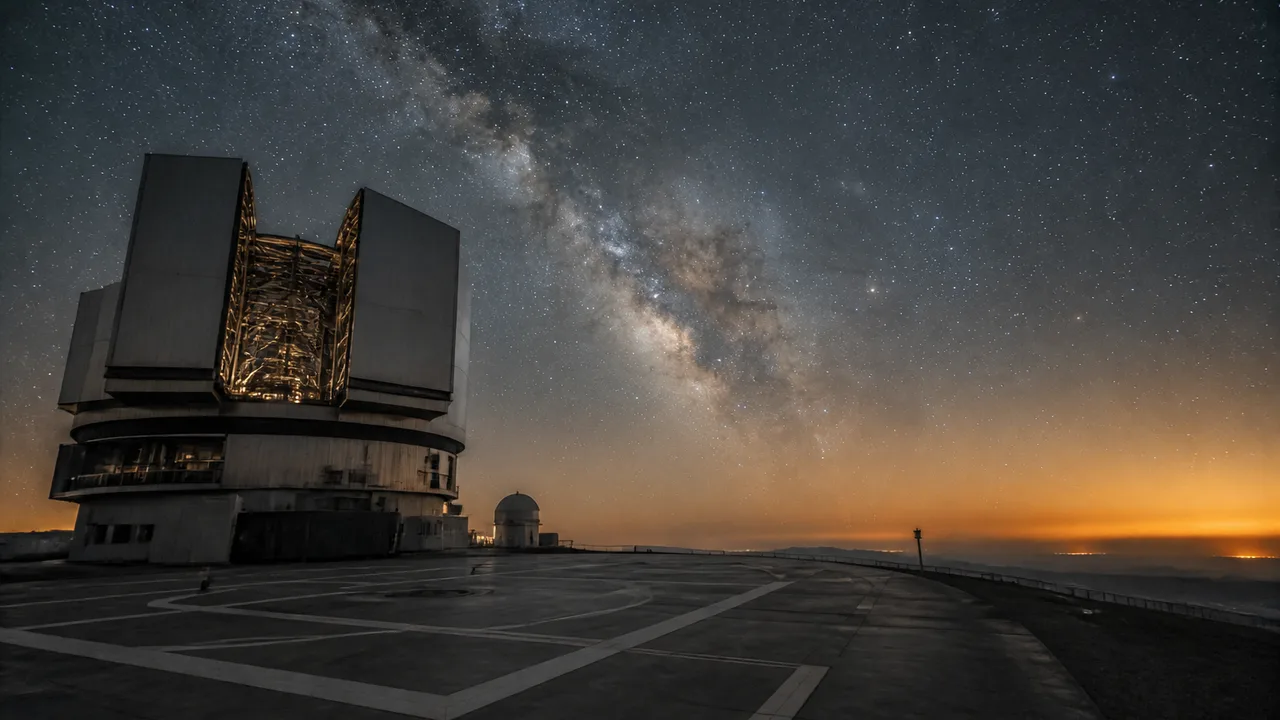
Photo: AI. Marcel Dubois
In 2015, hundreds of Native Hawaiian kia'i — protectors — formed a human blockade on the road to Mauna Kea's summit, stopping construction equipment headed toward the site chosen for the Thirty Meter Telescope. Some of the elders among them had been fighting this fight for decades, since the mountain's sacred summit began accumulating the domes of thirteen observatories. The TMT consortium — a collaboration between Caltech, the University of California, and international partners representing Canada, China, India, and Japan — had permits. They had funding. They had the blessing of the state of Hawaii. What they did not have was the consent of the people for whom Mauna Kea is not a mountain with good atmospheric seeing, but a deity. An ancestor. The place where sky meets earth and the dead return.
Science documentaries about the next generation of giant telescopes tend to skip that part.
The Wonder documentary Inside the $1.4 Billion Mega-Telescope Built to See the Beginning of Time is visually spectacular and scientifically thorough — a genuine feat of popular astronomy communication. It takes viewers from the 2009 Space Shuttle Atlantis servicing mission that rescued the aging Hubble, through the engineering marvels of the European Southern Observatory's complex in Chile's Atacama Desert, to the ambitions of three next-generation ground telescopes that could be operating in the 2020s. It covers dark energy, dark matter, the cosmic web, the auroras, and the eventual merger of the Milky Way with Andromeda. It is a lot of universe.
But the universe, as it turns out, is not politically neutral terrain. Mountains are not just mountains. Astronomers are not just astronomers. And every time we decide where to put a $1.4 billion instrument capable of seeing the birth of galaxies, we are also deciding whose land, whose sky, and whose silence can be requisitioned for the project.
Start with who died for the Hubble.
On February 1, 2003, Space Shuttle Columbia broke apart during re-entry, killing all seven crew members. The documentary names this event as the pivot point that nearly ended Hubble's life — the shuttle fleet was grounded, the final servicing mission was cancelled, and without repair, the telescope would have slowly died and eventually deorbited. What it does not do is sit with who those seven people were.
Rick Husband was a test pilot from Amarillo, Texas. William McCool was a Navy commander and the first in his family to go to college. Michael Anderson was an Air Force officer who grew up in Washington state, one of the few Black astronauts of his generation. David Brown had been a Navy flight surgeon who taught himself to fly. Laurel Clark was a Navy diving medical officer who'd treated patients in conditions that would have crippled most people. Kalpana Chawla, born in Karnal, Haryana, was the first woman of Indian origin to fly in space — she had wanted to be an astronaut since childhood, had earned a PhD in aerospace engineering, and was on her second mission when Columbia came apart. Ilan Ramon was the first Israeli astronaut, a fighter pilot who had participated in the 1981 airstrike on Iraq's Osirak reactor and who carried a miniature Torah scroll on board that had survived the Holocaust.
These were not interchangeable crew members. Their deaths reverberated through specific communities — Indian American families, Israeli families, Black military families, small towns in Texas and Washington. The Hubble's survival story runs directly through their deaths. The documentary acknowledges the disaster in a clause. It deserves a paragraph at minimum, and what it tells us — that scientific ambition has always been paid for by human beings willing to accept catastrophic risk — is not incidental to the story. It is the story.
Back on Earth, the story of who pays for astronomical ambition gets more complicated.
The three next-generation ground telescopes profiled in the documentary — the Giant Magellan Telescope at Las Campanas in Chile, the Thirty Meter Telescope originally slated for Mauna Kea, and the European Extremely Large Telescope at Cerro Armazones in Chile — are genuinely extraordinary instruments. The ELT (ESO quietly dropped the "Extremely" from its name in later planning documents) uses a segmented primary mirror with a current design specification of 39.3 meters — not the 42 meters cited in the documentary, which reflected earlier design specs before a redesign. ESO's cost estimates have also climbed substantially from the $1.4 billion figure the documentary references; more recent ESO documentation puts construction costs in the range of €1.3 billion ($1.4 billion at the time of earlier estimates) but with total program costs potentially higher depending on instrumentation and operations. The TMT's $1 billion price tag, too, has swelled with delays and redesigns.
These are public numbers worth tracking because they tell you something about how these projects actually get funded — through a combination of national science agencies, university consortia, and international governmental partnerships. The NSF funds the U.S. share of TMT. The ESO's budget comes from its fourteen member states, including Germany, France, and the UK. These are institutions that answer to governments, which answer to taxpayers, but which in practice exercise enormous discretion about where to build and what to build without meaningful input from communities on the receiving end of construction.
The TMT fight on Mauna Kea is the most visible example, but it is not the only one. The Atacama Desert, where Chile's cluster of world-class observatories now sits, is the ancestral territory of the Atacameño people, also called Lickan Antay. Their relationship to the land — and to the astronomy being conducted on it — is largely absent from any documentary about the observatories there.
Then there is Vera Rubin.
The documentary discusses the telescope then known as the Large Synoptic Survey Telescope, designed for a wide-angle view of the heavens that will image the entire sky twice every week, enabling measurements of dark energy across billions of years of cosmic time. What the documentary does not mention — because it predates the decision — is that in 2020, the LSST was officially renamed the Vera C. Rubin Observatory, in honor of the astronomer who spent her career being denied telescope time because she was a woman, and who, working with Kent Ford, produced the observational evidence that dark matter exists and outweighs ordinary matter by five to six times.
The renaming is the first time a major ground-based observatory has been named for a woman in astronomy's history. That sentence should land like what it is.
Rubin didn't discover dark matter by being given access to the best instruments. She discovered it despite consistent institutional resistance — she was refused access to Palomar Observatory for years, found it easier to work at institutions where women were less of an anomaly, and watched male colleagues receive credit and prizes for work that stood on her foundations. The observatory that will now carry her name is designed to measure the very phenomenon she identified through grit and decades of marginalization. The documentary, not unreasonably given its vintage, calls the instrument by its old bureaucratic acronym. But the new name carries a whole argument about whose contributions get recognized, whose labor gets written into stone, and how long the correction takes.
"Hubble isn't just a satellite," one astronaut says as Atlantis releases the repaired telescope back into orbit. "It's about humanity's quest for knowledge."
Humanity's quest for knowledge is a phrase that does a lot of work. It universalizes what is, in practice, a project conducted by specific institutions, funded by specific governments, staffed by people whose access to the profession has historically depended on their gender, their nationality, their race. The Hubble itself is named for Edwin Hubble, who did transformative work and who also was credibly accused by Cecilia Payne-Gaposchkin and others of claiming credit for observations that weren't his. The TMT might have been named for a Native Hawaiian astronomer — there are Native Hawaiian astronomers, people who grew up under some of the most observed skies on earth and who have PhDs and careers in the field — but it was named for its mirror diameter.
None of this means the telescopes shouldn't be built. The James Webb Space Telescope, which launched successfully in 2021 and is now parked at the Sun-Earth L2 point about 1.5 million kilometers from Earth, is already returning images that rewrite the timeline of early galaxy formation. Whether future servicing missions to Webb are possible remains an open engineering question — NASA has not formally ruled it out, and some engineers have noted the telescope was designed with future servicing in mind in ways that may prove accessible. What Webb will find about the first stars, the first galaxies, the chemical signatures of potentially habitable planets — that knowledge matters. The documentary is right about that. The cosmos is genuinely astonishing.
But the decision about where to put the instrument, whose mountain to flatten, whose silence to purchase, whose name to put on the building — those are not scientific questions. They are political and moral ones, and they are answered by institutions like the National Science Foundation, the European Southern Observatory, the University of California Regents, the Gordon and Betty Moore Foundation, and the Japan Society for the Promotion of Science, among others. These bodies make decisions with enormous consequences for specific communities and specific people, mostly without those communities in the room.
Pua Case has been protesting at Mauna Kea for years. She has given testimony at state hearings, spoken at international forums, and watched the legal battles play out across the Hawaiian court system. She is one of the ordinary people who made this story — not a footnote to it. The next time a documentary points a camera at a mirror the size of a city block and invites us to feel wonder, it might also point that camera at her.
The beginning of time is worth looking for. So is the question of who decides how we look.
More Like This
Crafting Supercars: The Science Behind Speed and Style
Explore how supercars like Alfa Romeo 4C and Aston Martin Vanquish are meticulously crafted using cutting-edge materials and precision engineering.
Exploring the Enigma of Antimatter at CERN
CERN's antimatter factory reveals mysteries of the universe's matter-antimatter asymmetry and the quest for new physics.
Exploring the Universe with New Telescopes
Delve into groundbreaking telescopes like Vera Rubin and Euclid, capturing cosmic wonders and expanding our celestial knowledge.
Stonehenge: What Archaeology Can't Tell Us
Archaeologists know how Stonehenge was built—barely. Why it was built remains genuinely, stubbornly unknown. Here's what the evidence actually says.
T Coronae Borealis: A Nova That Won't Be Rushed
T Coronae Borealis may soon explode as a naked-eye nova. Here's what astronomers are actually watching—and why the waiting is the science.
Einstein's Biggest Blunder Was Actually Right
Einstein invented the cosmological constant to keep the universe static—then ditched it. Decades later, it came roaring back. Here's what dark energy means for everything we think we know.

Roosevelt's 1936 Peace Promise: What He Really Meant
In 1936, FDR ran on "peace" — but he meant three different things by it. Unpacking that word reveals a political strategy still worth examining today.
The Anaconda Plan Was Right. People Paid for It.
Winfield Scott's Anaconda Plan was strategically vindicated — but the years it took to work were paid for in hunger, death, and bondage by ordinary people.