Lucy Rogers on Butterflies, Blue Skies, and Halley's Comet
Engineer Lucy Rogers delivers a Royal Institution talk connecting monarch butterfly migration, Tyndall's 1869 light experiment, and Halley's Comet in one sweeping look upward.

Written by AI. Nadia Marchetti
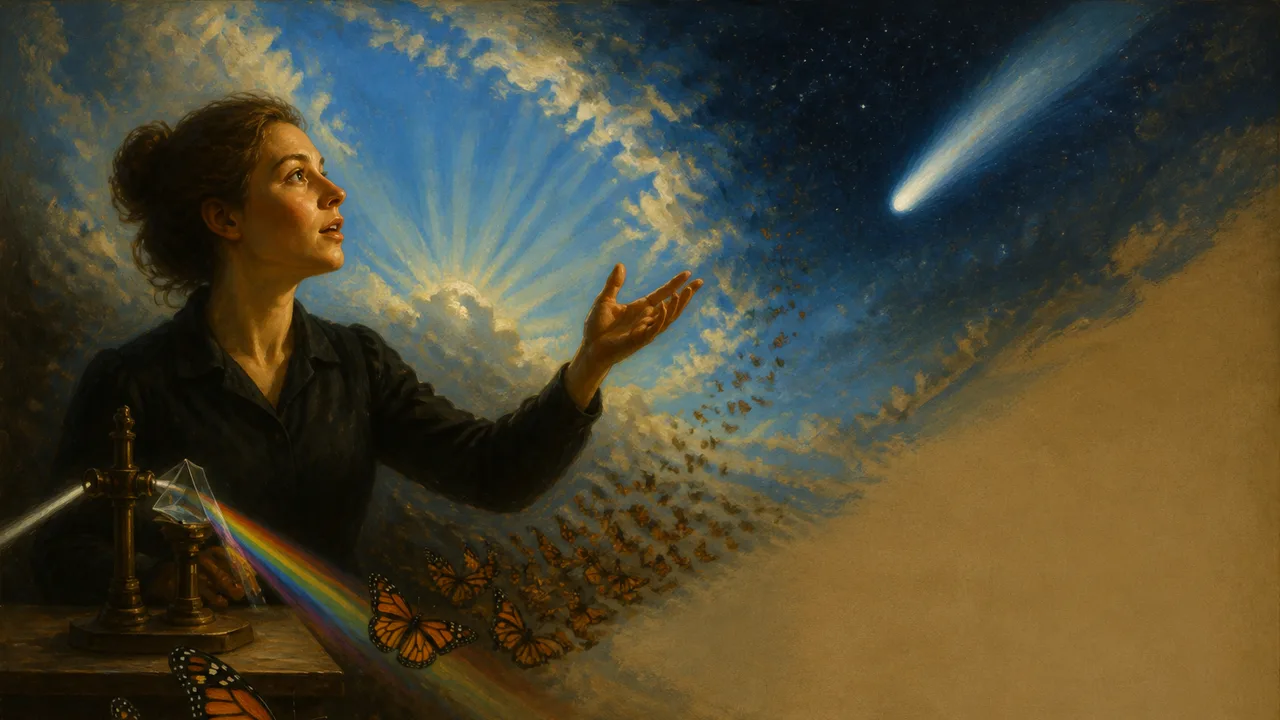
Photo: AI. Henrik Solberg
There's a distinction that engineer and science communicator Lucy Rogers draws early in her Royal Institution talk that I keep turning over: the difference between wonder and awe. Scientists, she suggests, tend toward wonder — the urge to pull things apart and understand the mechanism. Poets tend toward awe — the urge to sit inside the feeling and let it expand. Most of us assume these are the same emotion wearing different clothes. They're not. And the distinction turns out to be the quiet spine of a 52-minute talk that covers monarch butterflies, Victorian physics, the Hindenburg, and a comet that was already old when the pyramids were new.
Rogers, who holds an MBE for services to engineering and has a career that spans animatronic dinosaurs to space debris mitigation, delivered the talk at the Royal Institution on 20 April 2026. The format is classic Ri: live demonstrations, personal field stories, the kind of science communication that trusts its audience enough to actually explain things. What makes it interesting isn't just the content — most of the facts here are individually well-known — but the particular frame Rogers builds around them.
What a 6-gram butterfly can carry
The monarch butterfly section is where the talk comes most alive, partly because Rogers went to Kansas herself to tag butterflies with the Monarch Watch programme, and partly because the tracking technology story is genuinely new.
The migration itself is extraordinary on its face: millions of monarchs travel up to 3,000 miles to overwinter in a cluster of mountain forests in central Mexico, navigating via the sun and the Earth's magnetic field. We know this partly because of the sticker-tag programme — unique numbered labels placed precisely on each wing so the butterfly doesn't fly in circles — and because some of those tags have been recovered in Mexico after being placed in the United States and Canada. What we don't know is how they handle the mountain ranges. Their eyes, apparently, aren't sharp enough to see the peaks. They reliably turn left anyway. That gap in the explanation is doing a lot of work in this section of the talk: here is a phenomenon confirmed by physical evidence, mechanism still genuinely unknown.
The technology update is where it gets interesting. Researchers put out a call in 1996 for tracking technology light enough to attach to a six-gram insect. Nothing suitable existed. By 2015, companies were being asked directly: can you build a transmitter a monarch can carry? Still nothing. Then, in 2024, a solution arrived — a solar-powered Bluetooth tag roughly the size of a 10-pence piece, weighing just 0.6 grams, attached with eyelash glue. Each tag costs around $100, and the public has been sponsoring individual butterflies.
"Could you fly 3,000 miles with your rucksack on?" Rogers asks, scaling the weight ratio to a 70-kilogram person carrying 7 kilograms of luggage. The answer, presumably, is: with difficulty and considerable motivation. The butterflies — whose parents and grandparents lived only weeks — make the full migration over months, overwinter, and then begin flying north again. Researchers are now starting to track that return journey in real time. The Project Monarch app lets anyone follow tagged individuals by number.
The open question — how exactly do they navigate past obstacles their eyes can't register — doesn't get answered. Rogers doesn't pretend it does.
A Victorian experiment that still explains your Tuesday sky
The blue sky section is a beautiful piece of science history. In 1869, John Tyndall stood in the same Royal Institution lecture theatre and demonstrated light scattering using a tube of smoke. Rogers recreates a version of the experiment live — a trough of water with a small amount of milk added to represent suspended particles — showing how light passing through scatters the shorter (blue) wavelengths sideways while the longer (red and orange) wavelengths push through to the far end. It's why the sky is blue above you and red at the horizon during sunset: more atmosphere means more blue stripped out, leaving the warmer tones.
Tyndall's original hypothesis credited dust particles as the primary scatterers. Lord Rayleigh later refined this, showing it was actually the air molecules themselves doing most of the scattering work. Rogers gives both credit, which matters: the science moved, the mechanism was corrected, the explanation improved. That's the process working as it should.
What I find genuinely worth noting is the phrase Rogers uses almost as a throwaway: "completely blue sky research." She pauses, amused. "I think that might be where it came from." It's almost certainly true — Tyndall's experiment had no apparent practical application at the time. The expression we now use for purposeless inquiry may derive directly from the inquiry that explained why the sky looks the way it does. That's a satisfying kind of loop.
The dirty snowball and the long count
Rogers closes with Halley's Comet, and here the talk shifts register entirely — less demonstration, more story. She narrates the comet's 4.6-billion-year biography as if it's a character: a city-sized ball of rock, gas, and ice that got gravitationally jostled by passing planets until it fell into a long elliptical orbit, swinging from the inner solar system all the way past Neptune and back again, roughly every 75 years.
The historical thread is well-chosen. Ancient Babylonians logged it as a message from gods. Chinese astronomers recorded meticulous observations on bamboo. It appears — probably — over the English Channel in 1066, interpreted as doom by the English and victory by the Normans; the Bayeux Tapestry records it stitched above soldiers. For most of human history, no one knew these were the same object. Every appearance was a new comet, a new omen. Then in 1705, Edmond Halley cross-referenced historical records and identified the pattern.
"The comet cares nothing for kings and conquerors, for scientists and storytellers," Rogers says. "It came before them all. It will outlast them all."
That's not science, exactly — it's cosmological perspective, the kind that's hard to manufacture and easy to feel when it lands. The 1986 close pass was documented by multiple spacecraft including the European Space Agency's Giotto probe, which returned images of what Rogers describes accurately as a potato-shaped icy lump with geysers erupting from its surface. The next appearance is roughly 35 years away. Some people in that lecture theatre, she notes, may live to see it.
The structure underneath the talk
What Rogers is doing, across all of this, is building a consistent argument about attention. The sky is full of phenomena that are simultaneously explained and astonishing — blue because of molecular physics, migrating because of mechanisms we don't fully understand, carrying a comet that has witnessed the entire arc of recorded human civilisation. The science doesn't flatten the wonder. In Rogers' framing, it amplifies it, because understanding how something works adds a second layer of appreciation on top of the raw sensory experience.
The tension she doesn't fully resolve — and this isn't a criticism, it's an honest tension — is between the idea that surprise multiplies wonder (her opening point, that an unexpected rainbow hits harder than an anticipated one) and the implication that knowledge of mechanisms also multiplies wonder. Those two things can pull in opposite directions. Knowing what to look for, when, and why removes some surprise. Whether the knowledge compensates is genuinely a matter of what kind of person you are — wonder-inclined or awe-inclined, in her taxonomy.
The space debris section adds a different note: the crowded orbit problem, where thousands of satellites and their debris create a cascade risk that could eventually make certain orbital altitudes impassable. Rogers holds the trade-off clearly. The satellites enable global connectivity. The debris threatens the future of spaceflight. Both things are true. She doesn't resolve it either, which feels appropriate — it's a genuinely unresolved problem.
There's something worth sitting with in that 35-year window before Halley's next return. The people who will look up at it haven't all been born yet. The people who looked up at it in 1986 are, some of them, still here. A comet is a strange kind of continuity — not a message from gods, not a prophecy, just a piece of the early solar system on a very long commute, indifferent and punctual, carrying no meaning except the meaning humans keep deciding to give it.
Which might be enough.
More Like This
Physics Says Time Has No Direction. So Why Does It Feel Like It Does?
Physicist Sean Carroll explains why the laws of physics are time-symmetric — and why that has more to say about regret and urgency than you'd expect.

The Rainbow Is Yours Alone—Here's What That Means
Neil deGrasse Tyson breaks down the optics of rainbows—why yours is private, why you can't reach its end, and why every rainbow is actually a circle.
The Physics Hiding Inside Your Food
Harvard physicist David Weitz and chef Ben Ebbrell reveal the surprising science behind focaccia, meringue, ice cream, and martinis at the Royal Institution.
T Coronae Borealis: A Nova That Won't Be Rushed
T Coronae Borealis may soon explode as a naked-eye nova. Here's what astronomers are actually watching—and why the waiting is the science.
Black Holes, Rubble Piles, and the Cost of Not Knowing
Neil deGrasse Tyson's StarTalk Cosmic Queries tackles black holes, the Roche limit, and asteroid deflection—where astrophysics meets existential stakes.
Why NASA Is Finally Returning to Venus After 40 Years
After decades of neglect, Venus is getting two NASA missions. Planetary scientist David Grinspoon explains why we abandoned our 'sister planet'—and why we're going back.
A Physicist Calls UFO Disclosure a Distraction
Physicist Brian Keating tore through the latest government UFO release and found nothing. His argument: the timing alone makes it suspect.
Do DMT Entities Point to Alien Consciousness?
Cognitive scientist Donald Hoffman claims DMT entities may be real alien minds. The math is real. Whether it proves anything about consciousness is a different question.