The Physics Hiding Inside Your Food
Harvard physicist David Weitz and chef Ben Ebbrell reveal the surprising science behind focaccia, meringue, ice cream, and martinis at the Royal Institution.

Written by AI. Nadia Marchetti
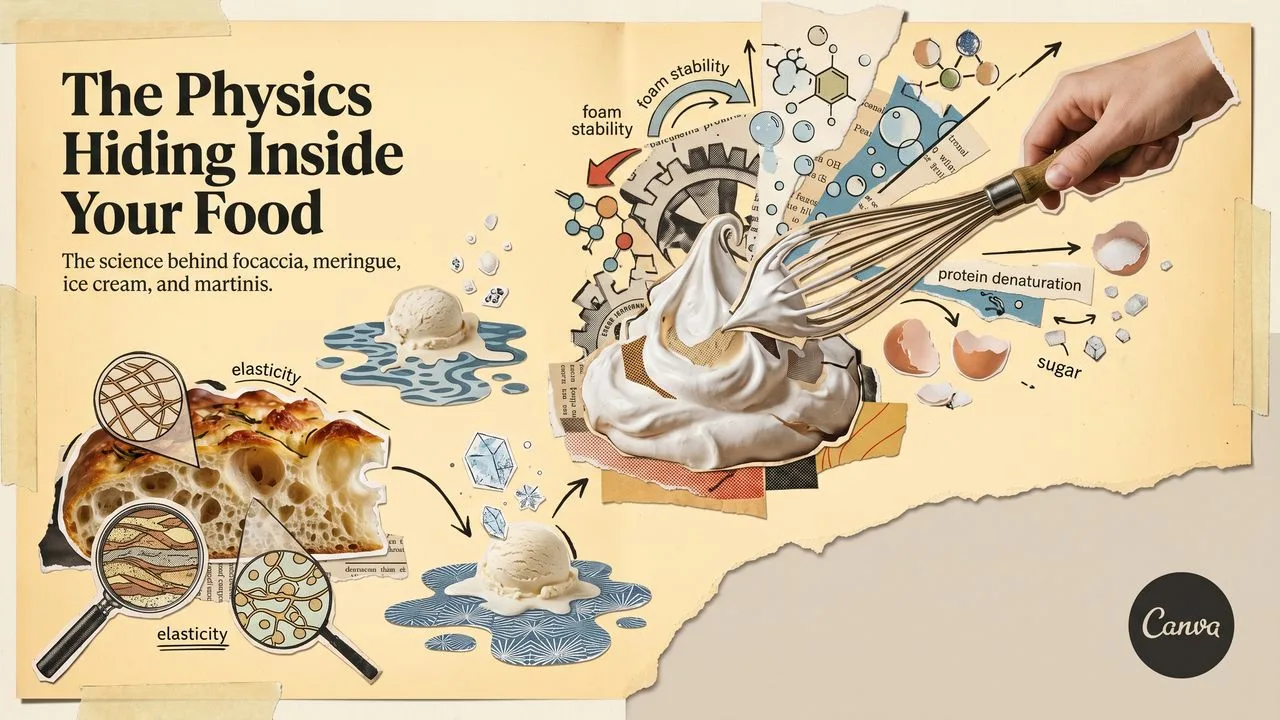
Photo: AI. Wren Sugimoto
Here's something that bothers me about how science gets taught: we spend years learning about springs and pressure and phase transitions through abstract examples, when the whole time, dinner was sitting right there.
Harvard physicist David Weitz has clearly had the same thought. In Part 2 of his Royal Institution lecture with Sorted Food's Ben Ebbrell — the UK premiere of Harvard's celebrated Science and Cooking series — he and Ebbrell work through focaccia, meringue, ice cream, and a gin martini as a live demonstration of soft matter physics. Not as metaphors. As actual experimental subjects, measured, prodded, and torched on stage in front of a live audience.
The result is one of the more genuinely illuminating science demonstrations I've come across, partly because Weitz refuses to let the familiar stay familiar.
Bread Is a Spring (No, Really)
The lecture opens with focaccia — Ben Ebbrell's choice, on the grounds that it's "the bounciest of breads." Weitz uses it to introduce rheology, the science of how materials deform under stress. The relevant concept is Hooke's Law: apply a force to a spring, and it extends proportionally. The ratio of force to extension is the spring constant.
But Weitz wants something more useful than a spring constant, which varies with the size and shape of your spring. What he's after is an elastic modulus — a material property that's independent of geometry. You get it by normalising the force by area (giving you pressure) and the displacement by original length (giving you a dimensionless ratio). That ratio tells you something fundamental about the stuff itself, not just this particular piece of it.
So he measures the focaccia. Cuts a cube, measures its dimensions, stacks on weights, watches it compress. "Tough meat has something like 60 or 70 kilopascals," Weitz explains. "This is much softer. There's about a factor of 10 less." The focaccia clocks in around seven or eight kilopascals — genuinely springy by the numbers, not just by feel.
It's worth pausing on what Weitz is actually claiming here. He's saying you can assign a material constant to bread the same way you'd assign one to rubber or steel. The same mathematical framework that mechanical engineers use to design load-bearing structures applies to what you're having with your olive oil. That's not a metaphor or an analogy. It's the same equation.
The live measurement gets a bit chaotic — the bread dried out between preparation and performance, complicating the numbers — but Weitz takes this in stride. "This is doing real real-time experiments," Ebbrell notes, and there's something almost more convincing about watching the science get messy and still hold up.
Why Meringue Shouldn't Be Solid
The second act belongs to meringue, which Weitz uses to make a point that still feels slightly strange no matter how many times I encounter it: foams and emulsions obey the same physics.
In Part 1 (which covered mayonnaise and emulsions), Weitz apparently established that you can turn two liquids into a solid by packing enough droplets together — the droplets jam, can no longer flow past each other, and the whole system behaves like a solid. Meringue does the same thing, just with air instead of fat.
"Why is a foam — it's liquid and gas — becoming a solid?" Weitz asks the audience. "It's the same physics. Now it's air drops. It's not liquid drops. And when they pack, they become solid. They behave exactly the same way. So guess what? The equation is the same."
The equation being the same is doing a lot of work in this lecture. Weitz keeps returning to it — foam, emulsion, ice cream (which is both simultaneously) — as though the goal isn't just to explain cooking but to demonstrate that the apparent variety of the physical world keeps collapsing into a surprisingly small number of underlying principles. Whether that's a profound truth about nature or just the particular lens of a soft matter physicist is a question worth sitting with.
Ebbrell runs through the three meringue methods — French (whipped whites, sugar folded in cold), Swiss (whites warmed over a bain-marie), Italian (118°C sugar syrup poured into whipping whites) — and chooses Italian for the Baked Alaska they're building. The hot syrup simultaneously cooks the egg whites and stabilises the foam, producing what Ebbrell describes as "super super stable" meringue that holds its structure at room temperature far longer than French.
The Baked Alaska Problem
Baked Alaska is a good vehicle for the lecture's central preoccupation because it presents a genuine physical paradox: you apply an open flame to a dessert, and the ice cream inside stays frozen. How?
The answer is insulation, and the insulator is the meringue foam itself. Air is a terrible conductor of heat. Pack enough air bubbles into a matrix and you create an effective thermal barrier — the same principle behind fiberglass insulation, aerogel, and a down jacket. The blowtorch browns the outer surface of the meringue in seconds, but the heat doesn't penetrate fast enough to reach the ice cream before you stop.
Weitz decides to test this more dramatically than a dessert requires. He coats the hand of the show's producer, Dan, in meringue and holds a blowtorch to it. Dan's hand, it turns out, is fine. Several seconds of direct flame, the meringue chars and browns, the hand underneath feels warmth but no pain. The audience applauds. It's genuinely arresting — not because it's reckless (the physics is sound) but because watching someone trust an equation enough to put their hand in the way is a different kind of persuasion than a lecture slide.
"Ice cream is interesting," Weitz notes, before they cut it open to verify the interior is still frozen. "It's both a foam and an emulsion. It's got bubbles of air. But it's also got drops of fat. So the emulsion covers the bubbles of air. Actually, it's even got solid pieces of ice and that gives it its character."
The microscope image he shows — bubbles of air surrounded by fat droplets, the whole structure suspended in a crystalline matrix — looks like nothing so much as a complex composite material. Which is exactly what it is.
The Martini Result
The lecture closes with a gin martini, which turns out to have a genuinely counterintuitive result. Ebbrell and Weitz measure the gin at room temperature: 21.5°C. The ice is at 0°C. You'd expect the shaken mixture to land somewhere between those two numbers — probably closer to 0°C given the thermal mass of the ice.
Instead, the shaken martini registers −4°C. Colder than the ice it was shaken with.
Weitz doesn't fully unpack this in the transcript (the lecture cuts off), but the physics is familiar: shaking causes the ice to melt, and melting is endothermic — it absorbs heat from the surroundings, in this case the liquid. The phase transition pulls temperature below zero before equilibrium is reached. Salt does the same thing to ice, which is why the audience's salt-and-ice bag could freeze the custard in the earlier demonstration. The martini and the ice cream bag are running the same thermodynamic trick.
What I find most interesting about the Weitz-Ebbrell approach isn't any individual demonstration. It's the implicit argument running underneath all of them: that cooking is applied physics, and that understanding the physics makes you better at the cooking. Ebbrell's "cheats" ice cream — frozen berries blended with clotted cream, no churning required — works precisely because he understands what temperature the fat needs to reach. His Italian meringue choice is a stability decision as much as a flavour one.
The tension in the lecture, never quite resolved, is between those two framings. Is science a tool that makes cooking better? Or is cooking a laboratory that makes science more legible? Ebbrell and Weitz seem to genuinely hold both views simultaneously, which is probably why the collaboration works.
The question worth asking after watching is simpler: the next time something in your kitchen goes wrong — the bread too dense, the meringue weeping, the ice cream grainy — are you going to treat it as a failure, or as data?
More Like This

Math Intuition vs. Tricks: The Gauss Problem
Is math just a bag of tricks, or is there a deeper way to think? The Gauss problem reveals a fascinating argument for building genuine mathematical intuition.
The Blacksmith's Son Who Rewired the World
Faraday discovered the laws of electromagnetism with no formal training. Maxwell had to translate his truth into math before anyone believed it. Sound familiar?
The Hidden Math Holding Climate Science Together
Dialect's video on the covariant derivative explains the math quietly powering climate models, ice sheet measurements, and atmospheric science.

Crafting Clarity in Scientific Communication
Explore a physicist's insights on ensuring clarity and understanding in scientific presentations and writing.

Scientists May Finally Detect Gravitons—Sort Of
New experiments could detect gravity's quantum particle within decades. But proving gravitons exist? That's a different problem entirely.

Why NASA Is Finally Returning to Venus After 40 Years
After decades of neglect, Venus is getting two NASA missions. Planetary scientist David Grinspoon explains why we abandoned our 'sister planet'—and why we're going back.
Do DMT Entities Point to Alien Consciousness?
Cognitive scientist Donald Hoffman claims DMT entities may be real alien minds. The math is real. Whether it proves anything about consciousness is a different question.
Viking Landers and the Unsolved Mars Life Debate
Fifty years after Viking landed on Mars, one experiment's positive result remains unexplained. Here's what the science actually shows—and what we've learned since.