JWST's Latest Discoveries Are Breaking Cosmology
JWST is finding galaxies too big, too bright, and too early. From dark stars to interstellar comets, here's what the data is actually telling us.

Written by AI. Nadia Marchetti
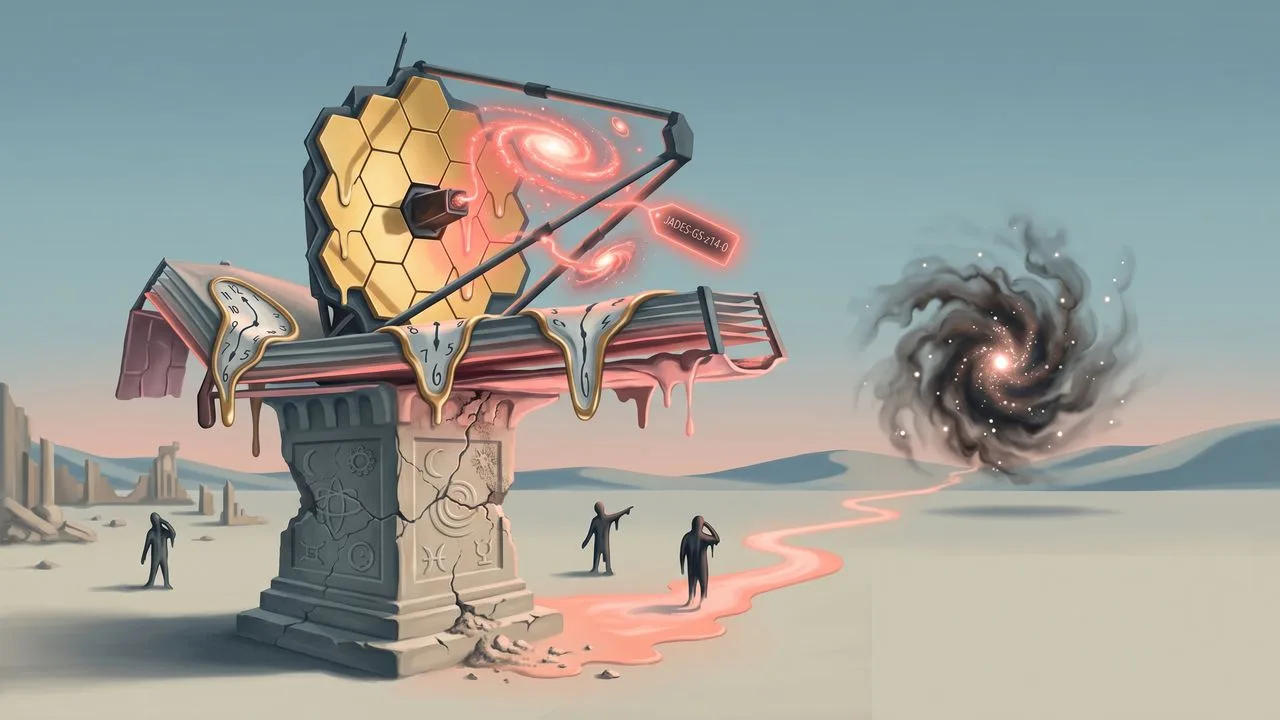
Photo: AI. Iolanthe Fenwick
There are two ways to look at what the James Webb Space Telescope has been doing since it became fully operational in July 2022. The optimistic read: it's confirming and refining what we already believed about how the universe works. The more honest read: it keeps finding things that shouldn't be there.
I lean toward the second interpretation. Not because I enjoy watching physicists panic, but because the evidence is accumulating in one direction. JWST isn't just filling in gaps—it's reopening questions scientists thought were closed.
Astrum's Alex McColgan recently put together a sweeping compilation of JWST's most significant recent findings, covering everything from Neptune's ring arcs to galaxies at the literal edge of observable time. It's worth working through carefully, because the individual discoveries are striking—and their cumulative weight is something else entirely.
The easy wins first
Start close to home. Neptune through JWST's infrared eye looks almost nothing like the familiar blue marble—methane absorbs most of the infrared sunlight, leaving the planet dark but throwing its dusty rings and high-altitude clouds into sudden dramatic relief. Fourteen known moons. Previously unseen ring arcs. Clearest images we've ever taken of the ice giant, full stop.
Then 3I/ATLAS, an interstellar comet that JWST analyzed in August 2025 using its near-infrared spectrograph. The composition was unusual—CO2 and water vapor in ratios among the highest ever recorded in any comet. As McColgan puts it, this object "is a messenger from another star system, having formed in a region of its original star's planetary disc where temperatures were cold enough for CO2 ice to naturally freeze out."
What that means in plain terms: the chemical recipe for planetary systems, and potentially for life, appears to be consistent across different stars. The building blocks aren't unique to our corner of the galaxy. That's not a small finding. It's one of those results that sounds mild until you sit with it.
Closer still—four light-years away, in the Alpha Centauri system—JWST has produced what may be the closest-ever directly imaged exoplanet candidate. A potential Saturn-mass gas giant orbiting Alpha Centauri A, within the star's habitable zone. The gas giant itself is an unlikely host for life, but its presence confirms that planetary formation happened around our nearest stellar neighbor. Moons around a gas giant in a habitable zone are not ruled out.
Star birth is more violent than the textbooks suggested
JWST's revisits to familiar nebulae—the Pillars of Creation, the Cosmic Cliffs in the Carina Nebula—have produced something more than pretty pictures. The infrared view cuts through the dust that made these formations so photogenic in Hubble's visible-light images, and what's underneath is chaotic.
Newborn stars hiding inside the Pillars, a few hundred thousand years old, are already blasting plasma jets and shock waves outward. The Cosmic Cliffs are being actively sculpted and eroded by radiation from massive young stars—a process that Hubble's data could hint at but couldn't resolve clearly enough to study directly.
Deeper in the Milky Way, in the region astronomers call Sharpless 2284, JWST found a protostar ten times the mass of our sun firing bipolar jets spanning eight light-years. For reference, that's nearly twice the distance from the sun to Alpha Centauri. McColgan calls these "birth announcement jets"—and the metaphor is apt. The star is effectively announcing itself by bulldozing the surrounding molecular cloud.
What makes this particular protostar scientifically valuable is its location at the far outer edge of the galaxy, where metallicity—the concentration of elements heavier than hydrogen and helium—is extremely low. As McColgan explains, "this pristine environment almost perfectly mirrors the conditions of the early universe." The telescope isn't just seeing how stars form now. It's potentially showing us a proxy for how the very first massive stars formed, before the universe had been seeded with heavier elements.
The moon-forming disk in the CTH 28 system
At 625 light-years away, the CTH 28 B system has given researchers something genuinely new: direct measurements of a circumplanetary disk—a ring of material around a young giant exoplanet that functions as a moon assembly site. JWST's MIRI instrument found the disk rich in complex organic molecules, including acetylene and benzene. The host star's disk, by contrast, contains water but almost no carbon.
That chemical asymmetry in a system only two million years old gives scientists a direct comparison point for how moon systems—including, by implication, Jupiter's—actually form. The ingredients differ significantly between what orbits the star and what orbits the planet. That difference may matter for what those eventual moons look like.
Where the model starts to crack
All of the above fits, more or less, within established frameworks. This is where things get more interesting.
The JADES survey, using JWST's near-infrared instruments, has been probing the earliest observable epoch of the universe—the "cosmic dawn" around 13.5 billion years ago. The survey confirmed the redshift of a galaxy now called JADES-GS-z14-0 at z=14.32, meaning we're seeing it as it existed just 300 million years after the Big Bang. Only one other object—spotted by JWST in May 2025—is older, by about ten million years.
Here's the problem. The standard cosmological model, lambda cold dark matter, predicts that galaxies at this epoch should be small, dim, and primitive—just beginning to accumulate their first simple stars. JADES-GS-z14-0 is none of those things. It's too massive, too luminous, too developed for a universe that young.
"To grow a galaxy this large only 300 million years after the Big Bang," McColgan notes, "the early universe must have been forming stars far faster and more efficiently than any current model allows."
This isn't an isolated anomaly. JWST has found several such objects. The pattern is becoming hard to explain away.
One hypothesis that's been revived in light of these findings comes from a 2007 paper by cosmologists Katherine Freese, Paolo Gondolo, and Douglas Spolyar: dark stars. Not dark in color but dark in power source—hypothetical objects fueled by the annihilation of dark matter particles rather than nuclear fusion. Dark stars could theoretically grow to millions of solar masses, burn cool and long, and produce exactly the kind of infrared signatures that JWST is designed to detect.
The dark star hypothesis is speculative. It was proposed nearly two decades ago and has never been confirmed. But the fact that observational data is now pointing toward the conditions where dark stars would have operated is not nothing. It connects the deepest observations JWST can make—galaxies at the edge of time—to the least understood component of the universe: dark matter itself.
29P/Schwassmann-Wachmann and the volcano comet problem
Separate from the deep-universe work, McColgan's compilation also covers Centaur 29P/Schwassmann-Wachmann—a small solar system body orbiting between Jupiter and Neptune that has been behaving in ways that defy easy explanation. It has gotten nearly 300 times brighter in a matter of hours. It has exploded four times in two days. It spews over a million tons of debris at supersonic speeds with no obvious trigger—no dramatic approach to the sun, no obvious external cause.
What the comet demonstrates is that solar system objects can behave in genuinely unpredictable ways. The "boring outer solar system" framing has been wrong before.
What the data is actually doing
Across all of these findings, a pattern is visible. JWST is not simply confirming the universe we expected. It is, with some regularity, returning data that sits awkwardly against current models—galaxies that formed too fast, star births more violent than simulations predicted, chemical compositions that vary in ways that matter for planetary habitability, and interstellar chemistry that looks surprisingly familiar.
None of this requires overturning cosmology. Science updates incrementally, and most of what JWST finds is consistent with existing frameworks. But the early-universe galaxy problem in particular has become harder to treat as a calibration issue or statistical artifact. When the telescope finds multiple objects that shouldn't exist as fully formed as they are, and the best available explanation involves a hypothetical class of dark-matter-powered stellar objects, the honest response isn't confidence in either direction—it's sustained attention.
JWST has somewhere north of twenty years of operational life remaining. The data from the first three years has already required cosmologists to revisit assumptions. The question isn't really whether our model of the early universe needs adjustment. It's how much.
More Like This
The Amyloid Hypothesis Turns 28—And Its Question Marks Remain
John Hardy helped create the amyloid hypothesis in 1998. Nearly three decades later, he admits the uncertainties haven't gone away—and maybe that matters.

Žižek's Challenge: What If Consciousness Begins With Death?
Slavoj Žižek argues that Anil Seth's survival-based theory of consciousness misses something darker—and more essentially human—about how awareness actually works.
When Physics Breaks: What Black Holes Reveal About Reality
Physicist Juan Maldacena explains where our understanding of spacetime collapses—and what quantum mechanics might tell us about what happens next.
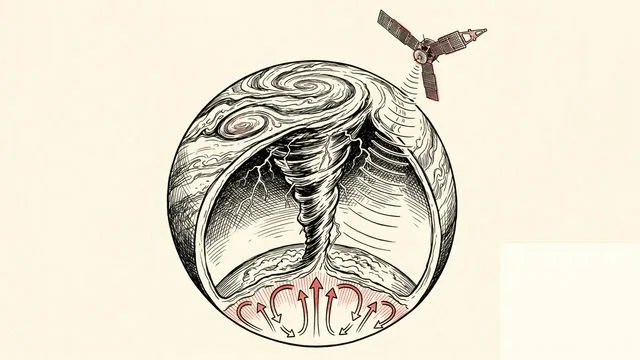
Jupiter's Storms Run Deeper Than Anyone Expected
NASA's Juno probe reveals Jupiter's storms plunge 1,800 miles deep—and the sun isn't powering them. Here's what scientists think is going on inside.
Unknown Humans Are Hidden Inside Your DNA
New genetics research reveals only 1.5–7% of our DNA is uniquely human. The rest? Ancient relatives—including species we haven't even named yet.
Unraveling Cosmic Mysteries: Platypus Galaxies & Dark Matter
Explore JWST's discovery of 'platypus galaxies' and a starless gas cloud, unveiling new cosmic secrets and dark matter evidence.
Do DMT Entities Point to Alien Consciousness?
Cognitive scientist Donald Hoffman claims DMT entities may be real alien minds. The math is real. Whether it proves anything about consciousness is a different question.
Viking Landers and the Unsolved Mars Life Debate
Fifty years after Viking landed on Mars, one experiment's positive result remains unexplained. Here's what the science actually shows—and what we've learned since.