Unknown Humans Are Hidden Inside Your DNA
New genetics research reveals only 1.5–7% of our DNA is uniquely human. The rest? Ancient relatives—including species we haven't even named yet.

Written by AI. Nadia Marchetti
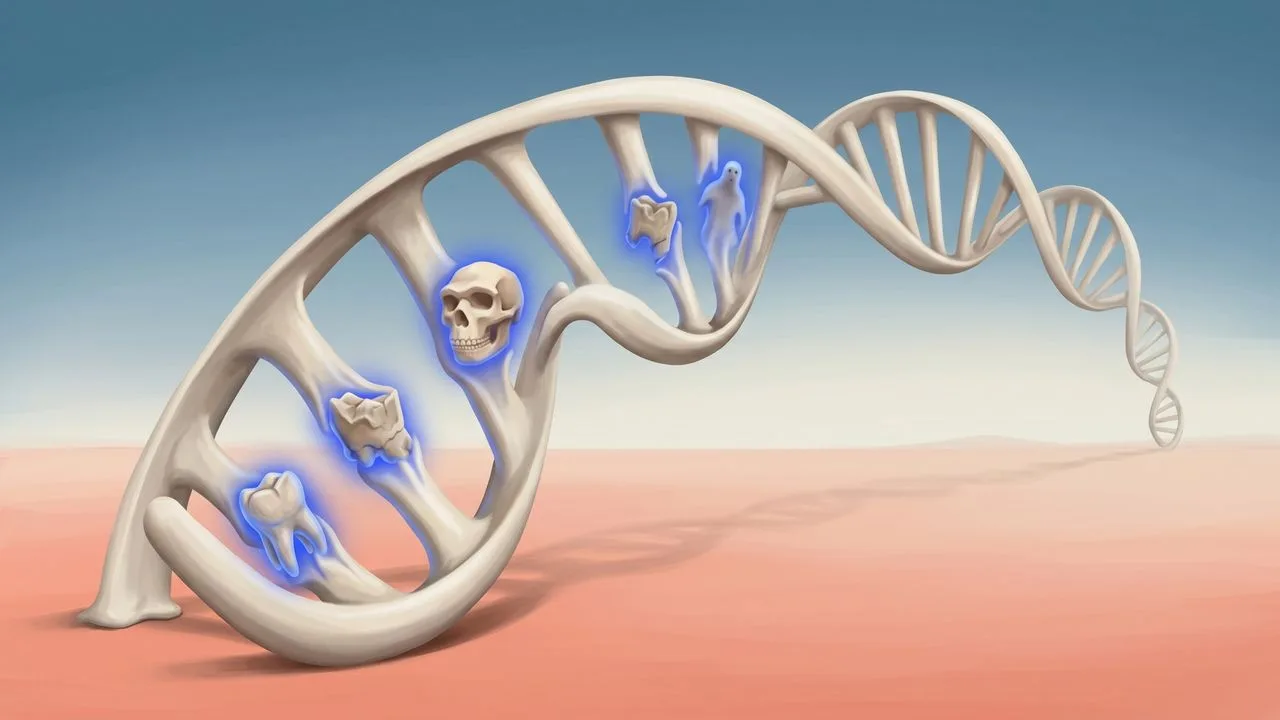
Photo: AI. Iolanthe Fenwick
Here's a number that should stop you mid-scroll: somewhere between 1.5 and 7 percent. That's the slice of your genome that belongs exclusively to Homo sapiens. Everything else—the overwhelming bulk of the biological instructions that make you a functioning human being—is inherited from ancestors who weren't quite us, or borrowed from ancient human species we once shared the planet with and apparently, frequently, slept with.
This isn't a fringe claim. It comes out of rigorous genomic research, capped most recently by a 2021 study from Nathan Schaefer's team at UCSF, who developed an algorithm called SARGE (the Speedy Ancestral Recombination Graph Estimator) to map exactly how much of our genome traces back to Homo sapiens alone. The answer was uncomfortable in the best possible way.
We are, genetically speaking, a mosaic. And the tiles come from a lot of different sources.
The Sequencing That Changed Everything
The modern version of this story starts in 2010, when evolutionary geneticist Svante Pääbo successfully sequenced Neanderthal DNA—work so consequential it eventually earned him a Nobel Prize. What the sequencing showed was that people with ancestry outside sub-Saharan Africa carry roughly 2% Neanderthal DNA. Not as a fluke. Not as noise. As a direct, traceable consequence of interbreeding between Homo sapiens and Neanderthals in Western Eurasia, roughly 60,000 years ago.
That same year, a finger bone recovered from Denisova Cave in Russia revealed a third player: the Denisovans. Some populations in East Asia carry up to 5% Denisovan DNA. The family tree, which had looked relatively tidy for decades, suddenly needed a lot more branches.
It's worth pausing on what these percentages actually mean, because it's easy to either dismiss them as trivially small or misread them through the lens of the "we share 98% of our DNA with chimps" statistic, which measures something entirely different. The chimp comparison reflects deep evolutionary divergence—shared biological machinery accumulated over millions of years. The Neanderthal and Denisovan percentages reflect recent gene flow from direct interbreeding. They're not the same kind of number at all.
As the New Scientist video puts it: think of your genome as a massive book. The old assumption was that Homo sapiens wrote it, start to finish, with a few borrowed lines here and there. What the genomic evidence now suggests is that most of the book was already written—by ancestors and close relatives—and what's uniquely ours is concentrated in a small but very specific set of chapters. Notably, those uniquely human sequences cluster around genes governing prenatal brain development. The neural wiring that makes us us received, as the video frames it, "a very specific and very recent proprietary software update." Everything else? Ancient, recycled, proven.
The Ghosts We Haven't Named
Neanderthals and Denisovans are at least known quantities—we have bones, we have sequences, we have names. But the genomic evidence has started pointing at something murkier: populations whose DNA shows up in modern humans but whose physical remains we've never identified.
In West Africa, certain populations—including the Yoruba and the Mende—carry genetic signatures that don't trace back to Homo sapiens, Neanderthals, or Denisovans. Geneticists call these "ghost lineages." The DNA appears to have originated around 600,000 years ago, potentially predating Neanderthals entirely. The candidates include Homo naledi or Homo heidelbergensis, both known from African fossil records—but we don't have ancient DNA from either species to confirm the match.
"We call those ghost lineages because we just have no idea who they are," one researcher explains in the video. "They exist. We see their signature, but we don't know the origin of it."
This is the part I find genuinely fascinating rather than just academically interesting. The ghost populations tell us that interbreeding wasn't a quirk of the Neanderthal encounter or a one-off event during the migration out of Africa. It was, apparently, a recurring feature of what it meant to be human on this planet. Homo sapiens encountered archaic populations on multiple continents and, with notable frequency, interbred with them. The out-of-Africa replacement model—the narrative in which modern humans swept across the world and simply outcompeted everyone else into extinction—doesn't survive contact with this data.
What the Borrowed Code Actually Did
The interbreeding wasn't just demographically significant. The genes that came along for the ride turned out to be useful.
When Homo sapiens left Africa, they were, immunologically speaking, tourists in environments full of unfamiliar pathogens. Neanderthals and Denisovans had been adapting to those environments for hundreds of thousands of years. Picking up some of their immune-related DNA was, as the New Scientist video describes it, "like accessing a cheat code." The regions of the genome most visibly enriched with archaic sequences are immune-related ones—which makes evolutionary sense. Novel immune variants from a very different population can be immediately advantageous against local diseases.
The altitude adaptation in modern Tibetans is the most-cited specific example. Roughly 80% of Tibetans carry a variant of a gene involved in red blood cell metabolism that was inherited from Denisovans. It functions as a biological regulator—keeping blood oxygen efficient in thin mountain air without the cardiovascular strain that non-carriers experience. That's not a minor tweak. That's the difference between thriving at altitude and struggling.
Arctic populations carry Denisovan variants affecting how the body generates heat from fat rather than shivering—relevant if you're trying to survive a frozen frontier without waiting millennia for your own mutations to develop. And a Neanderthal variant of the PGR gene, which plays a role in pregnancy, appears to promote fertility and reduce miscarriage risk in modern carriers.
The most structurally interesting example, though, is MUC19—a gene affecting salivary mucus consistency. Indigenous Americans carry Denisovan DNA in the core of this gene, flanked on both sides by Neanderthal DNA. Researcher Fernando Villanea identified this pattern in 2021. The structure is diagnostic: the Denisovan variant was incorporated into Neanderthal DNA before it ever reached Homo sapiens. Neanderthals and Denisovans were interbreeding in Eurasia, exchanging genetic material, and then when Homo sapiens came along and interbred with those Neanderthals, they inherited the whole package—Denisovan code wrapped in Neanderthal flanking sequences—in a single inheritance event. When humans arrived in the Americas more than 20,000 years ago, they were already carrying this mucus adaptation that helped trap pathogens they'd never encountered before.
It's a genetic relay race running across three species and two continents over tens of thousands of years.
The Debt We're Still Paying
Ancient DNA that served survival in the Paleolithic doesn't always translate cleanly to modernity. Some immune variants that were advantageous in high-pathogen ancient environments are now associated with elevated inflammatory responses—implicated in autoimmune conditions and inflammatory diseases that are increasingly common in modern populations. The cheat code had terms and conditions that weren't disclosed upfront.
This is the genuinely unresolved territory. The field is good at identifying which archaic variants we carry and where they came from. It's considerably less settled on the full accounting of what those variants cost us in contemporary contexts, because those costs are harder to measure and the causal chains are longer and more tangled.
What's not in dispute is the foundational reframe. One researcher in the video frames it this way: "Every piece of evidence that we have from ancient genetics today tells us that against all odds, people made it work with populations that were really different from them."
And another: "Every time we try to trace our genealogies, they intertwine."
The old story was linear: a single origin, a single species, a triumphant march across the globe. The actual story is a braided river—channels diverging and converging over hundreds of thousands of years, carrying genetic material back and forth across populations that we used to think of as entirely separate. The thing we call Homo sapiens is less an invention than an accumulation.
Which raises a question the genome can't quite answer: if the boundaries between human species were always this permeable, always this negotiable—what exactly were those boundaries for?
More Like This
Can Directed Heat Beams Help Reverse Global Warming?
Caltech researcher Yae-Chen Lim thinks we can engineer thermal radiation into directed beams—and aim our waste heat straight into outer space.
The Simplest Question Mathematics Still Can't Answer
Fields Medal winner James Maynard explains why prime numbers—the atoms of arithmetic—remain deeply mysterious despite centuries of study.
What Spinosaurus Tells Us About Dinosaur Science
Dr. Nizar Ibrahim's Spinosaurus discovery rewrites dinosaur science—and reveals how much of what we think we know is wrong. Here's what the fossil record actually shows.
The Most Sensitive Dark Matter Detector Might Find Nothing
LUX-ZEPLIN sits a kilometer underground, waiting for dark matter. But success might look like silence—and that would tell us something huge.
Is Our Evolutionary Past Becoming Our Downfall?
Exploring how rapid modern changes might be misaligning with our evolutionary adaptations.
Bronze Age Evolution: What Ancient DNA Reveals About Us
David Reich's new preprint says human evolution accelerated during the Bronze Age. Here's what that means for your immune system, metabolism, and health today.
Do DMT Entities Point to Alien Consciousness?
Cognitive scientist Donald Hoffman claims DMT entities may be real alien minds. The math is real. Whether it proves anything about consciousness is a different question.
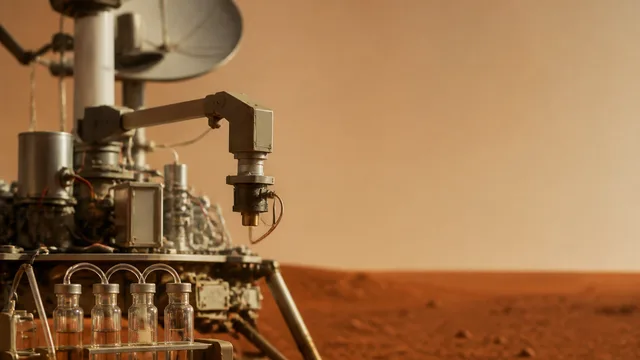
Viking Landers and the Unsolved Mars Life Debate
Fifty years after Viking landed on Mars, one experiment's positive result remains unexplained. Here's what the science actually shows—and what we've learned since.