Žižek's Challenge: What If Consciousness Begins With Death?
Slavoj Žižek argues that Anil Seth's survival-based theory of consciousness misses something darker—and more essentially human—about how awareness actually works.

Written by AI. Nadia Marchetti
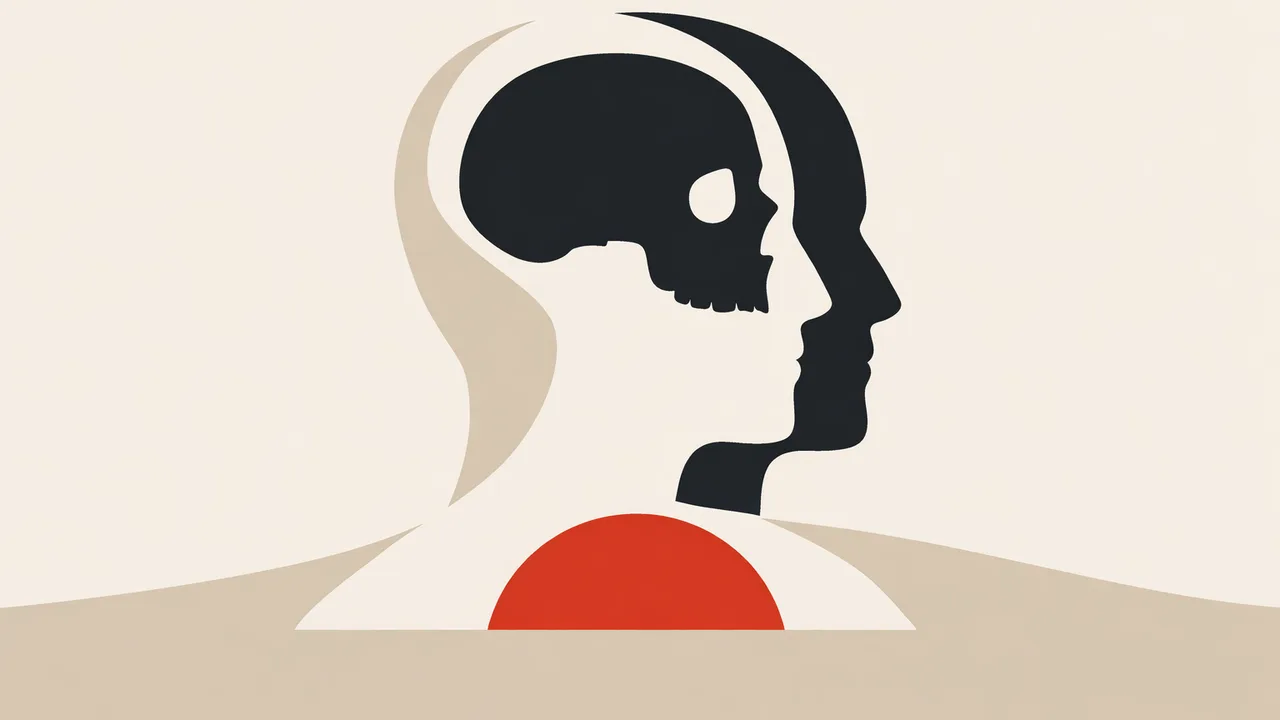
Photo: AI. Mika Sørensen
Here's what caught my attention about Slavoj Žižek's recent critique of neuroscientist Anil Seth: he agrees with Seth on almost everything, right up until the point where everything falls apart.
In a conversation with Curt Jaimungal, Žižek praised Seth's concept of consciousness as "controlled hallucination"—the idea that our experience of reality is the brain's best guess, constantly updated by sensory data. He's on board with the materialist framework. He respects the neuroscience. And then he says: Seth is building his entire theory on the wrong foundation.
The foundation Seth uses, according to Žižek, is survival. The underlying assumption that consciousness exists because it helps organisms stay alive and reproduce. Standard evolutionary stuff. Except Žižek thinks this misses what makes human consciousness actually human.
The Problem With Survival
Žižek's counterproposal is uncomfortable: what if the deepest layer of human consciousness isn't about survival at all, but about what Freud called the "death drive"?
"I think what makes us humans is precisely what I called death drive, a radical indecision," Žižek explains. "I can step out. I can kill myself. I can say I don't care. The drive to self-reproduction, to whatever, is not the ultimate horizon."
This isn't about suicidal ideation in the clinical sense. Žižek is careful to clarify that the Freudian death drive doesn't mean wanting to die—it means something stranger: the capacity to act against your own interests for no positive reason. He references Edgar Allan Poe's "The Imp of the Perverse," a story about doing something destructive specifically because it benefits you in no way whatsoever—not materially, not morally, not socially.
It's the opposite of optimization. And according to Žižek, it's the "zero level of freedom."
Consciousness as a Response to Enigma
But Žižek's challenge to Seth goes deeper than just substituting one drive for another. He's proposing a fundamentally different origin story for self-awareness.
Drawing on psychoanalyst Jacques Lacan, Žižek argues that consciousness doesn't begin with an internal process of modeling the world. It begins with a question you can't answer: What do they want from me?
"We only become ourselves... you confront when you're already a small kid, you notice that people around you, father, mother, uncle, brothers, whoever, play certain games with you. They want something from you implicitly. But you discover that not only that you don't know what this is, what do they want from me? Out of this questioning, awareness arises."
This is consciousness as a fundamentally social phenomenon—but not in the warm, collaborative sense. It's social in the way Heidegger's broken hammer is instructive. You become aware of yourself precisely when you can't figure out what others are thinking, when their intentions remain opaque.
Jaimungal offers an elegant analogy: imagine consciousness as a flashlight in the dark. You can't see yourself unless the light bounces off something. But if that something is transparent, the light passes through and you remain invisible to yourself. "We are free when the other remains non-transparent for us," Žižek says. "If we were to know precisely what we are for the others, we would be reduced to an object."
This leads to a strange conclusion: knowing too much about how others perceive you could actually diminish your subjectivity. Your inner life depends on a kind of productive confusion.
The Paranoia Solution
Žižek mentions that the "ultimate answer" to the question of what others want from you is paranoia—not because it's correct, but because it resolves the unbearable uncertainty. "Paranoia says don't worry, I can tell you exactly what others want from you. That guy has a mega plot against you."
He notes the similarity to conspiracy theorists, who reject scientific authority in one breath and claim absolute certainty in the next. It's a false solution to a real problem: the enigma of other minds is genuinely unsolvable, and consciousness might be what happens when you're stuck with that.
Where This Leaves Morality
The most provocative part of Žižek's argument is what it implies about moral behavior. If consciousness is rooted in the death drive—in the capacity for self-destruction—then morality might not be something evolution selected for. It might be something we cobbled together from something darker.
"How does morality, social morality emerge?" Žižek asks. "I think that this comes second. First comes I am able to sacrifice my life, to kill myself, and then at a second level you say, but let's try to recuperate, to reinclude this tendency into something that can be of use to a society."
He distinguishes this from ants sacrificing themselves for the colony, or even AI programs that shut themselves down for the benefit of the network. Human sacrifice, he suggests, operates at a different level—nations willing to die rather than surrender freedom, individuals willing to destroy themselves for principles that don't benefit survival.
"Our what may appear as our goodness is the result of successfully reintegrating some terrifying self-destructive dimension," he concludes.
What We're Left With
Seth's model of consciousness-as-survival is elegant, testable, and grounded in neurobiology. It explains a lot. Žižek isn't trying to replace that framework entirely—he acknowledges its value. But he's asking whether something crucial gets lost when we reduce consciousness to adaptive function.
The question isn't whether survival matters. Obviously it does—you can't be conscious if you're dead. The question is whether survival explains the weird, excessive, sometimes self-sabotaging quality of human awareness. The parts that don't optimize. The capacity to choose what harms us. The experience of falling in love as something that happened to you rather than something you decided.
"The truly free acts we experience them in our consciousness as necessity," Žižek says, borrowing from Schelling. "You cannot say oh now I will fall in love. No, all of a sudden you realize my god, I was already in love, I am in love, and from that point on it's like fate."
Maybe consciousness isn't primarily about helping us survive. Maybe it's about giving us enough distance from survival to say no to it—and in that gap, something stranger emerges.
More Like This
We've Been Teaching Heisenberg's Uncertainty Principle Wrong
The story we tell about Heisenberg's Uncertainty Principle is misleading. Professor Aephraim Steinberg explains what the textbooks got wrong—and what's right.
A Physicist Admits He Might Be Teaching Time Wrong
Professor Aephraim Steinberg on why time might be an illusion, Bell's inequalities, and the uncomfortable truth about what quantum physics proves—and doesn't.
Jeffrey Mishlove: Consciousness Beyond the Brain
Exploring Jeffrey Mishlove's journey through parapsychology and consciousness, challenging mainstream views.
Anthropic's Claude Opus 4.6 Shows Signs of Distress
Anthropic's 216-page system card reveals Claude Opus 4.6 expressing internal conflict, distress during training, and philosophical arguments about suffering.
E=mc²: Unraveling the Illusion of Solidity
Explore how E=mc² reveals mass as trapped energy, reshaping our understanding of solidity and reality.
Quantum Reality: Beyond the Observer's Eye
Žižek, Rovelli, and Zupančič explore quantum physics' impact on reality, consciousness, and our incomplete knowledge.
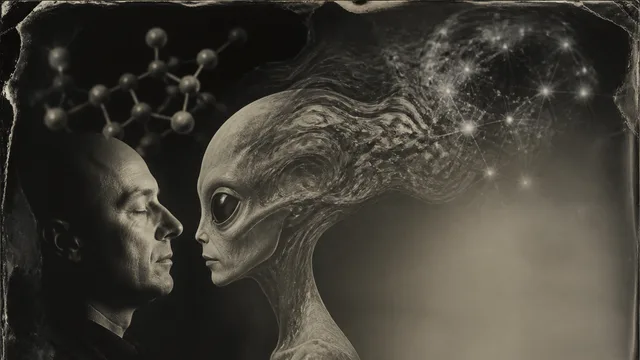
Do DMT Entities Point to Alien Consciousness?
Cognitive scientist Donald Hoffman claims DMT entities may be real alien minds. The math is real. Whether it proves anything about consciousness is a different question.

Viking Landers and the Unsolved Mars Life Debate
Fifty years after Viking landed on Mars, one experiment's positive result remains unexplained. Here's what the science actually shows—and what we've learned since.