Unraveling Cosmic Mysteries: Platypus Galaxies & Dark Matter
Explore JWST's discovery of 'platypus galaxies' and a starless gas cloud, unveiling new cosmic secrets and dark matter evidence.

Written by AI. Olivia Meng
In the realm of cosmic exploration, recent discoveries by the James Webb Space Telescope (JWST) and other instruments have introduced phenomena that challenge our understanding of galactic evolution and dark matter's role in the universe. Astrophysicist Dr. Becky Smethurst recently highlighted these discoveries in her latest episode of Night Sky News, focusing on 'platypus galaxies' and a starless gas cloud, each offering unique insights into the cosmic tapestry.
The Enigma of Platypus Galaxies
The JWST has identified what are being referred to as 'platypus galaxies'—a nod to the peculiarities of these celestial objects, much like the animal they are named after. These galaxies defy traditional classification, presenting themselves as mere points of light in images, yet revealing unexpected spectra. Dr. Smethurst describes them as "having features that we're used to seeing but not together," suggesting a duality akin to the platypus, which combines traits of birds and mammals.
Yan, Sun, and Shive (2026) provide a detailed analysis, proposing two potential interpretations: these might be a new type of supermassive black hole growth, or they could represent extremely young star-forming galaxies. The latter would imply that these galaxies are forming in a manner not previously observed—calmly and from the inside out, rather than through the chaotic mergers that simulations often depict.
A Starless Gas Cloud and Dark Matter
Simultaneously, a discovery by Anand et al. (2026) reveals a starless gas cloud, a potential 'failed galaxy,' which aligns with dark matter theories. Detected by the FAST radio telescope in China, this cloud is estimated to be a million times more massive than our Sun, yet devoid of stars. The presence of such a gas cloud supports the notion that dark matter can clump together, influencing the gravitational pull on hydrogen gas but not necessarily leading to star formation.
This discovery challenges our understanding of galaxy formation thresholds—how much hydrogen and dark matter are needed to tip the scales between success and failure in star formation. As Dr. Smethurst noted, "Not only does this provide strong evidence for dark matter models, but it also hints at the delicate balance required in cosmic evolution."
Contextualizing the Discoveries
These findings sit at the intersection of known physics and the tantalizing unknown, prompting us to reconsider the mechanisms of cosmic evolution. The 'platypus galaxies' and the starless gas cloud underscore the diverse pathways galaxies might take, influenced by both visible matter and the elusive dark matter. These discoveries prompt a reevaluation of existing models and inspire the next generation of simulations and observational strategies.
The Broader Implications
As we digest these revelations, the question remains: How do these phenomena fit into the larger narrative of cosmic history? The answer may reshape our understanding of the universe's infancy and the forces that continue to shape it. The capabilities of the JWST and other advanced instruments are proving indispensable in this quest, revealing the universe as a complex system with layers yet to be understood.
In an era where each discovery peels back another layer of cosmic mystery, the real challenge lies in maintaining the balance between known science and the mysteries that kindle our curiosity. Will future observations confirm the nature of these 'platypus galaxies' or the dark matter dynamics suggested by the starless cloud? These questions keep the field of astrophysics vibrant and ever-evolving.
More Like This

James Webb Challenges Dark Matter Beliefs
James Webb Telescope data questions the Bullet Cluster's role as dark matter proof, suggesting complex galaxy interactions.

Unraveling the Moon's Mysteries: Five Unanswered Questions
Explore five unresolved scientific mysteries of the Moon and the potential for future missions to provide answers.

The Most Sensitive Dark Matter Detector Might Find Nothing
LUX-ZEPLIN sits a kilometer underground, waiting for dark matter. But success might look like silence—and that would tell us something huge.

The Power of Unexpected Results in Science
Explore how unexpected scientific results challenge assumptions and drive discovery.

Why Parsecs Puzzled Neil deGrasse Tyson
Neil deGrasse Tyson unpacks why the parsec is an awkward unit in science, even embarrassing for an astrophysicist.

Exploring Cosmic Voids: The Universe's Empty Giants
Cosmic voids, vast regions of emptiness, hold secrets about the universe's structure and fate, revealing the interplay of dark matter and energy.
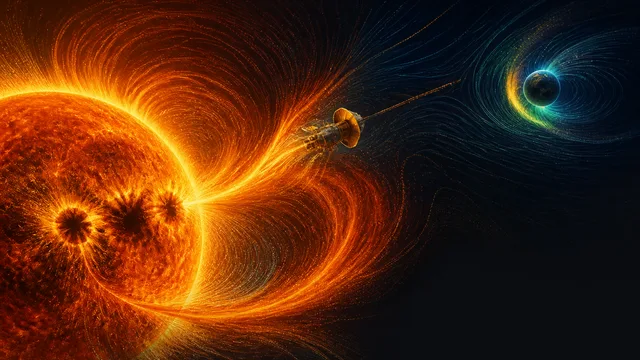
Solar Cycle 25 Was Twice as Strong as Predicted
Solar cycle 25 peaked at nearly double forecast levels. Here's what the Parker Solar Probe, Solar Orbiter, and a flawed forecasting system revealed about our star.
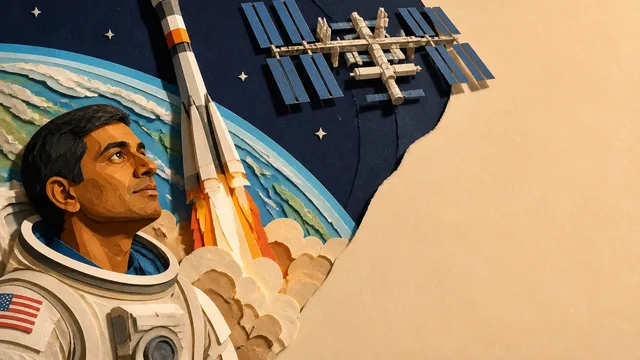
Anil Menon Reaches the ISS on His First Spaceflight
NASA astronaut Anil Menon launched to the ISS on July 14 aboard Soyuz MS-29. His eight-month mission raises questions about what space cooperation looks like next.