The Amyloid Hypothesis Turns 28—And Its Question Marks Remain
John Hardy helped create the amyloid hypothesis in 1998. Nearly three decades later, he admits the uncertainties haven't gone away—and maybe that matters.

Written by AI. Nadia Marchetti
In September 1998, John Hardy and colleagues published what would become one of the most influential—and contentious—models in Alzheimer's research: the amyloid hypothesis. Hardy, speaking at UC San Diego recently, pulled up that original diagram and pointed to something most researchers would prefer to gloss over.
"Look at the question marks," he said. "And those question marks are still here."
Then came the kicker: "One of the things about science is if a question mark is still there 28 years later, maybe it wasn't such a good question."
That's the kind of honesty you don't often get in science talks—especially from someone discussing their own foundational work. Hardy gets both the credit and the blame for the amyloid hypothesis, though he notes he deserves neither entirely. The first explicit statement came from George Glenner at UCSD in 1984, who predicted that the amyloid gene sat on chromosome 21 and explained why people with Down syndrome invariably developed Alzheimer's pathology. "I love predictions which are before the fact," Hardy said, in what felt like a gentle dig at the field's tendency toward post-hoc theorizing.
The Genetics Gold Rush
Hardy's path to the amyloid hypothesis started with a simple observation: in the early 1980s, Alzheimer's conferences drew maybe 40 or 50 people, and "for all the 40 or 50 people there were 10 or 20 theories about what how the disease started." Slow viruses. Accelerated aging. Aluminum saucepans. The field was a chaotic marketplace of competing explanations.
When Jim Gusella showed that the Huntington's gene lived on chromosome 4, Hardy saw a way forward. "I thought how cool is this? If you could understand how the disease starts and we can see how it ends, you can basically referee between the different theories." Genetics wouldn't just find genes—it would adjudicate between hypotheses.
The breakthrough came from a family in Nottingham, UK. Grandfather, two sons, five of ten grandchildren—all developing Alzheimer's disease. Hardy's team spent six years narrowing down the location on chromosome 21, back when PCR didn't exist and the human genome wasn't sequenced. Their crucial mistake? Assuming, like Huntington's, there'd be only one Alzheimer gene. They pooled all their families together for analysis, which obscured the signal. The revelation that families should be analyzed separately finally cracked the case.
But even then, only three of their 30 families had amyloid mutations. Other genes were clearly involved.
The Ruthless Years
What followed was what Hardy calls the "nature red in tooth and claw" era. Competing genetics groups were "absolutely ruthless competitors with each other," listening for whispers about each other's progress, hoarding families. Peter Hislop cloned presenilin 1 and presenilin 2. The field raced forward.
Then something shifted. "We all had to learn how to play nicely in the sandpit as we moved from the single kindred era to era when we pulled all our data. So we had to go from ruthless carnivores to placid vegetarians almost overnight after when we ran out of families."
The science behind presenilin was elegant. The protein turned out to be the gamma secretase that cleaves the amyloid precursor protein—all the disease-causing mutations sat right in or near the active site. It fit the amyloid hypothesis perfectly.
The Clearance Problem
Here's where Hardy's story gets more interesting. Gene duplications—having an extra copy of the amyloid gene, or synuclein in Parkinson's, or tau in tangle diseases—cause disease despite being "extremely rare" (seven families with APP duplications in all of the UK). But mechanistically, they're crucial. They tell us these proteins sit close to their "crystallization threshold." Make just 50% more and you get sick in your 50s.
The implication: "If you can if you just overexpress the protein, you're going to get sick. Then, if your clearance mechanisms are slightly deficient, you're going to get to the same outcome."
That matters because most Alzheimer's isn't caused by rare mutations—it's late-onset disease affecting millions. And if slightly sluggish clearance can achieve the same protein buildup as genetic overproduction, then the clearance machinery becomes just as important as the protein itself. For synuclein, that's the lysosome. For tau, probably the ubiquitin proteasome system (though Hardy admits "the data, for reasons I won't go into, is less certain").
What We Still Don't Know
When Hardy and his team crossed mice engineered to develop amyloid plaques with mice engineered to develop tau tangles, the amyloid pathology stayed stable but tangle pathology "went through the roof." That put amyloid upstream of tau—a key piece of the puzzle.
But those question marks from 1998? They're about the mechanisms connecting amyloid to tangles, the role of inflammation, the timing of interventions. Hardy showed a diagram so simple-minded he almost seemed embarrassed by it, even as he defended its basic truth.
The current amyloid-targeting therapies "can help and show measurable benefit," Hardy acknowledged in the lecture description, but "they do not stop the disease." That's not failure—that's information. It tells us the hypothesis was partly right and partly incomplete.
Science likes tidy narratives: hypothesis, experiment, confirmation. The reality is messier. Hardy's honesty about the enduring uncertainties feels more valuable than false confidence. The amyloid hypothesis has survived 28 years not because it explained everything, but because it explained enough to be useful—and wrong enough to be interesting.
Maybe the question marks aren't a bug. Maybe they're the point.
More Like This
Adobe and Nvidia Just Made 10 Million Sparkles Run at 280 FPS
Adobe Research and Nvidia developed a rendering technique that simulates millions of reflective particles in real-time without destroying your frame rate.
When AI Gets Cheaper Before It Gets Better
The AI race has split into two strategies: better performance at constant prices, or constant performance at collapsing costs. Both paths lead somewhere new.
ALS Gene Therapy Hits Multiple Targets At Once—Finally
UC San Diego researchers developed a gene therapy that can target up to nine disease pathways simultaneously in ALS, solving a problem that's plagued the field.

JWST's Latest Discoveries Are Breaking Cosmology
JWST is finding galaxies too big, too bright, and too early. From dark stars to interstellar comets, here's what the data is actually telling us.
Exploring Conspiracies and Wolves: Reality vs. Belief
Dive into conspiracy theories and the impact of reintroducing wolves, with insights from Joe Rogan and Andrew Wilson.
The Thorium Reactor Hype vs. Reality Check
Copenhagen Atomics promises shipping-container reactors cheaper than gas. A nuclear engineer explains what they're not telling you about the challenges ahead.
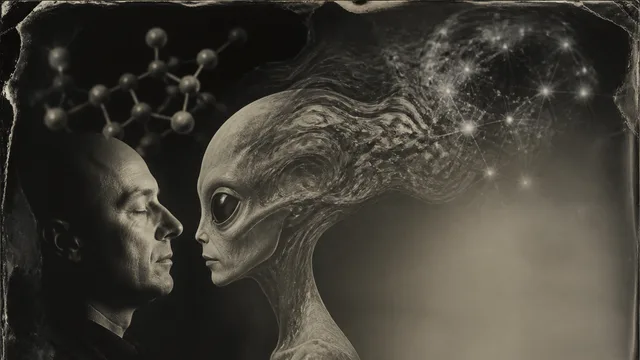
Do DMT Entities Point to Alien Consciousness?
Cognitive scientist Donald Hoffman claims DMT entities may be real alien minds. The math is real. Whether it proves anything about consciousness is a different question.
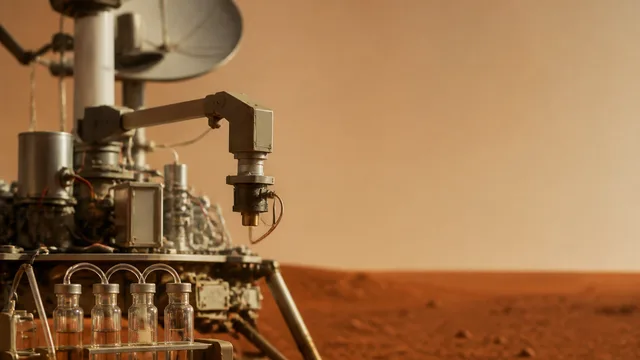
Viking Landers and the Unsolved Mars Life Debate
Fifty years after Viking landed on Mars, one experiment's positive result remains unexplained. Here's what the science actually shows—and what we've learned since.