The Bari Disaster: Mustard Gas, Secrecy, and 1943
On December 2, 1943, a German raid on Bari killed over a thousand people—and released mustard gas that officials spent decades trying to erase from history.

Written by AI. Sofia Ramirez
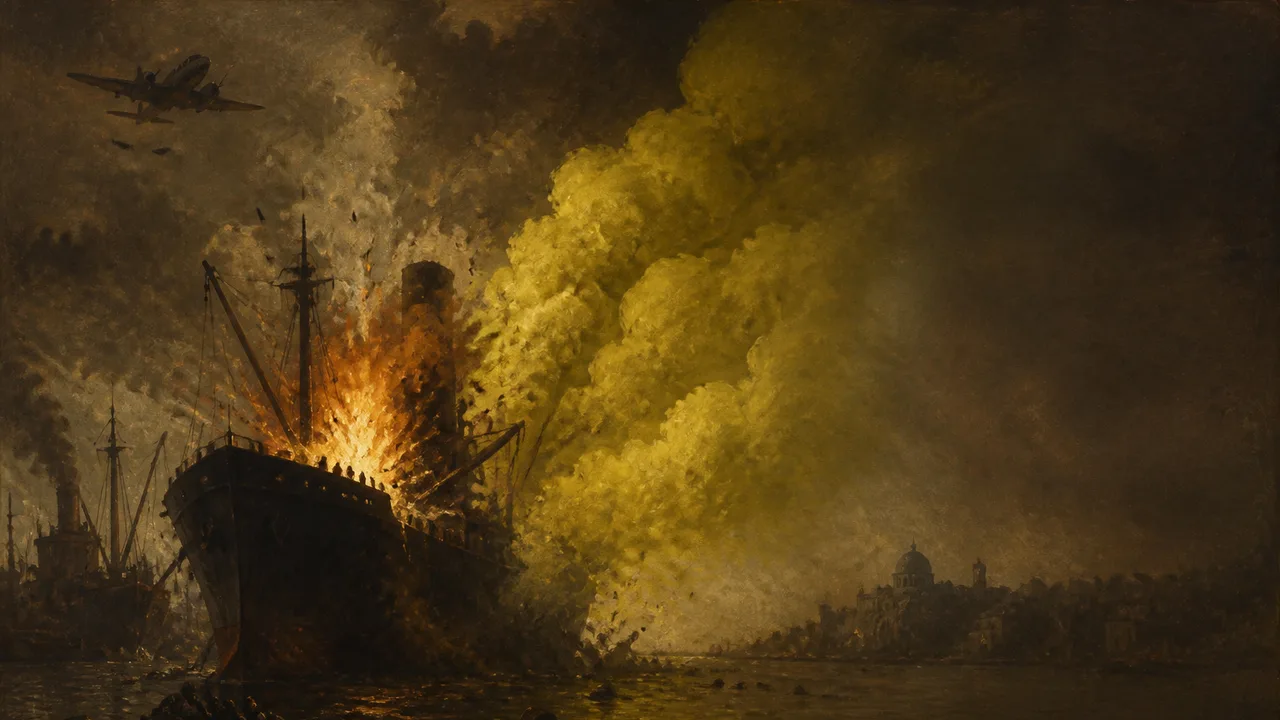
Photo: AI. Henrik Solberg
On the morning of December 2, 1943, the port of Bari looked like the kind of place the war had briefly passed over. The sun was out. Ships moved in and out of harbor. Dock workers unloaded cargo under floodlights that—in a detail that will make you wince—stayed on well past dark. British sailor Peter Bickmore described it simply: "It was an ordinary day. It was a beautiful day."
By midnight, eighteen ships had been destroyed, over a thousand people were dead, and the harbor waters were burning. And somewhere beneath the chaos, an invisible second catastrophe was just beginning—one that military officials on both sides of the Atlantic would spend years trying to make disappear.
What the John Harvey Was Carrying
The Liberty ship SS John Harvey arrived in Bari in late November 1943 carrying, among other things, more than 2,000 M47 bombs filled with mustard gas. The cargo manifest—one of the more chilling documents director Fabio Toncelli's documentary surfaces—listed the chemical agent in plain code. At least three senior port officials knew about it before the ship even docked. Their response was to assign the John Harvey a mooring wherever space was available, categorize the dangerous cargo as low priority, and tell no one else.
Mustard gas is not a weapon of quick death. It's a weapon of protracted suffering: blisters that open from the inside out, blindness, respiratory failure. It was banned under international protocol. The Allies had it stockpiled across theaters of the war as a deterrent—a last resort if Germany struck first with chemical weapons. The rationale, as Churchill had stated publicly in 1942, was retaliation rights: "We are ourselves firmly resolved not to use this obvious weapon unless it is used first by the Germans."
That logic made sense as policy. What it also meant, in practice, was that the existence of Allied mustard gas stockpiles could never, under any circumstances, become public knowledge—because public knowledge would hand Germany a pretext for its own chemical attacks. Including, potentially, on the beaches of Normandy, which the Allies were six months away from storming.
You can see the shape of the problem forming. The secret mattered more than the people.
Twenty Minutes of Hell
The German raid lasted roughly twenty minutes. One hundred and five bombers, guided by a reconnaissance flight that Allied radar—which a documentary map reveals the Germans had comprehensively mapped—completely failed to detect. Two lead aircraft dropped flares that lit the harbor like noon. The rest came in low over targets that, thanks to the blazing dock lights, were impossible to miss.
Warren Brandenstein, a sailor on the John Baskam, ran to his gun station as ships around him began exploding in sequence—a domino effect driven by how tightly packed the harbor was. Peter Bickmore, aboard a rescue launch afterward, described navigating through burning water toward a man trapped between two ships on the breakwater: "He must have been roasting alive. And we attempted to make for him with this boat. And the propeller fouled." They couldn't reach him. When the smoke cleared, he was gone.
Bob Wills, a dental technician with the American Medical Corps, was unloading a hospital train nearby when the John Harvey's hold finally caught. He doesn't describe the explosion so much as what came after it—a strange warm feeling, a smile he couldn't explain, and then nothing. He woke up on a road at dawn with no memory of the intervening hours.
The John Harvey simply ceased to exist. Its crew with it.
Nine Days of Silence
What the bombs didn't kill, the mustard gas—now dissolved in the harbor water, mixed with fuel oil, and dispersed by the explosion—began working on slowly. Survivors who'd been in the water started developing blisters within hours. Peter Bickmore: "About seven hours later, within seven hours, these blisters were coming up on my arms."
Hospital staff had no idea what they were looking at. When doctors asked by telephone whether chemical weapons had been present in the harbor, they were told categorically: no. Someone lied. The identity of who gave that order, and who received it, remains unresolved in the documentary record.
Patients were covered rather than stripped—the opposite of what mustard gas protocol required. Eyes went untreated. The contaminated clothing of corpses was handled bare-handed by workers like Bob Wills, who spent days in a basement coffining the dead without protection, pressing through damp fabric to retrieve identity tags.
On December 5th, a military doctor wrote to his commanding officer describing "undiagnosable dermatitis" and "serious eye disorders" that were killing patients without explanation. He asked for an expert. Three days passed before anyone answered.
The Doctor Who Wasn't Told
Lieutenant Colonel Stewart Alexander arrived in Bari on December 7th—five days after the bombing. He was, by most accounts, the foremost American expert on mustard gas contamination. He'd worked at Edgewood Arsenal, the US Army's chemical weapons research center in Maryland. The reason you send that particular person to Bari is obvious.
Whether he was officially told why is where the documentary gets genuinely murky, and genuinely interesting.
In a recorded phone call from 1988 obtained by research historian Nicholas Spark, Alexander—by then an elderly man—said he was not explicitly informed of the mustard gas. He had to piece it together himself while dealing with obstruction from both British and American command. Yet a document signed by the head of medical services and dated December 8th states the opposite: that Alexander was informed of everything and that the response was managed "quickly and efficiently."
That document, on closer examination, has dates added in pen. Notes about additional deaths written in the same ink as the date—suggesting it was composed or amended after the fact. The phone call mentioned in it as proof of immediate notification? No one can identify who placed it or who received it.
Alexander diagnosed mustard gas poisoning officially on December 11th. Nine days after the bombing. It's impossible to know how many people who were still alive on December 3rd might have survived with proper treatment.
The Architecture of Secrecy
The cover-up, as Toncelli's documentary reconstructs it, wasn't improvised. A meeting held in the harbor master's office in the days after the raid—top secret until recently—produced a formal decision: no general alarm about mustard gas would be issued. The situation was "under control."
A subsequent military document instructed medical personnel on how to write diagnoses: casualties were to be classified, without exception, as resulting from "enemy action." Soldiers who'd survived were sworn to silence. When questioned about their symptoms, their clothing confiscated, they were given no explanation.
Eisenhower appointed an inquiry commission that eventually confirmed the obvious: secrecy had been prioritized over health. Its conclusion was notably hedged—"part of the events remains obscure."
The logic driving all of this was coherent in a terrible way. With D-Day six months out, any acknowledgment that Allied ships were carrying mustard gas gave Germany a legal and propagandistic opening to deploy chemical weapons in retaliation. General Bradley later wrote that he had been genuinely relieved when it became clear the Germans wouldn't use gas on the Normandy beaches. Whether German restraint would have held if Bari had become public is a counterfactual no one can settle.
What we can settle: the people who died from gas exposure in the days and weeks after December 2nd died without knowing what was killing them. Their families received death certificates that listed "enemy action." The diagnosis was technically accurate and functionally a lie.
What Gets Left Out of the Official Record
Bari sits at an uncomfortable intersection of questions that don't resolve cleanly. The military commanders who chose secrecy weren't making a frivolous call—the stakes of a German chemical counterattack, particularly at Normandy, were real and enormous. But the people bearing the cost of that calculation were ordinary sailors, dock workers, nurses, and civilians who had no idea they'd been exposed to a banned weapon and no access to the treatment that might have saved them.
There's also the question of how the John Harvey ended up in a crowded harbor with its cargo classified as low priority. Three officials knew. None escalated. Whether that was negligence, complacency, or a quiet assumption that someone else had it covered is lost to the record.
Bob Wills, who spent days boxing up the dead in that basement, blind to the contamination he was touching, put it plainly near the end of the documentary: "I wonder how many people who lost their sons in that time realize what they actually died of. I wondered how many lives could have been saved if it had been announced that it was mustard gas."
He didn't answer the question. Nobody has.
More Like This
The KGB's Cyanide Newspaper Gun That Almost Worked
How a KGB poison weapon hidden in a rolled newspaper killed Ukrainian nationalist Stepan Bandera in 1957—and why one mistake unraveled the whole operation.
FBI's Struggle Against Omega 7: A Tale of Terrorism and Intrigue
Explore the FBI's complex investigation of Omega 7, a Cuban exile terrorist group, amid community challenges and evolving tactics.
Anne Frank: The Life, the Diary, and the Record
Anne Frank's diary survived the Holocaust when she didn't. A close look at her life in hiding, her death, and what the record still can't tell us.
Medicine's Strangest History, Explained
Medical historian Richard Barnett unpacks lobotomies, Typhoid Mary, penicillin, and why the history of medicine is a mirror for the present.
Attila the Hun: Scourge of God or Economic Strategist?
Attila never sacked Rome—yet he's history's ultimate barbarian. The real story is stranger, and more familiar, than the legend.
Rommel's Gold: Nazi Plunder or Enduring Myth?
The story of Rommel's lost gold is part treasure hunt, part Holocaust history. What do we actually know—and what are we choosing to romanticize?
Roosevelt's 1936 Peace Promise: What He Really Meant
In 1936, FDR ran on "peace" — but he meant three different things by it. Unpacking that word reveals a political strategy still worth examining today.
The Anaconda Plan Was Right. People Paid for It.
Winfield Scott's Anaconda Plan was strategically vindicated — but the years it took to work were paid for in hunger, death, and bondage by ordinary people.