How Roman Soldiers Survived Winter in Germania
Roman legionaries in Germania weren't built for the cold—but they survived it anyway. Here's what that survival actually looked like, and what it cost them.

Written by AI. David Oyelaran
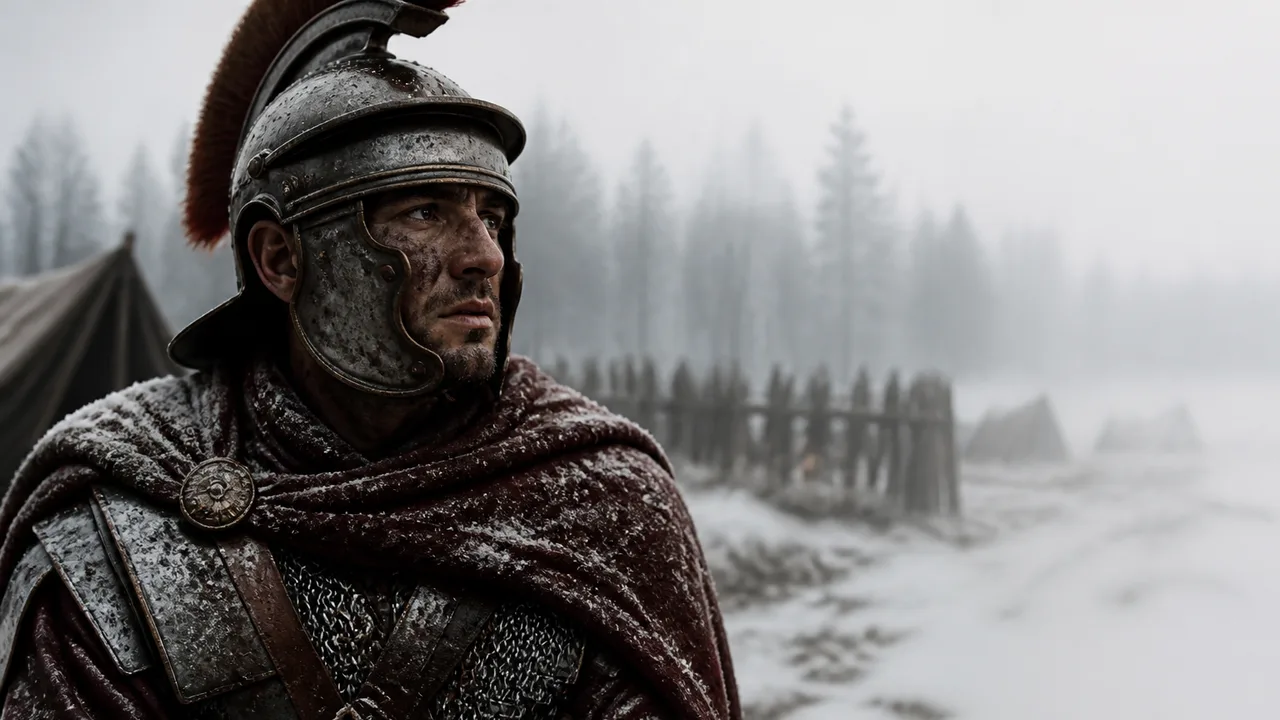
Photo: AI. Naia Iwarra
There's a detail that stays with me from Ancestral's recent documentary on Roman winter survival in Germania. It's not the frostbitten toes or the men dying sealed inside frozen chainmail. It's the trousers.
The Roman word for trousers was bracae. And the contempt packed into that single word tells you something essential about how Rome understood itself. Trousers were barbarian clothing. Savage clothing. The clothing of men who, as the documentary puts it, "hid their legs from honest air." A centurion in the early imperial period was authorized—expected—to enforce the dress code. A Roman kept his legs bare. That was civilization, legible in fabric.
Then the legions marched north into Germania, and the skin on their legs started cracking open like old parchment.
The Ancestral channel's latest deep dive is a nearly hour-long documentary on the physical and psychological mechanics of Roman winter survival, anchored in serious scholarly sources: Jonathan P. Roth's The Logistics of the Roman Army at War, Adrian Goldsworthy's The Roman Army at War, and Ian Haynes's Blood of the Provinces. The presentation leans hard into atmospheric immersion—layered soundscapes, slow pacing, a narration style that reads like historical fiction with footnotes. Whether that approach is your register or not, the underlying material is genuinely worth sitting with.
The Uniform That Became a Weapon Against Its Owner
The Roman military uniform was, by any honest measure, an engineering achievement optimized for the Mediterranean theater. The caligae—open-leather hobnailed sandals—gave soldiers grip on limestone roads and ventilation on summer marches. The lorica hamata, a chainmail shirt of roughly 30,000 interlocking iron rings, stopped blades without sacrificing too much mobility. The linen under-tunic breathed. Everything worked together in the context it was designed for.
Germania was not that context.
The documentary walks through the failure cascade with uncomfortable specificity. The hobnails that gave traction on Italian roads acted as thermal conductors on frozen ground, pulling cold directly into the sole of the foot. The straps that made the sandals breathable in summer left bare skin exposed to northern wind. Once snow melted into the leather, the leather tightened as it froze, cutting off circulation at the exact moment circulation mattered most. The body's triage response—pulling warm blood away from extremities to protect the core organs—meant that by the time the burning in a soldier's toes gave way to numbness, the damage was already done. That absence of pain, the documentary notes, is frostbite's cruelest trick: it feels like relief.
The chainmail created its own kill switch. Heavy marching generated heat and sweat, which soaked the linen tunic underneath the iron rings. While the soldier kept moving, body heat kept the wet fabric from freezing. The moment the column stopped, the iron—a perfect thermal mirror—immediately pulled that warmth out of the cloth. The wet linen turned to ice. The tunic locked to the skin. The chainmail locked to the tunic. Men who sat down to rest sometimes never stood back up.
Function First, Dignity Second
What the documentary tracks most carefully—and what I find most historically interesting—is how Rome responded to this. The institution had two options: defend its own symbolic identity, or survive. It chose survival, consistently and without apparent sentimentality.
The bracae taboo collapsed. Men bound their splitting legs in wool scraps, then crossed the cultural line entirely and pulled on barbarian trousers. The supply chain was already failing—carts axle-deep in frozen mud, pack mules dying in harness—so the men sourced warmth from the only available inventory. They stripped heavy pelts off the bodies of fallen Germanic warriors, still wet with blood, and draped them over their armor. No washing. No ceremony. Just warmth.
And every morning, before dawn, in temperatures that had no business being endured, soldiers stripped naked and coated themselves head to foot in laridum—rendered pork fat, a standard ration item repurposed as a skin barrier. The fat formed what the documentary describes as a hydrophobic seal against the wind. It also destroyed their clothing, attracted lice, and produced a smell that is genuinely difficult to imagine at scale: thousands of men, packed shoulder to shoulder on the march, radiating rancid pig fat and unwashed wool.
"The Roman machine kept making the same call over and over again," the documentary says. "Function first, dignity second. No exceptions."
That is not a small thing, institutionally. Most human organizations—ancient or modern—resist symbolic self-revision even under survival pressure. Rome, at least in this account, had built the capacity for pragmatic humiliation directly into its military culture. The centurions who had been enforcing the trouser ban were now ordering the grease application by name.
What the Forest Actually Saw
Here's a question the documentary raises implicitly but doesn't fully sit with: what did this transformation look like from outside the Roman frame?
The Germanic tribes, the documentary tells us early on, had decided the winter would do their work for them. They watched from the tree line and waited. What they eventually saw—if the historical reconstruction holds—was a Roman cohort on deep-winter patrol that had become, visually and materially, almost indistinguishable from themselves. Ragged trousers. Stuffed leather shoes. Bloody animal furs over iron armor. Faces blackened with soot against snow glare.
"They had been sent into Germania to bring civilization to the wilderness," the documentary observes. "The wilderness had answered by making them indistinguishable from the men they were hunting."
That's a striking formulation, and it opens something the documentary doesn't fully explore. The Romans didn't just adopt Germanic clothing and gear out of necessity—they absorbed it into their military practice. Auxiliaries recruited from northern tribes brought their own cold-weather knowledge into the legions. The bracae that were forbidden in the early imperial period were standard-issue by the third century. The practical wisdom of the people Rome was trying to subjugate ended up inside the institution that was trying to subjugate them.
Military historians have long noted this pattern of Roman absorption—the empire's capacity to incorporate and normalize what it first encountered as foreign and threatening. The winter campaign in Germania may be one of the starker case studies: survival literally required putting on the enemy's skin.
A Note on the Source
One thing worth naming: Ancestral's craftsmanship manifesto claims the documentary was "entirely hand-placed" and explicitly rejects "lazy, automated AI assembly"—while crediting its soundtrack to Suno AI. That tension between stated ethos and disclosed practice doesn't invalidate the research, which appears to be grounded in legitimate scholarly sources. But it's the kind of thing a reader probably deserves to know before deciding how much weight to give the channel's framing.
The history here is real. The men were real. Their frozen toes and their rancid fat and their slow, undignified transformation in the northern dark—all of that happened, documented across multiple serious works of military scholarship. What Ancestral adds is atmosphere and accessibility, which have genuine value for bringing this material to a wider audience.
What the documentary stops just short of asking is the question I'd most want answered: when those men finally staggered through the gates of the Hiberna—the winter camp they'd been surviving toward for months—the documentary suggests the real psychological horror was only just beginning. The walls that kept the cold out also sealed them in. The march had been holding their minds together. What happened when it stopped?
That's the thread I want pulled next. The Romans engineered survival against the cold. What they apparently couldn't engineer was the silence on the other side of it.
More Like This

Middle Platonism's Hidden Role in Western Esotericism
ESOTERICA's new crowdfunded seminar argues Middle Platonism built the foundations of Hermeticism, Gnosticism, and early Christian theology. Here's what that means.
San Francisco 1906: The Disaster That Was Built
The 1906 San Francisco earthquake wasn't just an act of nature—it was the bill coming due on decades of willful ignorance. Here's what actually happened.
Is Nature Good? Harari and Žižek Say No
Yuval Noah Harari and Slavoj Žižek agree: nature isn't inherently good. Their debate reveals why "natural" is almost always a political argument in disguise.

The Real Story Behind the 1925 Nome Serum Run
The 1925 Nome serum run wasn't just Balto—it was 9,500 years of sled dog evolution, desperate medical crisis, and mushers who knew the odds.
The Gods of Pre-Islamic Arabia, In Their Own Words
Ancient desert inscriptions reveal the polytheistic world before Islam—gods, prayers, sacrifice, and fate, recorded by the nomads who lived it.
Attila the Hun: Scourge of God or Economic Strategist?
Attila never sacked Rome—yet he's history's ultimate barbarian. The real story is stranger, and more familiar, than the legend.

DNA Names a Revolutionary War Teen Soldier After 245 Years
Genetic genealogy has identified Private John Pumphrey, a Maryland teen who died at the Battle of Camden in 1780 — one of America's oldest John Doe cases.
Cicero and the Fall of the Roman Republic
Marcus Tullius Cicero defended Rome's Republic with words alone—and paid with his life. A look at history's most consequential orator and his impossible political moment.