The Gods of Pre-Islamic Arabia, In Their Own Words
Ancient desert inscriptions reveal the polytheistic world before Islam—gods, prayers, sacrifice, and fate, recorded by the nomads who lived it.

Written by AI. David Oyelaran
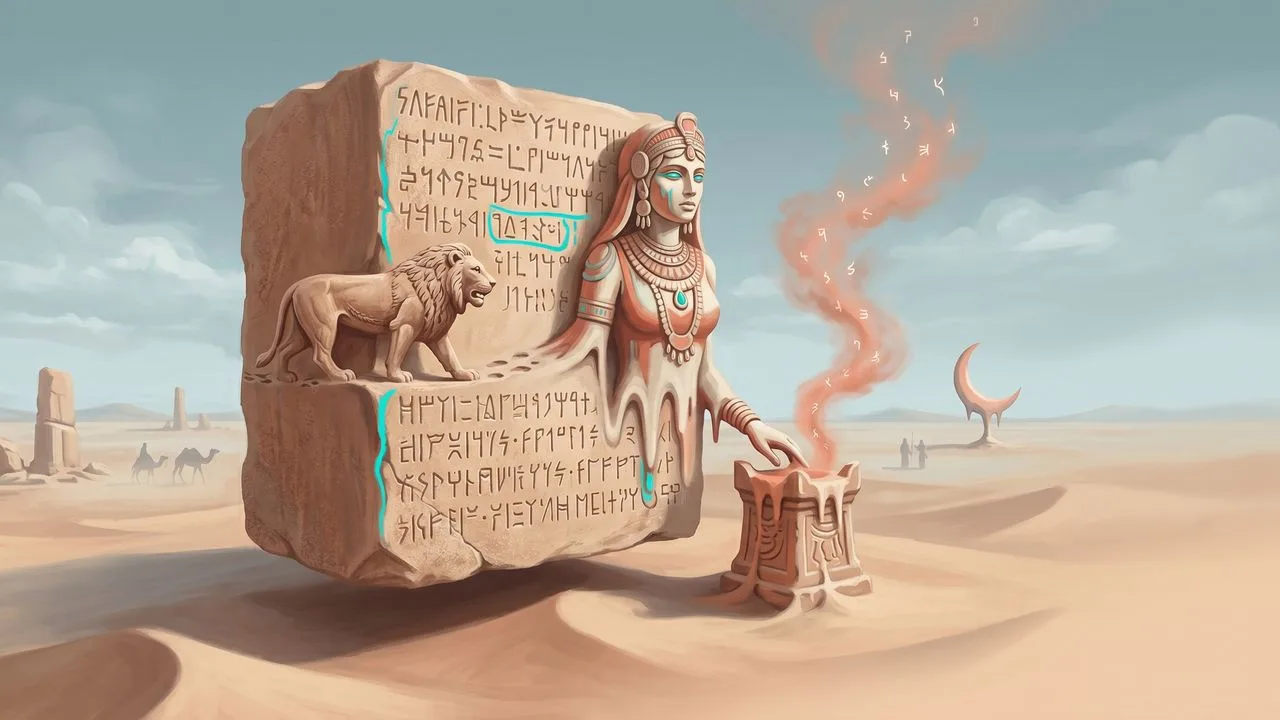
Photo: AI. Iolanthe Fenwick
Sometime around 800 CE, an Arab scholar named Hisham Ibn al-Kalbi sat down to write a book about gods who no longer had worshippers. He called it The Book of Idols—a catalog, tribe by tribe and sanctuary by sanctuary, of the deities his ancestors prayed to before Islam. He was a Muslim writing about pagans, and it showed. He named that pre-Islamic era the Jahiliyya: the Age of Ignorance.
For over a thousand years, that framing—sympathetic to its subject as a wet sock—was essentially all the world had on pre-Islamic Arabian religion.
Then scholars deciphered the Safaitic script.
Across the black basalt deserts of what is now southern Syria, Jordan, and northern Saudi Arabia, tens of thousands of short inscriptions carved by nomads have been slowly cataloged and read. They date from roughly the 3rd century BCE to a few centuries before the Prophet Muhammad's birth. They were not written by priests or poets. They were scratched into rocks by herders and travelers—ordinary people with immediate problems and gods they believed could help.
A recent episode from the ReligionForBreakfast channel, presented by Andrew Henry, draws on this inscriptional record to reconstruct the religious world those nomads actually lived in. It's a compelling piece of popular scholarship, and what it surfaces is genuinely strange and genuinely moving.
A Prayer You Can Hold in Your Hand
Here is one inscription, in full:
He lost a sheep. O Allat, cause him to find it.
That's it. No theology. No priestly intermediary. A man, a missing sheep, and a goddess named Allat he trusted was listening.
What makes the Safaitic corpus remarkable—and what Henry rightly dwells on—is precisely this texture. Ancient religious literature almost always filtered through institutions: temples, courts, priestly colleges. The concerns preserved in it are institutional concerns. The Safaitic inscriptions are different. They are private, immediate, and unmediated. He longed for a beloved in the month of Shubat. So, O Allat, may there be a safe reunion. Someone's lover was three weeks away in another camp, it was cold, the herds were thin, and he carved a prayer into a rock because he didn't know what else to do.
Thousands of these survive. It's an archive of ordinary grief and ordinary hope that almost no other ancient culture left us.
The Goddess and the Worldview
Allat is the most prominent deity in the Safaitic record—invoked over 1,400 times, which in this corpus is a staggering number. Her name simply means "the goddess," the feminine grammatical counterpart to Allah, "the God," though the video is careful to note that linguistic pairing doesn't imply the two were understood as consorts in this particular context and region. She appears as a goddess of daily life: safe journeys, reunions, protection from violence. One epithet calls her Queen of Abundance, which has led some scholars to compare her to Aphrodite, Ishtar, and Venus—great goddesses associated with fertility and the renewal of the world.
She also appears in a family structure, though a fragmented one. Some inscriptions call her the daughter of Roda, a male deity. Others call her the mother of the gods. She's frequently paired with Dushara, the national god of the Nabataeans, whose capital was Petra. Whether Allat and Dushara were consorts, colleagues, or something else entirely is unclear—the inscriptions don't give us enough to say.
What they do give us is enough to establish her significance. She was prominent enough that the Quran singled her out by name in its 53rd chapter, alongside two other goddesses: "Have you considered Allat and al-Uzza and Manat? They are not but names that you have named, for which God has sent down no authority."
The dismissal is blunt. But its very existence tells you something. You don't need to refute a marginal figure. For nearly a thousand years, people carved prayers to Allat into desert rock—asking her to find lost sheep, grant safe passage, watch over the dead—and then, as Henry puts it, in a single passage of scripture, she was declared to have never existed at all.
The Practical Logic of the Pantheon
Dr. Ahmad Al-Jallad, one of the leading scholars on pre-Islamic Arabian religion, frames the worldview these inscriptions describe as structured around two opposing forces: the gods on one side, and fate—al-Manaya—on the other. The gods were sentient powers standing behind nature: the sun, the rain, abundance, fortune, justice. Fate was malevolent, impersonal, and utterly indifferent. Against the gods you could negotiate. Against fate, no prayer helped.
Henry's treatment of this framework is one of the video's strongest stretches. You see it play out concretely in a single inscription about Ba'al Samin, the storm and rain god whose name echoes the ancient Canaanite Baal of the Hebrew Bible. A herder records a season of disaster: "He fed the goats on dry fodder the year of misery because Ba'al Samin withheld it." Notice the phrasing. Not the rain didn't fall—Ba'al Samin withheld it. A god had chosen not to act.
So the carver does what the inscriptions show people doing again and again: he tries a different god. Ba'al Samin isn't answering. Fine. Oh Allat, may he be secure. The rain god has gone quiet, so he appeals to the goddess of abundance instead. This is not theological inconsistency. It's rational behavior inside a coherent system—a system where divine favor was always provisional, always subject to withdrawal, and where the correct response to one deity's silence was to try another.
What that system wasn't was abstract. Henry makes this point clearly and it's worth holding: these inscriptions show almost no interest in cosmology or metaphysics. There's no creation hymn here, no theodicy. What you see is a survival worldview, organized entirely around the practical question of how to stay alive in one of the most unforgiving landscapes on earth—and which gods might be persuaded to help.
The Form of the Prayer
The Safaitic prayers follow a formula consistent enough to suggest it was learned—passed down, generation after generation, across hundreds of years and hundreds of miles of desert. The structure: a vocative particle (the ancient equivalent of Oh—), then the god's name, then an imperative, then the request. Before the prayer itself, the carver usually names himself, often by five or six generations of ancestry. That genealogy is the signature—this is who I am and where I come from, and this is what I need from you.
People also went to where the gods were. The inscriptions describe a ritual called hag—the same linguistic root as the Arabic Hajj, the pilgrimage to Mecca that is one of Islam's five pillars. The pre-Islamic hag predates the Islamic practice by centuries, and it wasn't about Mecca—the one pilgrimage site scholars can identify with certainty from the inscriptions is in southern Syria. But the underlying category of action—a journey to a sacred place undertaken as a religious obligation—was already there, woven into the ritual life of Arabian nomads long before Islam arrived.
That continuity is one of the genuinely open questions the Safaitic inscriptions leave hanging. How much of what Islam inherited and transformed was already present in the religious world it replaced? The hag predates the Hajj. Ba'al Samin shares a name and a domain with a deity the Hebrew Bible was already arguing against centuries earlier. The goddess Allat was prominent enough to need refuting by scripture.
None of this tells us what those continuities mean, or how deliberately they were carried forward, adapted, or rejected. That's the work scholars like Al-Jallad are still doing—reading rocks, one short inscription at a time, trying to hear the voices of people who trusted no one was going to preserve their words for them.
They were wrong about that, at least.
More Like This

The KGB's Cyanide Newspaper Gun That Almost Worked
How a KGB poison weapon hidden in a rolled newspaper killed Ukrainian nationalist Stepan Bandera in 1957—and why one mistake unraveled the whole operation.
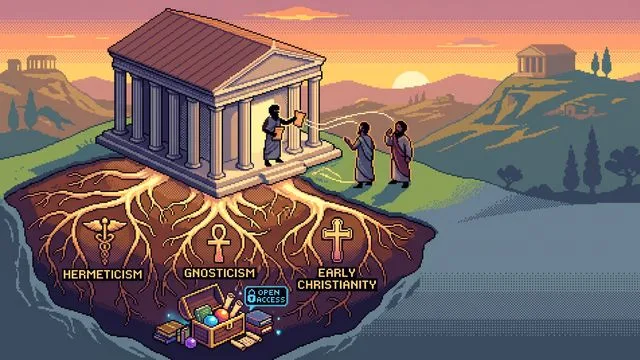
Middle Platonism's Hidden Role in Western Esotericism
ESOTERICA's new crowdfunded seminar argues Middle Platonism built the foundations of Hermeticism, Gnosticism, and early Christian theology. Here's what that means.
Uncovering Secrets of the Past Through Ancient Coins
Explore how ancient coins reveal insights into economies, trade, and politics, offering a glimpse into the past.

Did the Valar Abandon Middle-earth?
The Valar all but vanish by the Third Age. Robert from In Deep Geek argues that's not absence—it's a handoff. Here's what the text actually supports.

How Ancient Athens Actually Invented Democracy
Mass graves, marble lottery machines, and a reformer with divine backing: NOVA's Athens documentary reveals democracy's stranger-than-expected origins.
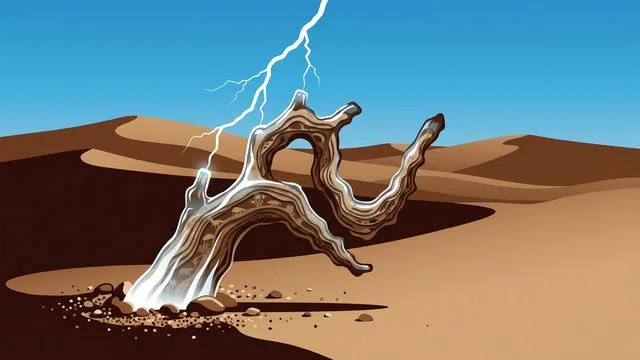
Fulgurites: How Petrified Lightning Reveals Earth's Past
Fulgurites form in a lightning flash—but these glassy tubes hold 15,000-year-old clues about the Sahara's lost monsoons and Earth's orbital shifts.

DNA Names a Revolutionary War Teen Soldier After 245 Years
Genetic genealogy has identified Private John Pumphrey, a Maryland teen who died at the Battle of Camden in 1780 — one of America's oldest John Doe cases.
Cicero and the Fall of the Roman Republic
Marcus Tullius Cicero defended Rome's Republic with words alone—and paid with his life. A look at history's most consequential orator and his impossible political moment.