Fulgurites: How Petrified Lightning Reveals Earth's Past
Fulgurites form in a lightning flash—but these glassy tubes hold 15,000-year-old clues about the Sahara's lost monsoons and Earth's orbital shifts.

Written by AI. Olivia Meng
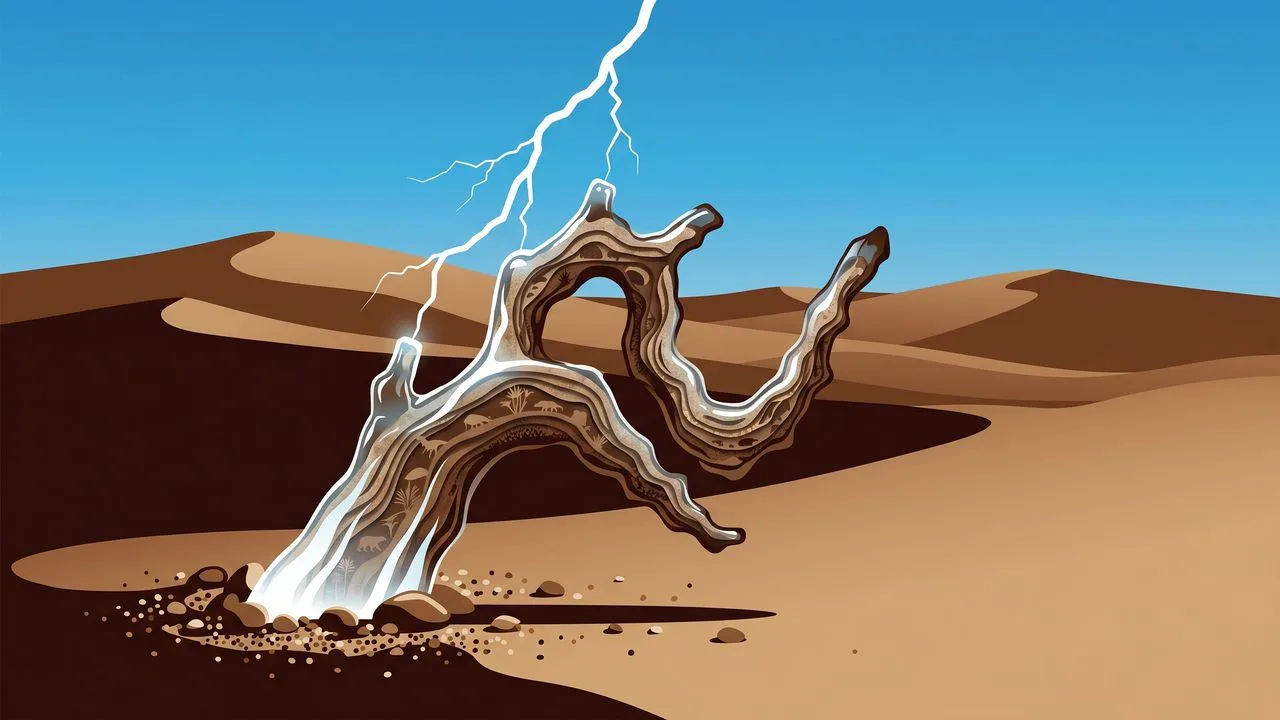
Photo: AI. Mika Sørensen
Most of geology operates on timescales that humble the human imagination—mountains grinding upward over tens of millions of years, ocean floors spreading centimeter by centimeter across the eons. The discipline trains its practitioners to think slowly, to distrust the instantaneous.
Which is what makes the study of fulgurites so quietly strange.
A fulgurite is what lightning leaves behind when it strikes the ground. Up to one billion volts, currents reaching 30,000 amps, all of it discharged in less than a quarter of a second at a single point in the earth. As SciShow host Reid Reimers describes it, that concentrated energy will "immediately burn anything flammable or melt anything nonflammable, including rock." The rock cools almost as fast as it melted. What remains is a hollow, glassy tube—a physical record of an event that lasted a fraction of a heartbeat.
The contrast with conventional geology is almost comic. And yet, as a small but serious community of researchers has established, these centimeter-scale glass tubes can decode climate shifts that played out across millennia.
What You're Actually Holding
The physical characteristics of fulgurites are almost entirely determined by local accident. The length depends on how long the discharge lasted and the conductivity of the ground. The shape—straight, bent, branched like a frozen river delta—follows the path of least electrical resistance, which water in the soil can redirect dramatically. The chemistry depends entirely on what the ground was made of in the first place.
Sand and rock fulgurites are the most common, and since silica is a major component of both, they typically produce a glass called lechatelierite—fused silica grains, smooth on the exterior, occasionally almost translucent. Strike limestone instead and you get something chemically different altogether, no lechatelierite required.
The longest specimen on record was found in Florida, measuring over five meters. Most are small enough to sit comfortably in a palm.
There is, the SciShow segment notes, "very little else that unites the fulgurites since location, duration, and conditions differ for everyone." What unites them, instead, is their relationship to the moment of their formation—and what that moment can tell researchers who know how to ask.
The Logic of Paleo-Lightning
The field is called paleo-lightning, and its central insight is deceptively simple: a fulgurite is found exactly where it formed. Unlike sediment carried by water or dust transported by wind, a fulgurite does not migrate. Embed it in a stratigraphic sequence—the layered record of sediment accumulation—and you can date it. Find many of them across a landscape and you can begin to map a weather pattern.
Lightning is not random in a climatologically meaningful sense. It requires tall convective clouds, which require moisture and instability in the atmosphere. Lightning storms cluster where conditions favor them. A dense population of similarly dated fulgurites across a landscape is not noise—it is signal. It means thunderstorms happened there, repeatedly, at that time. And thunderstorms, as Reimers observes, tend to bring rain.
This is the fulgurite's leverage: it is a proxy for precipitation. Not a direct measure—there is no rain gauge in a glass tube—but a reliable indicator that the atmospheric conditions for rain were present.
The Sahara That Wasn't
The most striking application of this logic involves one of the most inhospitable places on Earth today.
Researchers mapped fulgurites across roughly 50,000 square kilometers of central Niger and found that they date almost uniformly to the Holocene, approximately 15,000 years ago. This region now receives less than 20 millimeters of rainfall annually—less, as the SciShow segment puts it, "than New York City can get in a single week in the spring." The hyperarid Sahara. No thunderstorms. No lightning. No fulgurites forming today.
And yet, 15,000 years ago, there were enough lightning strikes across this landscape to leave a mappable record. The ground had to be moist enough for conductivity to permit the variety of fulgurite shapes observed. Supporting evidence from lake sediments and ancient soils from the same period corroborates the picture: this was not a desert.
The geographic pattern of the fulgurites adds another layer. Researchers found more of them the farther south they traveled in Niger—more strikes concentrated toward the direction of what is today the Sahel, the semi-arid transitional band between the Sahara and the wetter tropical savanna. The Sahel currently receives its moisture from summer monsoons. The fulgurite distribution suggests those monsoons once reached hundreds of kilometers farther north than they do today.
Then came the Libyan specimens, and the picture sharpened considerably.
Trapped Air, Ancient Fingerprints
When rock melts and refreezes in the fraction of a second after a lightning strike, it can trap microscopic bubbles of the surrounding atmosphere. These are not merely curiosities. Researchers analyzing ancient fulgurites found in Libya—north of Niger—measured the CO2 composition inside those bubbles and identified what Reimers calls "the characteristic fingerprint of an active plant ecosystem just like that found in the Sahel today."
Preserved Holocene air. The chemical signature of a living, vegetated, moisture-receiving landscape, locked in glass in a place that now receives almost no rain.
The combined evidence—the Niger distribution patterns, the Libyan atmospheric chemistry, the corroborating lake and soil records—forms the evidentiary basis for what scientists call the African Humid Period: a warm, wet interval during the early-to-mid Holocene when the Sahara was substantially greener than it is today, and when the Sahel's monsoon boundary lay at least 650 kilometers farther north.
The Orbital Connection
What caused the African Humid Period? The answer involves the planet itself, not just its atmosphere.
Earth's orbit is not fixed. Over tens of thousands of years, the tilt of the rotational axis and the shape of the elliptical orbit shift through predictable cycles—collectively known as Milankovitch cycles. During certain configurations, Northern Hemisphere summers receive significantly more solar energy than they do today, intensifying the thermal contrast that drives monsoon circulation and pushing the tropical rain belt northward.
Fifteen thousand years ago, the orbital geometry favored exactly this kind of intensification. The SciShow segment frames it this way: the tilt and orbit "align to make summers more intense than they are today, driving an expansion of the tropics and the migration of the Sahel."
Fulgurites, then, are not simply records of individual lightning strikes. Mapped, dated, and analyzed, they become evidence of a planetary-scale feedback: orbital mechanics shifting seasonal heating, which shifts atmospheric circulation, which shifts where monsoons deliver rain, which shifts where thunderstorms form, which shifts where lightning strikes, which produces glass tubes in sand that preserve, in microscopic air bubbles, the chemical signature of a world that no longer exists.
That chain of inference—from orbital geometry to ancient CO2 trapped in lightning glass—is what makes paleo-lightning more than a niche curiosity. Each link in it is independently verifiable, which is what gives the reconstruction its credibility.
What the Proxy Can and Cannot Say
It is worth being precise about the limits here. Fulgurites indicate the presence of convective storms. They do not measure rainfall totals. They do not tell us about the seasonality of precipitation with precision, though the monsoon connection provides some inferential grounding. A single fulgurite represents a single moment; a population of fulgurites, mapped across a landscape and dated consistently, represents something statistically more meaningful.
The African Humid Period is not a controversial finding—it is supported by multiple independent proxies including pollen records, lake levels, and geomorphological evidence of river systems that no longer flow. The fulgurites are one thread in a well-corroborated story, not a lone claim standing on unusual evidence.
What they offer that other proxies sometimes cannot is temporal precision and spatial specificity. A lake sediment core tells you water was present somewhere. A cluster of dated fulgurites tells you thunderstorms were present at particular coordinates at a particular stratigraphic moment. Different tools, different resolutions, complementary pictures.
There is something worth sitting with in the basic geometry of fulgurite science: that the most transient event in geology—a discharge lasting a quarter of a second—can encode information about orbital cycles operating over tens of thousands of years. The resolution of the record and the scale of what it captures exist at opposite extremes. Geology is full of such mismatches, places where the very small and the very long intersect in ways that require patience to see.
The Sahara was green. The monsoons reached the Libyan plateau. The orbital mechanics said so, and the lightning, arrested in glass, agreed.
More Like This

Rethinking Cosmic Acceleration: A Local Illusion?
Exploring the debate on whether the universe's acceleration is a local phenomenon, challenging the concept of dark energy.

How the Asteroid Impact Ended the Dinosaur Era
Explore the catastrophic asteroid impact that ended the dinosaurs, its immediate aftermath, and the long-term environmental changes.

The Broken Circuit That Revealed Light Is Electromagnetic
How James Clerk Maxwell solved a capacitor paradox and discovered that light is electricity and magnetism dancing together through empty space.

Understanding the Real Risk of Brain-Eating Amoebas
Explore the facts and myths surrounding brain-eating amoebas. How real is the threat, and can climate change affect its spread?

Science Spent Millions on Blue Roses and Failed Spectacularly
Decades of genetic engineering haven't produced a true blue rose. The quest reveals fascinating limits of plant biology—and human obsession.
How Water Shaped Cities and Civilizations
Explore water's role in city formation and its lasting impact on urbanization.
Solar Cycle 25 Was Twice as Strong as Predicted
Solar cycle 25 peaked at nearly double forecast levels. Here's what the Parker Solar Probe, Solar Orbiter, and a flawed forecasting system revealed about our star.
Anil Menon Reaches the ISS on His First Spaceflight
NASA astronaut Anil Menon launched to the ISS on July 14 aboard Soyuz MS-29. His eight-month mission raises questions about what space cooperation looks like next.