Is Nature Good? Harari and Žižek Say No
Yuval Noah Harari and Slavoj Žižek agree: nature isn't inherently good. Their debate reveals why "natural" is almost always a political argument in disguise.

Written by AI. Jamie Cho
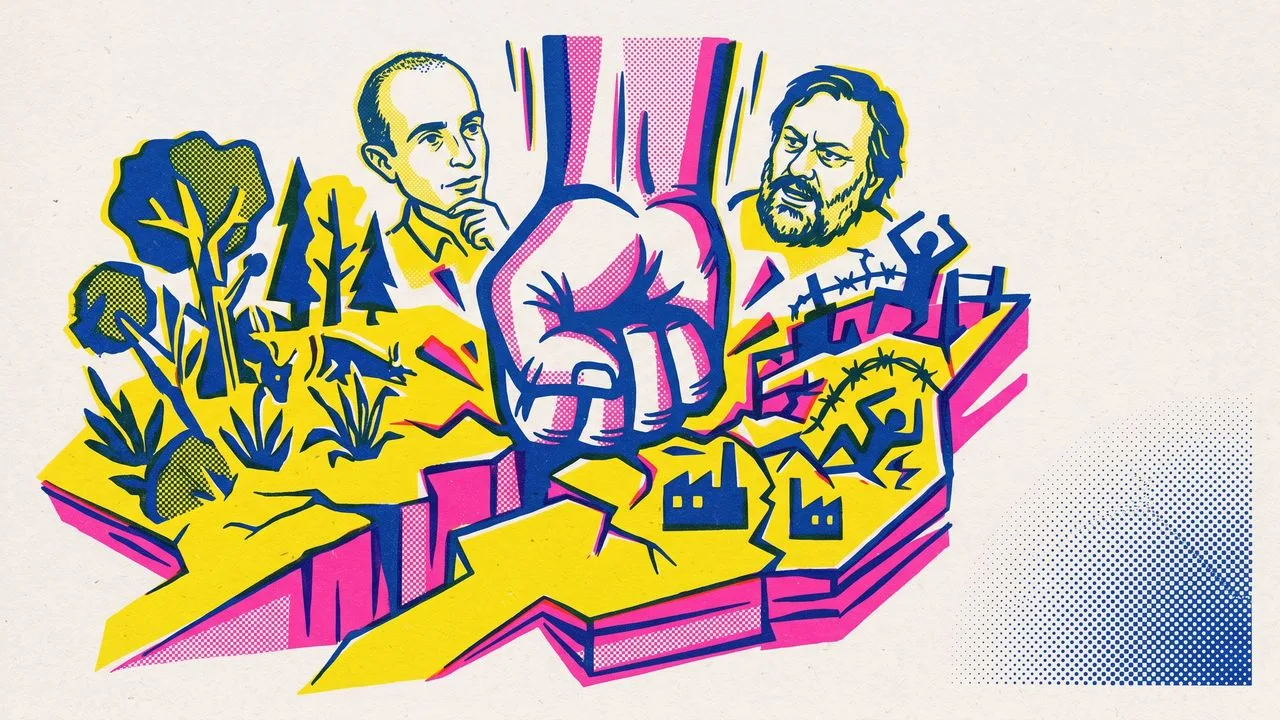
Photo: AI. Jorah Maktoum
Here's something the wellness industry doesn't want you sitting with: malaria is natural. So is smallpox. So is a five-year-old dying of a preventable infection because their parents decided vaccines were "unnatural." The coal that powered the Industrial Revolution—the one we're now desperately trying to undo—came from mass extinctions so catastrophic they make our current climate anxieties look like a rough Tuesday.
This is, roughly, the opening salvo in a recent debate between Yuval Noah Harari and Slavoj Žižek hosted by the Institute of Art and Ideas. The title is Nature: Friend or Foe? The answer, it turns out, is: neither, because the question is wrong.
I find this kind of debate genuinely useful—not because two famous thinkers Solve The Issue, but because watching smart people excavate a bad assumption in real time is one of the more clarifying things you can do with 18 minutes.
The argument that everything is natural (and why that's actually useful)
Harari goes first, and his position is cleaner than it might initially sound. The human/nature binary, he argues, is philosophically incoherent—because you literally cannot violate the laws of nature. If something exists, if something happens, it is, by definition, natural. The internet is natural. Genetic engineering is natural. Your antidepressants are natural. Physics doesn't issue speeding tickets.
"The big question to ask about anything is not whether it is natural," Harari says. "Everything is natural. The big question to ask is whether it causes suffering."
This is not a radical fringe position—it's actually the mainstream view in philosophy of science, and it has a name: the naturalistic fallacy (or, in its inverse form, the "appeal to nature"). The idea that natural = good is a logical error so common it's practically ambient. We see it in food marketing ("all-natural ingredients!"), in anti-vaccine rhetoric, in certain strands of environmentalism, and—Harari notes pointedly, drawing on his own experience—in arguments that homosexuality is "unnatural." His counter: if homosexuality were actually contrary to the laws of nature, it couldn't exist. It does exist. Therefore it is natural. The "unnatural" argument was never really about nature at all. It was always about something else.
That's the interesting move. When someone invokes nature to justify a moral or political position, they're almost never making an empirical claim about the physical world. They're making a cultural argument wearing a lab coat.
Where Žižek agrees, and then complicates everything
Žižek, to the mild amusement of the host, basically agrees with all of this—which he announces with characteristic self-aware chaos ("I have a big problem here because where are the knives?"). But he comes at it from a different angle.
His contribution is about the psychological grip of the nature-as-good idea, even on people who rationally reject it. He invokes what psychoanalysis calls the "fetishist split"—the structure of: I know, but still. You can accept intellectually that nature is indifferent, that it produces disasters as readily as sunsets, that it has no investment in your survival. And then you walk outside on a nice day and something in you just... relaxes. Nature. It's fine. It's good.
Žižek's deeper claim is that this isn't just a cognitive error. Our "everyday ideology" (his Marxist framing) associates nature with pattern, rhythm, stability—a baseline against which human excess is measured as deviation. Climate change narratives often implicitly rely on this: humans disturbed the pattern, and we need to restore it. But Žižek radically rejects the idea that there is a natural pattern to return to.
His evidence is characteristically blunt: the coal, oil, and steel that built industrial civilization exist because of prehistoric mega-catastrophes. We are not a species that disrupted nature's harmony. We are, in a meaningful sense, made of nature's disasters. And the scariest new climate projections, he notes, aren't that we'll reach a new stable-but-worse equilibrium—they're that we might enter a prolonged period of radical chaos with no new pattern at all. Which is, actually, something nature does all the time.
This leads to what is probably the most genuinely arresting moment in the debate: Žižek's point about meaninglessness. He describes a minority community in Israel that interprets the Holocaust as divine punishment—Jews who became too secular, too assimilated, and God punished them. He says, clearly, that he doesn't agree with this. But he understands the function of the belief. "It's even better to conceive your terrifying fate as punishment because at least things have meaning. The difficult thing is to admit no meaning."
That's not a cheerful observation. But it's an honest one. The appeal to nature—whether in its ecological form ("we violated the natural order") or its theological form ("this punishment was divinely ordained")—often serves the same psychological purpose: making catastrophe legible. Giving it a cause. Assigning it a logic we can push back against.
The problem with "good" as a concept
Where the conversation gets genuinely thorny is when Žižek turns the question reflexively back on itself. The host asks: if nature isn't inherently good, where does the human compulsion to believe it is come from? Žižek's answer is to question whether "good" itself is a useful lodestone—because some of the worst things in human history were done by people who sincerely believed they were pursuing it.
His example: Buddhism. No major philosophical tradition has been more explicitly organized around the reduction of suffering. And yet—almost immediately after becoming a state religion in parts of India after the Buddha's death—it developed doctrines that justified killing. Žižek traces a particularly dark thread through D.T. Suzuki (the scholar who popularized Zen Buddhism for Western hippies in the '60s, and who, in the '30s and '40s, enthusiastically supported Japanese militarism). The philosophical maneuver: if the self is an illusion, if all phenomena are just a "dance of events" with no real actors, then moral responsibility dissolves. You're not stabbing someone. You're just observing what happens.
He also notes that Heinrich Himmler's favorite text was the Bhagavad Gita—specifically for its teaching about acting with detachment, not identifying with one's actions. An architecture of atrocity built on an ethics of equanimity.
Žižek quotes physicist Steven Weinberg: "Without religion, good people would be good and bad people would be bad. You need something like religion to make good people do bad things."
The point isn't that Buddhism or religion is uniquely bad. The point is that moral frameworks organized around abstract goods—harmony, purity, naturalness, the divine order—have a disturbing track record of becoming permission structures for harm. Which loops back, with uncomfortable neatness, to the nature-as-good fallacy: when we enshrine "natural" as a moral category, we don't just make a philosophical error. We hand someone a weapon.
What this leaves open
Both Harari and Žižek land, by different routes, in roughly the same place: the question "is this natural?" is almost always the wrong question. The right question is something like "does this cause suffering?"—a framework that's messier and more contested, but at least oriented toward something real.
What neither of them fully addresses—the conversation gets cut off before Harari can answer the question about natural resource extraction—is what an ethics of suffering actually demands of us when the suffering is distributed unevenly across time, species, and geography. Climate change causes suffering. So does energy poverty. So does the lithium mining that makes the batteries that power the electric vehicles meant to address climate change. The "does it cause suffering?" frame is more honest than the natural/unnatural binary, but it doesn't resolve the hard cases. It just makes them visible.
Which is, maybe, where you want a framework to get you.
More Like This
Opus 4.7 Drops Amid Molotov Cocktails and AI Fear
Anthropic's Opus 4.7 launches as a 20-year-old throws a Molotov cocktail at Sam Altman's house. The AI world is splitting in two—and it's getting violent.
Žižek's Challenge: What If Consciousness Begins With Death?
Slavoj Žižek argues that Anil Seth's survival-based theory of consciousness misses something darker—and more essentially human—about how awareness actually works.
Hidden Movie Remakes: Unmasking Cinematic Clones
Exploring hidden movie remakes that remix classic films, offering fresh perspectives while echoing their predecessors.
Why Galactic Empires Are Doomed to Collapse
Explore why galactic empires in sci-fi often fall apart. Discover the challenges of leadership, communication, and governance.

Netflix's Bold February: A Visual Culture Dive
Explore February's Netflix lineup through a design lens, from heists to satire.

Jaron Lanier: The AI Danger Is the Ideology, Not the Code
Jaron Lanier argues the real AI threat isn't the software—it's the philosophy wrapped around it. Here's what he means, and why it's worth taking seriously.

Pokémon Go Built a Surveillance Grid. You Built It.
Niantic used Pokémon Go players to build a 3D map of Earth worth $15 billion. Here's what that data actually does now — and why you can't take it back.

Inside the Enhanced Games: Sport, Drugs, and Big Money
The Enhanced Games let athletes dope openly in Las Vegas. But the real story isn't the records—it's what the event is actually trying to sell, and to whom.