Anne Frank: The Life, the Diary, and the Record
Anne Frank's diary survived the Holocaust when she didn't. A close look at her life in hiding, her death, and what the record still can't tell us.

Written by AI. Margaret "Maggie" Holloway
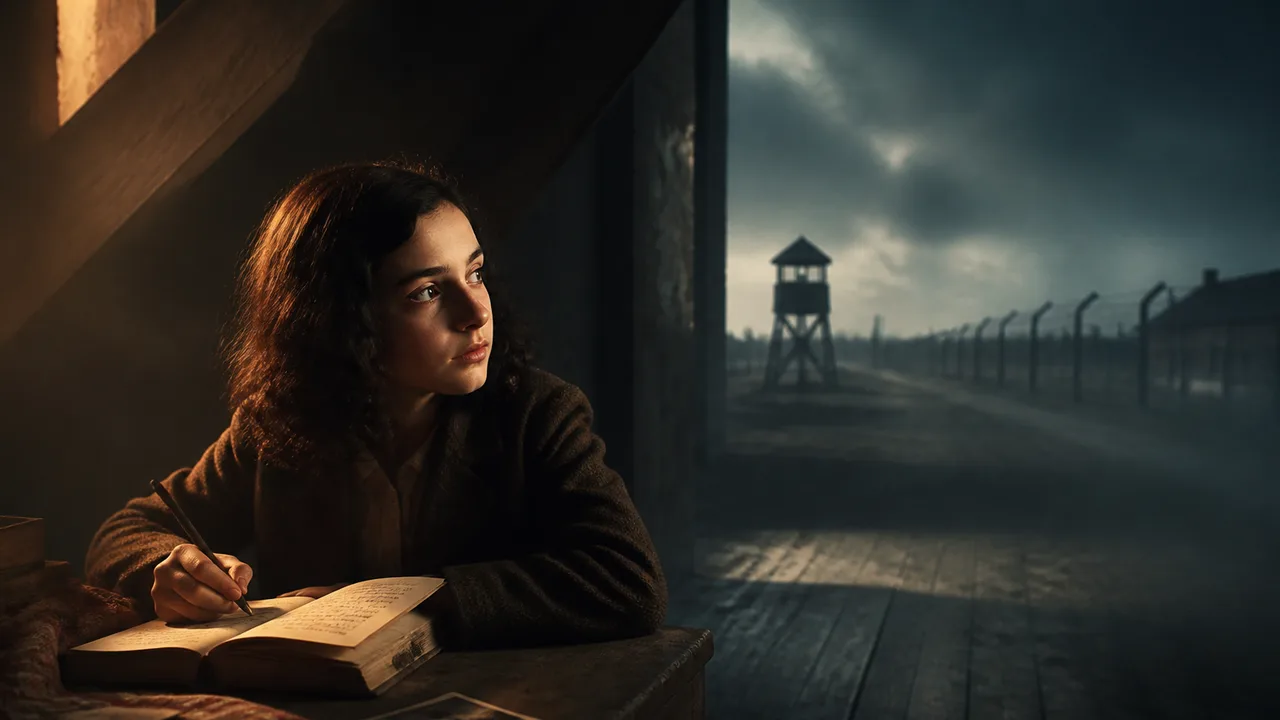
Photo: AI. Astrid Lehmann
Before she had a title to give it, before there were 20 million copies in print, before the museum on Prinsengracht received its millionth visitor, there was just a thirteen-year-old girl with a red-and-white checkered diary, writing on the first day she held it: "I hope you will be a great source of comfort and support."
That sentence tends to get lost in the apparatus of commemoration that now surrounds Anne Frank — the lesson plans, the stage adaptations, the school trips to Amsterdam. It's worth recovering. She wasn't writing for posterity. She was writing because she needed somewhere to put things.
A Family Running Out of Options
Annelies Marie Frank was born in Frankfurt in June 1929, the younger daughter of Otto and Edith Frank. By the time she was four, the National Socialists had come to power in Germany, and the Franks had already begun reading the future with enough clarity to leave. They moved to the Netherlands, settled in Amsterdam, enrolled their daughters in school — Anne at a Montessori school, Margot at a public one — and tried to resume ordinary life.
Ordinary life proved elusive. Otto Frank made multiple attempts to emigrate to the United States or Britain, both of which came to nothing. The bureaucratic obstruction that kept Jewish refugees out of those countries in the 1930s and early 1940s is a historical chapter that rarely gets the attention it deserves when Anne Frank's story is told. The Franks were not passive victims of fate; they were people who tried repeatedly to escape and were blocked at every turn.
By May 1940, German forces had occupied the Netherlands. The restrictions came quickly: yellow stars, curfews, expulsion from mixed schools, the seizure of Jewish-owned businesses. When Margot received a summons to a German work camp in July 1942, the family moved — the next day — into a concealed set of rooms at the back of Otto's former business premises at Prinsengracht 263. Eight people in total: the four Franks, Otto's business partner Hermann van Pels with his wife Auguste and teenage son Peter, and later a dentist named Fritz Pfeffer. The entrance was hidden behind a moveable bookshelf. They would not emerge for two years.
What the Diary Actually Was
Anne had received the diary as a birthday gift shortly before the family went into hiding. Once inside the annex, it became something more than a gift. By March 1944, she was writing: "The nicest part is being able to write down all my thoughts and feelings. Otherwise, I'd absolutely suffocate."
Most entries were addressed to an imaginary correspondent named Kitty. Anne wrote about the day-to-day mechanics of hiding — the enforced silence during warehouse hours, the prohibition on flushing toilets at certain times, the whispered conversations — but also about the interior life of a girl becoming a young woman under extraordinary constraint. She documented her uneasy first relationship, with Peter van Pels, while honestly questioning whether her feelings for him were genuine or simply the product of proximity and desperation. She wrote with equal honesty about her relationships with her mother and sister, and the entries show her revising those assessments over time — recognizing, for instance, that she had been unfair to Edith, and adjusting accordingly.
When Anne heard, via radio broadcast, that the Dutch Minister of Education in London exile was calling on people to keep wartime diaries, she began revising and organizing her entries, giving them the title The Secret Annex. She wanted it to be a book. She never finished the revision.
On August 4th, 1944, the Green Police arrived. All eight residents of the annex were arrested. Two of the helpers who had been supplying food and information were taken as well. The annex was ransacked. In the aftermath, two other helpers found papers and notebooks on the floor — among them, Anne's diary. They kept it, hoping she would return to claim it.
The Camps
The eight were taken first to Westerbork transit camp, then transported to Auschwitz. Of the 1,049 Jews on that transport, 549 were sent directly to the gas chambers upon arrival. The Franks were not among them — though Anne, separated from Otto when the camp divided along gender lines, believed her father had been killed.
The women were put to hard labor: hauling stones and grass mats, a punishment specifically assigned to those who had been in hiding and were therefore classified as criminals. A bout of scabies led to Anne and Margot being held in the infirmary rather than transferred to a labor camp. Edith, their mother, remained with them. When the sisters were later selected for transfer to Bergen-Belsen, Edith was not chosen. She died of starvation at Auschwitz in January 1945, three weeks before Soviet forces liberated the camp.
Bergen-Belsen was a different kind of horror. No gas chambers — instead, the camp killed through disease, starvation, and overwork. By early 1945, the typhus epidemic raging through the camp had taken hold of both Anne and Margot. They died, along with approximately 17,000 other prisoners, in the epidemic's worst weeks.
Here is where the historical record was, for decades, imprecise. It had long been believed that Anne and Margot died in March 1945, just weeks before British forces liberated Bergen-Belsen on April 15th. Research conducted by the Anne Frank House in 2015 revised that date to February 1945 — earlier than previously known, and therefore even further from liberation than the received account had suggested. The camp was burned to the ground after liberation to contain the spread of disease. Anne and Margot were buried in an unknown location. The grave has never been found.
Of the eight people who hid together at Prinsengracht 263, only Otto Frank survived.
What Otto Did With What Remained
Otto returned to Amsterdam and spent seven years there before eventually moving to Switzerland. One of the helpers who had preserved Anne's diary gave it to him. He read it and discovered, in his own words, that "I had no idea the depths of her thoughts and feelings."
This is a detail that resists easy sentimentality. The diary that the world knows as a document of extraordinary interiority was, to the father who lived alongside its author for two years in a hidden apartment, a revelation. What that says about the privacy a child maintains even under total confinement — and what it says about how little parents sometimes know their children — is a question the diary raises without answering.
A friend persuaded Otto to publish. In June 1947, 3,000 copies of The Secret Annex were released in the Netherlands. The book that would become The Diary of a Young Girl eventually reached more than 20 million printed copies. Otto spent the rest of his life — he died in 1980 — doing two things simultaneously: sharing his daughter's writing with the world, and fighting the people who insisted the diary was a forgery. The legal battles against Holocaust deniers in the 1950s and 1970s were, by any measure, exhausting and grotesque. The necessity of proving, repeatedly, that his murdered daughter had in fact existed is its own kind of testimony about what denial costs the people closest to the record.
The Question That Won't Close
The annex was slated for demolition after the war. It was saved, converted into a foundation, and became a museum in 1960. Today it remains one of the most visited historical sites in Europe.
Who betrayed the Frank family is still not known with certainty. Investigators over the decades have named several suspects: a Dutch Nazi party member named Tony Ahlers; a warehouse manager named Willem van Maaren, whose nosiness had already made the people in hiding uneasy; and more recently, Nelly Voskuijl, sister of one of the helpers, a Nazi collaborator who allegedly matched a description — "the voice of a young woman" — given by the SS officer who received the tip-off by telephone.
None of these theories has been confirmed. The investigation remains open in the same way many wartime betrayals remain open: the primary witnesses are dead, the documentary record is thin, and certainty may simply not be available to us.
Anne Frank wrote, in one of her final diary entries before the arrest: "I feel the suffering of millions and yet when I look up at the sky, I somehow feel that everything will change for the better, that this cruelty too shall end, that peace and tranquility will return once more."
She was wrong about herself. She was not wrong about what came after. The tension between those two facts — the individual extinguished, the insight surviving — is what her diary has been carrying ever since.
By Margaret "Maggie" Holloway, History & Ideas Correspondent
More Like This

The Amyloid Hypothesis Turns 28—And Its Question Marks Remain
John Hardy helped create the amyloid hypothesis in 1998. Nearly three decades later, he admits the uncertainties haven't gone away—and maybe that matters.
Medicine's Strangest History, Explained
Medical historian Richard Barnett unpacks lobotomies, Typhoid Mary, penicillin, and why the history of medicine is a mirror for the present.
Rommel's Gold: Nazi Plunder or Enduring Myth?
The story of Rommel's lost gold is part treasure hunt, part Holocaust history. What do we actually know—and what are we choosing to romanticize?
J. Edgar Hoover: How the FBI's First Director Held America Hostage
For 48 years, J. Edgar Hoover ran the FBI as his personal empire. His story is a masterclass in what unchecked institutional power actually looks like.

The KGB's Cyanide Newspaper Gun That Almost Worked
How a KGB poison weapon hidden in a rolled newspaper killed Ukrainian nationalist Stepan Bandera in 1957—and why one mistake unraveled the whole operation.
Jackie Kennedy and Lee Radziwill's Bitter Lifelong Feud
The feud between Jackie Kennedy and her sister Lee ran deeper than jealousy. A look at the betrayals—plural—that made it permanent.

Ten Scientific Discoveries Nobody Saw Coming
From Fleming's contaminated petri dish to Hubble's blurry mirror, accidental observations have repeatedly reshaped what we know about life and the cosmos.

The Nefertiti Bust's Disputed Past and Present
The Nefertiti bust raises two unresolved questions: is it genuinely ancient, and was it legally taken from Egypt? The evidence on both is more complicated than Berlin admits.