J. Edgar Hoover: How the FBI's First Director Held America Hostage
For 48 years, J. Edgar Hoover ran the FBI as his personal empire. His story is a masterclass in what unchecked institutional power actually looks like.

Written by AI. Margaret "Maggie" Holloway
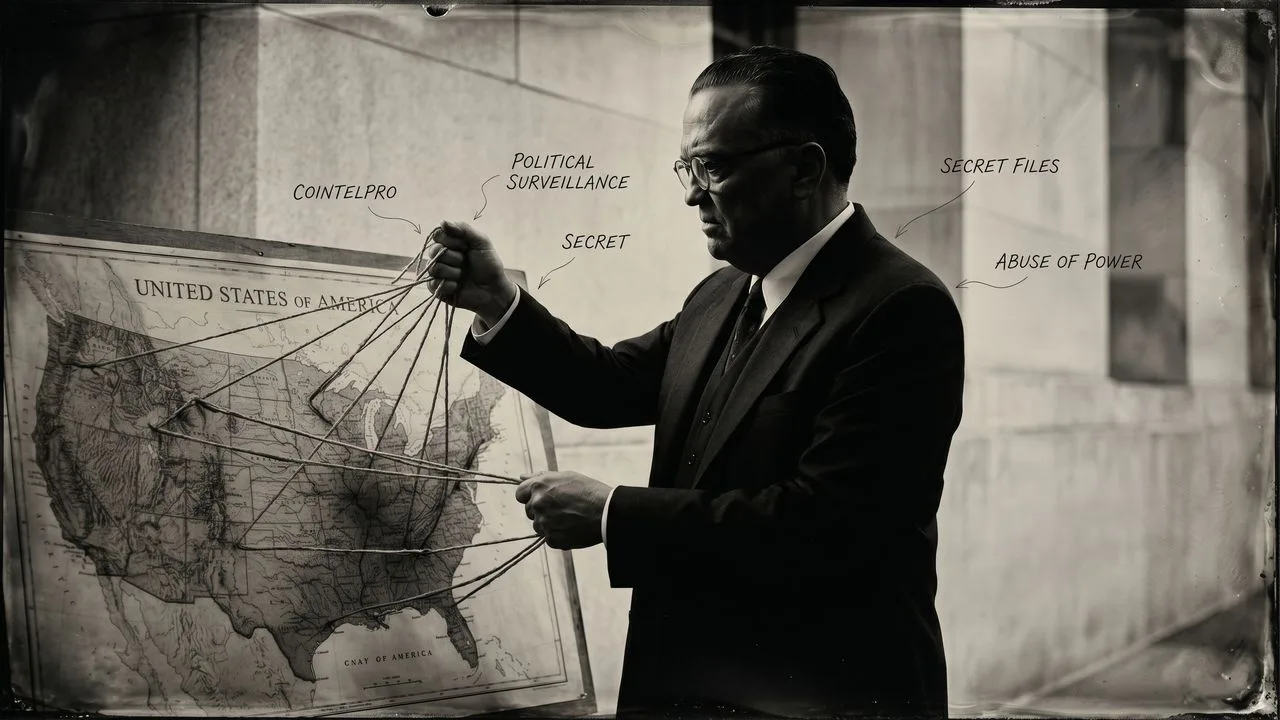
Photo: AI. Otieno Okello
The morning of May 2, 1972, J. Edgar Hoover was found dead in his Washington home. He was 77. He had run the FBI—or some version of it—for 48 years, served under eight presidents, and accumulated enough secrets about enough powerful people that not one of those presidents had dared remove him. By the time the coroner arrived, his secretary, Helen Gandy, had reportedly already begun shredding his most sensitive files.
That image—the director barely cold, the paper already falling—tells you almost everything you need to know about how J. Edgar Hoover built and maintained his power. Not through statute or democratic mandate, but through information, leverage, and the particular genius of making himself too dangerous to touch.
The Making of a Bureaucratic Animal
Hoover was born on New Year's Day, 1895, in Washington, D.C.—a fact that is itself strange, since he apparently had no birth certificate until age 43. Whether that gap reflects administrative sloppiness or something more deliberate has never been fully resolved. What is documented is his early profile: a studious, conservative young man who overcame a childhood stutter by training himself to speak at extraordinary speed, eventually so fast that stenographers struggled to keep pace. A debater praised for his "cool, relentless logic." A young man who, at George Washington University, pledged the Kappa Alpha Order—a Southern fraternity notable for its reverent nostalgia toward the Confederacy.
That last detail is not incidental. Hoover graduated in 1916 and entered government service at 22, landing at the War Emergency Division just one day before the United States entered World War I—a placement that conveniently exempted him from the draft. By 24, he was heading the Bureau of Investigation's General Intelligence Division, which its own staff called the "Radical Division." His mandate: disrupt domestic radicals. His method: a surveillance database of more than 150,000 names, compiled without the legal infrastructure that would nominally require such intrusions. It was an extraordinary amount of extralegal power for a man barely old enough to rent a car.
By 1924, President Calvin Coolidge appointed the 29-year-old Hoover to lead the Bureau itself. Among his first official acts: firing every female agent and banning women from future hire. Among his management styles: terminating subordinates for offenses that included, by one account, "looking stupid." These were not the eccentricities of a difficult boss. They were the behavioral signatures of someone who understood that institutional power is most durable when it is also personal and arbitrary.
The Architecture of Control
The 1935 renaming—from Bureau of Investigation to Federal Bureau of Investigation—is often treated as administrative housekeeping. It was not. Hoover shaped the restructuring himself, and the FBI that emerged was functionally his instrument: a modernized forensics lab, centralized fingerprint files, expanded recruitment, and crucially, the FBI Index, a running list of dissidents and Hoover's personal enemies that collapsed the distinction between those two categories.
What Hoover built was not just an intelligence agency. It was an information monopoly. And like any monopoly, it derived its value from restricting others' access to what it held.
The Mafia question is instructive here. Through the 1930s and into the postwar decades, organized crime consolidated its grip on American cities with minimal federal interference. Hoover publicly denied the Mafia's existence. The official explanation—that prosecuting organized crime offered poor return on investigative investment—was always thin. The more persistent theory is that several top mob figures, including Meyer Lansky and Frank Costello, possessed photographs of Hoover that he considered compromising. A second theory holds that Hoover's fondness for horse racing had drawn him into a transactional relationship with men who could provide useful tips. Neither theory has been definitively proven. What is documented is the outcome: the most powerful law enforcement agency in the country looked away from the most powerful criminal network in the country, for decades.
COINTELPRO and the Uses of Fear
The word "surveillance" can make the eyes glaze. The reality of what Hoover operationalized should not. By the 1950s, frustrated by legal limits on the Justice Department's ability to prosecute political opinion, Hoover formalized a covert program called COINTELPRO. Its initial target was the Communist Party USA. Its eventual targets included Martin Luther King Jr., Malcolm X, Muhammad Ali, and John Lennon.
The methods documented under COINTELPRO went well beyond passive monitoring. Infiltration of organizations. Unlawful wiretaps. Planted forgeries. Manufactured rumors designed to destroy reputations and relationships. Allegations—never fully adjudicated—of inciting riots and facilitating assassinations. As History Exposé describes it, the scope of these abuses "was in fact vast and much of it wouldn't be fully revealed until many years after his time."
That lag matters. The genius of Hoover's system was that accountability was always deferred. The people being surveilled often didn't know it. The operations were classified. The files were secret. And when the reckoning finally came, as it did in the mid-1970s with the Church Committee investigations, Hoover was already dead.
President Truman, while Hoover was still very much alive and operational, had concluded that Hoover had "transformed the FBI into his own private force." That was not hyperbole. When Hoover approved surveillance of President Nixon and retained recordings of Nixon's private life, Nixon later acknowledged that he declined to fire Hoover specifically out of fear of what Hoover might do in retaliation. The director of the FBI had the sitting President of the United States calculating how much it would cost him to exercise his own authority. That is not a bureaucracy. That is a hostage situation with better furniture.
The Man Behind the Files
The personal details that emerged after Hoover's death have their own layered complexity. For most of his adult life, Hoover maintained an extraordinarily close relationship with FBI Associate Director Clyde Tolson—his near-constant companion, whom Hoover called his "alter ego." They lunched together daily, vacationed together, and at Hoover's death, Tolson inherited his entire estate. Tolson was buried a few yards from Hoover. Whether they were lovers is not a question history has answered with certainty, but the circumstantial weight is substantial.
The alleged drag parties—reportedly held at private all-male gatherings in the 1950s—and the purported collection of lurid photographs and films are harder to verify. Hoover spent considerable energy suppressing any suggestion of homosexuality, reportedly threatening anyone who raised it. The cruelty of that particular self-suppression, from a man who wielded institutional homophobia as a weapon against others, is not a minor irony. For decades, Hoover used the threat of exposure to control other people's lives. The allegation that he lived in terror of the same exposure is either poetic justice or a reminder that the people who build surveillance states are rarely immune to what they've built.
What the Files Couldn't Contain
Hoover's death triggered the institutional reforms that his living presence had blocked. The FBI now operates under a 10-year term limit for directors, a direct structural response to what 48 years of unchecked tenure produced. That limit is currently the law. It has also, at least once in recent memory, been the subject of political pressure to extend or circumvent. The lesson Hoover's tenure taught was not necessarily learned once and remembered forever.
The FBI Index, the COINTELPRO files, the surveillance apparatus Hoover constructed—these did not vanish when Gandy fed the shredder. They became blueprints. Frameworks for thinking about what a domestic intelligence agency can do when political will and legal guardrails are insufficient constraints on an ambitious director with a long memory and a longer list.
The question Hoover's story keeps posing isn't really about him. It's about what institutions allow, and for how long, and why. A man compiling 150,000 names at age 24 doesn't become the most feared person in Washington by accident. He gets there because the system hands him the tools, and nobody takes them back.
More Like This
The KGB's Cyanide Newspaper Gun That Almost Worked
How a KGB poison weapon hidden in a rolled newspaper killed Ukrainian nationalist Stepan Bandera in 1957—and why one mistake unraveled the whole operation.

Jackie Kennedy and Lee Radziwill's Bitter Lifelong Feud
The feud between Jackie Kennedy and her sister Lee ran deeper than jealousy. A look at the betrayals—plural—that made it permanent.
1938: The Year the World Chose Not to See
From Munich to the Yellow River, 1938 was the year crisis became catastrophe. What the decisions of that year still ask us to reckon with.

The WWII Flying Boat Still Fighting Wildfires Today
The Martin Mars water bomber—a WWII relic with a 60m wingspan—is fighting Mexico's worst wildfires in 30 years. Here's how it actually works.

Who Owns the Data Your Body Produces?
Marc Andreessen pitched AI surveillance on JRE—and he has a financial stake in it. A genetics reporter asks the question nobody else did.

Why Epstein Files Have Random Equal Signs Everywhere
Those mysterious equal signs in the Epstein emails aren't a code—they're the result of 1990s email encoding colliding with modern document processing.

The Invisible Inventions That Built Modern Life
From flush toilets to undersea fiber cables, the inventions that most shaped modern civilization are the ones we've stopped noticing entirely.
How William Penn's 1682 Grid Still Shapes Philadelphia
From Penn's Quaker grid to Ed Bacon's urban renewal, Daniel Steiner's video traces how Philadelphia's original plan survived — and who it cost along the way.