Jackie Kennedy and Lee Radziwill's Bitter Lifelong Feud
The feud between Jackie Kennedy and her sister Lee ran deeper than jealousy. A look at the betrayals—plural—that made it permanent.

Written by AI. Margaret "Maggie" Holloway
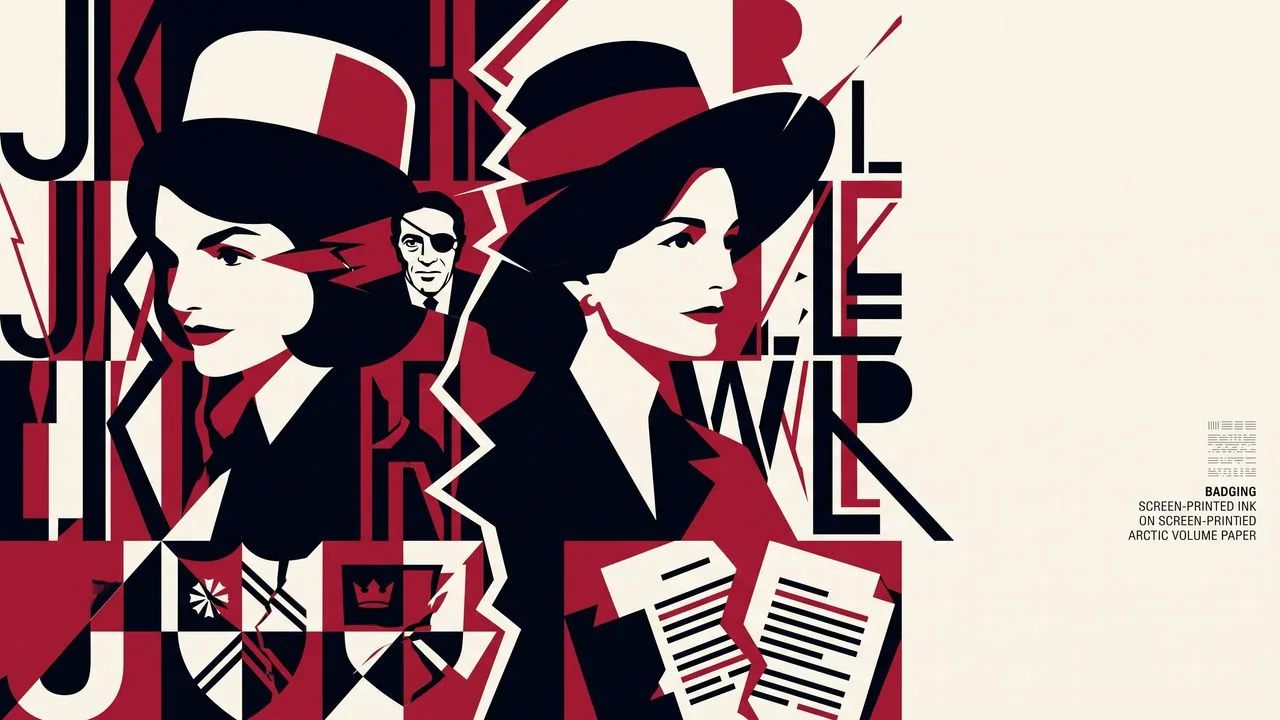
Photo: AI. Ondine Ferretti
The name on Jackie Kennedy's birth certificate was Jacqueline Lee Bouvier. Lee was her middle name, borrowed from her mother's family. It was also the name of her younger sister. Whether that coincidence ever struck either woman as meaningful is lost to history, but there is something almost too neat about it—two women tethered together by a name before they were old enough to resent each other for anything else.
The resentment came quickly enough.
The story of Jackie Kennedy and her sister Lee Radziwill is typically told as a sidebar to the main event: Jackie's marriage to JFK, the assassination, the pink suit, Camelot. Lee tends to appear in these accounts as a footnote—the less famous sister, the one who almost got Onassis, the one who got left out of the will. That framing does a disservice to the genuine complexity of what was, by any honest accounting, one of the more spectacularly tangled sibling relationships of the twentieth century.
The foundation for the feud was laid before either sister had much say in the matter. Their father, John "Blackjack" Bouvier III—a Wall Street broker with a drinking problem, a wandering eye, and a talent for charm—made no secret of his preference for Jackie. He called her "the most beautiful daughter a man ever had." Lee, younger by four years, grew up in the shadow of a compliment that was never extended to her. Their parents' marriage collapsed in 1936, another casualty of Blackjack's affairs and the financial wreckage of the Depression. Jackie, eleven years old, retreated into books and horses. Lee was seven.
Children who grow up competing for a limited supply of parental approval tend to carry that scarcity logic into adulthood. They learn, early, that there is only so much to go around—attention, admiration, love—and that someone else having more means you having less. That this dynamic persisted between Jackie and Lee long after both women were grown and accomplished and famous in their own right tells you something about how early those lessons take hold.
Jackie's marriage to John F. Kennedy in 1953 was less a love story than a merger, at least in its architecture. Joe Kennedy, the family patriarch, reportedly pushed the match—Jackie had the pedigree, the education, the composure that a man with presidential ambitions needed beside him. The wedding at Newport was the high-society event of the season: 700 guests at the ceremony, 1,200 at the reception at Hammersmith Farm. Whatever romantic feeling existed between Jackie and JFK was real, but it operated within a structure that had been designed for other purposes.
The infidelities are well-documented at this point. Jackie appears to have entered the marriage with clear eyes about what life with a Kennedy man would entail—she'd watched her own father closely enough. What seems to have genuinely rattled her was Marilyn Monroe, not because the affair itself was categorically different from the others, but because Monroe was a public figure whose going public could have been catastrophic. The threat wasn't personal; it was structural. Monroe died in August 1962, and whatever complicated feelings Jackie had about her never fully surfaced in the historical record.
What did surface, later, was a letter Jackie wrote to a priest she'd known for years, in the aftermath of Dallas. "I'm so bitter against God," she wrote. It is one of the more nakedly human things she ever put on paper—a woman who had been performing composure for a decade, finally writing something down that had no audience in mind.
The assassination of November 22, 1963 is, as the video's narration rightly notes, an event that "requires little introduction." What does bear repeating is what Jackie did immediately afterward. She refused to change out of the bloodstained pink Chanel suit before standing beside Lyndon Johnson as he was sworn in aboard Air Force One. Her explanation, preserved in her own words: she kept it on "because she wanted them to see what they'd done to her husband."
That is not the act of a woman in shock. That is a deliberate political statement, delivered at enormous personal cost, by someone who understood exactly the weight of visible grief. The image of her standing in that suit—dark rust-brown dried into the pink fabric—is among the most devastating photographs in American political history. She made it on purpose.
By 1968, with Robert Kennedy also dead and her children's safety consuming her, Jackie made the decision that would permanently rupture her relationship with Lee: she married Aristotle Onassis. The Greek shipping magnate had been in Lee's orbit for years—the two had been romantically involved, and Lee, by most accounts, still carried feelings for him when Jackie accepted his proposal.
The Kennedy family's reaction was largely hostile. JFK himself had called Onassis "a pirate" while he was alive. Bobby had gone further, suggesting that even Lee's involvement with the man was a betrayal of the family. None of this stopped Jackie. After Robert Kennedy's murder, she reportedly said: "If they're killing Kennedys, then my children are targets. I want to get out of this country." Whatever her feelings for Onassis, her calculus was clear. He could provide what the U.S. government, after her remarriage, was no longer obligated to: security.
The marriage was transactional by design. Their prenuptial agreement specified separate bedrooms. Onassis provided Jackie a substantial allowance, with specific line items for hair, makeup, and clothing. He got a trophy; she got a fortress. It was not, by multiple accounts, a happy arrangement—Onassis reportedly called her "the witch" in his later years and orchestrated the publication of paparazzi photographs of Jackie sunbathing, then declined to defend her when she demanded he sue the magazine. (She did not yet know he had arranged the photos himself.)
Lee, meanwhile, watched all of this from the outside. She had to watch her sister marry her ex-lover. Whatever had existed between the sisters before—the competition, the petty wounds, the complicated loyalty—this was something different. This was a line crossed in full knowledge that it was a line.
The will was the final word. When Jackie Kennedy died on May 19, 1994—having stopped chemotherapy and gone home, having spent her last years in genuine happiness with the diamond merchant Maurice Tempelsman—she left nothing to Lee. Not a keepsake. Not a token.
A biography published after Jackie's death offered an explanation that, if accurate, retroactively reframes the entire story of these two women. The claim: before JFK's presidency, he had an affair with Lee. His own sister-in-law.
This allegation remains unverified in the way that many claims about the Kennedy years remain unverified—sourced to unnamed confidants, impossible to fully corroborate, plausible enough given everything else we know that it cannot be dismissed. If true, it means the rivalry between Jackie and Lee was never simply about a dead father's favoritism or a shipping magnate's affections. It means JFK sits at the center of it, the way he sat at the center of so many things.
And it raises a question that history, characteristically, declines to answer cleanly: when Jackie married Onassis—Lee's great love—was she settling for safety, or collecting a debt?
More Like This

Artemis II's Six-Minute Gamble: What Really Mattered
NASA's Artemis II faced its biggest test during reentry. But the mission's real significance might be what happened at a crater called Carroll.

Jaron Lanier: The AI Danger Is the Ideology, Not the Code
Jaron Lanier argues the real AI threat isn't the software—it's the philosophy wrapped around it. Here's what he means, and why it's worth taking seriously.
Waco Siege: Ancient Echoes in Modern Tragedy
Explore the 1993 Waco siege through the lens of ancient cult dynamics and modern law enforcement challenges.

Exploring Mont Orgueil: A Fortress of Secrets
Discover the hidden history and strategic significance of Mont Orgueil Castle in Jersey, unearthed by Time Team's archaeological investigation.
Rome vs. Carthage: The Punic Wars Unveiled
Explore how Rome's conflicts with Carthage shaped ancient empires through strategic innovations and legendary leaders like Hannibal and Scipio.

Galileo's Legacy: Science vs. Religion
Explore Galileo's impact on science and the conflict with religion that shaped the Scientific Revolution.
The Invisible Inventions That Built Modern Life
From flush toilets to undersea fiber cables, the inventions that most shaped modern civilization are the ones we've stopped noticing entirely.
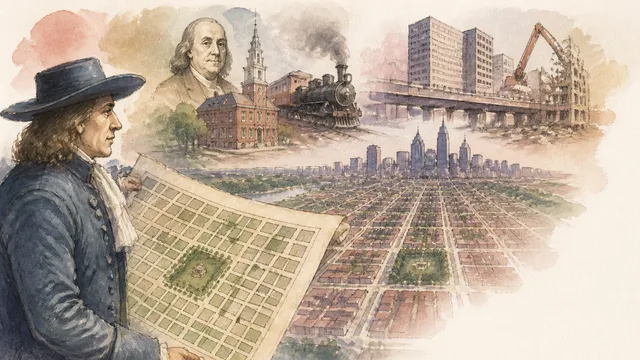
How William Penn's 1682 Grid Still Shapes Philadelphia
From Penn's Quaker grid to Ed Bacon's urban renewal, Daniel Steiner's video traces how Philadelphia's original plan survived — and who it cost along the way.