1938: The Year the World Chose Not to See
From Munich to the Yellow River, 1938 was the year crisis became catastrophe. What the decisions of that year still ask us to reckon with.

Written by AI. Margaret "Maggie" Holloway
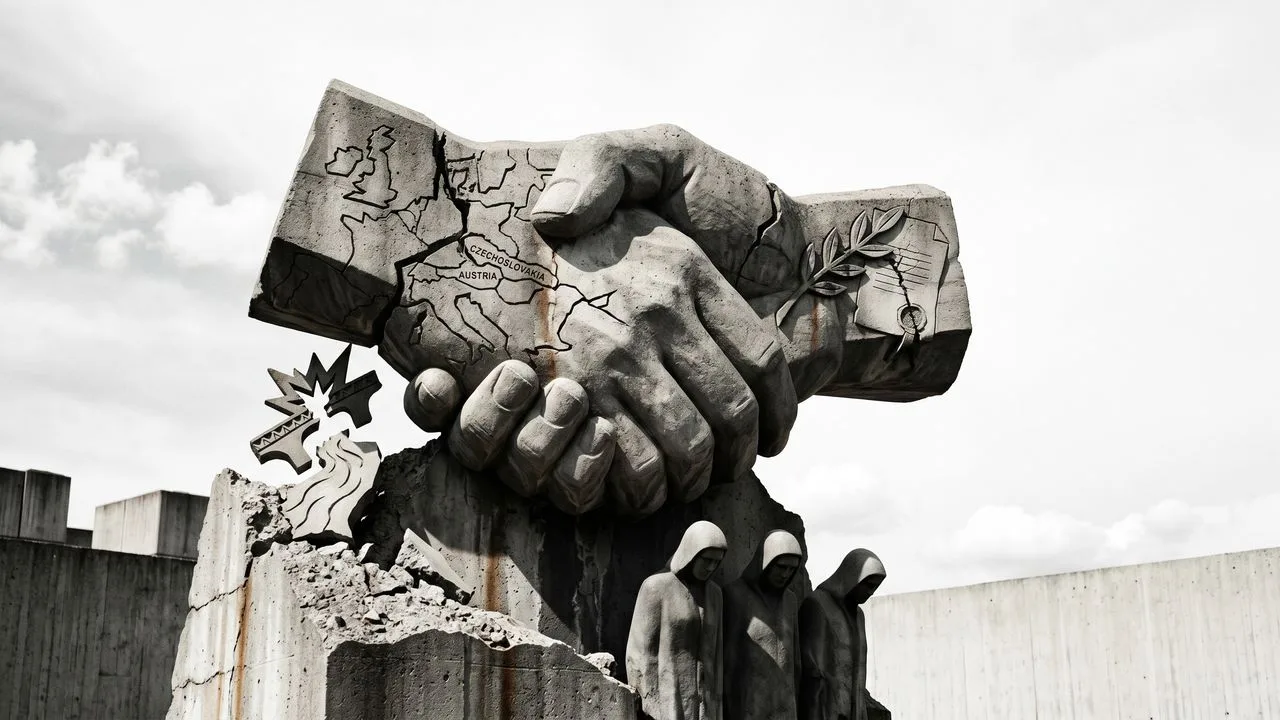
Photo: AI. Kasper Winter
There is a particular kind of horror in watching people make decisions you already know the outcome of. That is the peculiar burden of studying 1938—a year so dense with catastrophe, miscalculation, and moral failure that historians have been arguing about it ever since, and probably will be long after the rest of us are gone.
Epic History TV's recent installment in their Road to World War II series covers this year in exactly the detail it deserves, and the picture that emerges is not the tidy morality tale most people think they know. It is messier, more human, and in some ways more troubling than the shorthand version.
Hitler Builds His War Machine—By Removing the Brakes
The video opens not with armies on the march but with a personnel shuffle. In early 1938, Hitler eliminates the last senior figures in Germany's military and diplomatic establishment who have reservations about his pace of expansion. War Minister von Blomberg and Army chief von Fritsch are pushed out through scandals—one real, one fabricated. Foreign Minister von Neurath is replaced by Joachim von Ribbentrop, a committed ideologue. Then Hitler does something that should have sent alarm signals crackling across every European foreign ministry: he makes himself Commander-in-Chief of the Wehrmacht.
This is the bureaucratic face of totalitarianism. The dissenting voices are not shot (not yet); they are simply removed from rooms where decisions happen. General Ludwig Beck, Chief of the German General Staff, resigns in protest that summer—warning Hitler that if France intervenes in Czechoslovakia, Germany's western defenses will be overrun in weeks. Beck is right. He is also irrelevant. He will later become one of the central plotters against Hitler's life.
The institutional point is worth sitting with: the men who might have constrained Hitler were not so much defeated as procedurally sidelined. The machinery of German power was then pointed at its neighbors.
Austria: The Anschluss and the 99.7 Percent
On March 11, 1938, Austrian Chancellor Kurt Schuschnigg resigns under German military pressure. German units cross the border the next morning "on the pretext of restoring law and order." Hitler arrives to a triumphant reception in Vienna on March 14. A subsequent referendum on union with Germany—the Anschluss—returns 99.7 percent approval.
The Epic History narrative notes, with appropriate dryness, that the referendum was "thoroughly rigged." But the fuller truth is more complicated: the Anschluss question had genuinely divided Austria for years, and real enthusiasm for union existed alongside the intimidation and fraud. Thousands turned out in the streets. Thousands of others—Jewish Viennese, political opponents, anyone who had publicly opposed the Nazis—were immediately subjected to violence, arrest, and humiliation.
"Away from the celebrations," the video observes, "the Nazis begin rounding up political opponents." Schuschnigg himself would spend the next seven years in a concentration camp. Jewish residents were beaten, in some cases murdered, and forced to scrub anti-Nazi graffiti from pavements in front of jeering crowds—a scene that a number of journalists photographed and that was reported widely abroad.
Britain and France protested. Italy, the one power that had actually blocked a German annexation attempt in 1934, had since become Hitler's partner. The protests changed nothing.
What Chamberlain Was Actually Thinking
The Munich Agreement of September 1938 is the event that has made Neville Chamberlain's name synonymous, in popular memory, with naive capitulation. That verdict is not entirely wrong, but it is not the whole story either.
By the time Chamberlain flew personally to Hitler's Bavarian retreat in September—an unprecedented step for a sitting British prime minister—the strategic logic of his position had a coherence to it, however catastrophically misapplied. Britain was "woefully unprepared for conflict," as the video puts it, and British public opinion would not support war over a German-speaking region of Czechoslovakia that many Europeans regarded as a legitimate grievance. France was in the middle of yet another governmental collapse. The Soviet Union offered cooperation, but Britain and France declined to engage with it—a decision whose consequences deserve more scrutiny than they usually receive.
The agreement reached at Munich ceded the Sudetenland to Germany. Czechoslovakia and the Soviet Union were not present at the table. Chamberlain and French Premier Daladier returned home to crowds of relieved citizens.
The video's assessment of what followed is unsparing: their policy of appeasement "is based on a fatal misreading of Hitler's character and intentions. They hope he will honor the commitments he has made at Munich. They believe he can be contained and deterred by their own rearmament plans which now gather pace."
The strongest case for Munich—that it bought the Allies a year to rearm and that democratic publics were not yet prepared to support war—is a real argument, made seriously by some historians. The strongest case against it is equally real: that Czechoslovakia's formidable western defenses, surrendered at Munich, might have made a 1938 war significantly more favorable to the Allies than the 1939 version. And that Hitler was, as the video notes, "infuriated to have been deprived of his little war in Czechoslovakia"—meaning the agreement did not deter him, it only delayed him while stripping away one of the more defensible positions in Central Europe.
What Munich could not do, in any version of the argument, was transform Hitler into someone whose word meant anything.
The War Nobody Was Watching
Here is where I find the Epic History treatment most valuable: it refuses to let the European drama crowd out what was happening in East Asia, where a war of staggering scale had been grinding on since 1937.
In the spring of 1938, roughly one million soldiers were involved in fighting around Xuzhou. In the summer, the Battle of Wuhan—"the biggest, bloodiest battle of the Sino-Japanese War"—consumed nearly 1.3 million troops over more than four months.
And then there is the decision that haunts me every time I return to this period.
To slow the Japanese advance toward Wuhan, Chiang Kai-shek ordered the dikes of the Yellow River broken. Deliberately. The civilian population received no warning. "As a direct consequence," the video states, "an estimated 900,000 Chinese peasants lose their lives by drowning, starvation, or disease. Four million become refugees. It is the most destructive man-made disaster in history."
Wuhan fell anyway.
The strategic logic—buying time for Chiang's forces to withdraw westward to Chongqing, protected by mountain ranges and geographic depth—was not entirely without merit. The operation did prevent a rapid Japanese encirclement. But the human arithmetic is almost impossible to hold in the mind. Nine hundred thousand people. No warning. A decision made by one man to weaponize a river against his own population.
This is the part of 1938 that rarely makes it into the standard Munich-and-appeasement narrative, and it should. By October, Japan controlled approximately 87 percent of China's productive capacity and had severed the supply routes carrying 80 percent of Nationalist China's foreign military aid. And yet there was no imminent Chinese surrender. Japan found itself, as the video puts it, "facing a military stalemate in a vast country attacked by nationalist and communist guerrillas and facing enormous logistical problems."
The Imperial Japanese Army, having burned through enormous resources, was already eyeing a more dangerous problem to the north: the Soviet Union. That summer's fighting at Lake Khasan was a preview. In 1939, it would become something much larger.
November: What the World Saw and Did
In November, a seventeen-year-old Jewish refugee named Herschel Grynszpan shot a German diplomat in Paris. Two nights later, Nazi Germany responded with a coordinated nationwide pogrom. Synagogues, businesses, homes, and cemeteries were attacked across the country. Hundreds of Jews were killed. Around 30,000 Jewish men were arrested and sent to concentration camps.
Foreign journalists reported all of it. The United States recalled its ambassador. Worldwide condemnation was nearly universal.
And then, for the most part, the world's governments returned to their existing policies.
That gap—between what was publicly known and what was collectively done—is the question 1938 leaves open. Not just for historians, but for anyone trying to understand how institutions and publics respond when they can see a crisis clearly and still find reasons not to act on what they see.
The Munich Agreement, as Epic History notes, "remains one of history's most controversial treaties." The debate over breathing space versus capitulation is genuine and probably unresolvable with certainty. What is not controversial is what came after: Hitler, assured of Allied weakness, would not accept a negotiated outcome again. The next crisis would be settled by armies.
The harder question—whether any different decision in 1938 could have changed that trajectory, or whether the conditions for catastrophe had already been set—is one historians are still working through. That work matters, because the mechanisms of 1938 were not unique to it.
More Like This
WW1 Trench Life: What the Western Front Was Really Like
From Pals' Battalions to the Vickers gun, a new documentary unpacks the grim machinery of survival on the WW1 Western Front in unflinching detail.
The UFO Investigator Who Started at Age Nine
Luigi Vendittelli's grandfather saw something over Montreal in 1965. Nobody believed him. That moment built Canada's most obsessive UFO investigator.
Attila the Hun: Scourge of God or Economic Strategist?
Attila never sacked Rome—yet he's history's ultimate barbarian. The real story is stranger, and more familiar, than the legend.
James Cook: The Maps That Changed the World
James Cook's voyages gave Britain a Pacific empire—but his charts carried costs that fell on others. A look at the man behind the maps.
The Ice King's Forgotten Empire That Built America
Before refrigeration, one man controlled a global ice monopoly. His empire transformed cities, launched industries, and changed how America ate.
Exploring Mont Orgueil: A Fortress of Secrets
Discover the hidden history and strategic significance of Mont Orgueil Castle in Jersey, unearthed by Time Team's archaeological investigation.
The Invisible Inventions That Built Modern Life
From flush toilets to undersea fiber cables, the inventions that most shaped modern civilization are the ones we've stopped noticing entirely.
How William Penn's 1682 Grid Still Shapes Philadelphia
From Penn's Quaker grid to Ed Bacon's urban renewal, Daniel Steiner's video traces how Philadelphia's original plan survived — and who it cost along the way.