Rommel's Gold: Nazi Plunder or Enduring Myth?
The story of Rommel's lost gold is part treasure hunt, part Holocaust history. What do we actually know—and what are we choosing to romanticize?

Written by AI. Sofia Ramirez
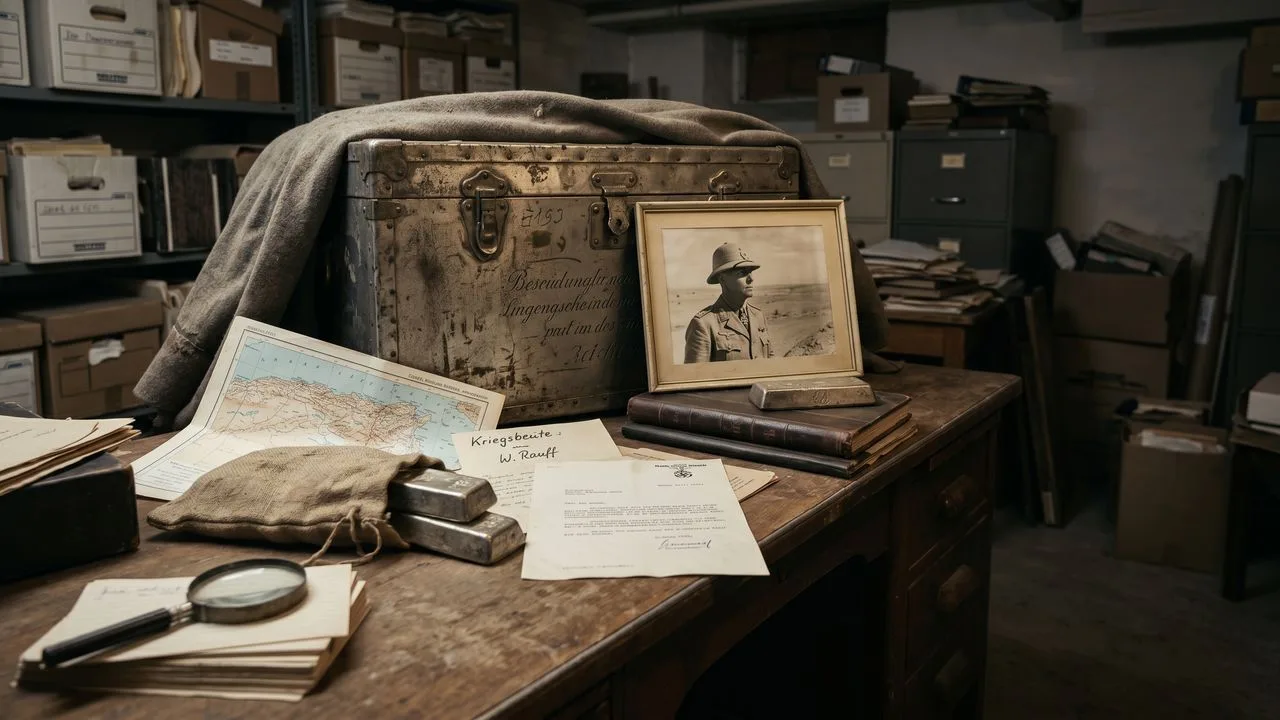
Photo: AI. Marcel Dubois
The story tends to get packaged as adventure. A legendary general. A desert campaign. Tons of gold, unaccounted for. Someone, somewhere, sitting on a suitcase full of stolen treasure while the rest of the world wonders where it went.
But strip away the treasure-hunt framing and what you're actually looking at is a story about systematic theft from Jewish communities, an unrepentant war criminal who spent decades living comfortably in South America, and an accounting that was never fully made. The History Channel's History's Greatest Mysteries covers the Rommel gold question with a combination of genuine historical detail and the genre's characteristic pull toward intrigue. It's worth taking both seriously—the history and the framing—because they're telling us different things.
What Actually Happened in North Africa
By December 1940, the Italian military's North African campaign was in freefall. Allied forces had routed nine Italian divisions and captured some 130,000 soldiers. Hitler, threatened by the potential loss of the southern Mediterranean, sent in General Erwin Rommel—a decorated World War I veteran and architect of Blitzkrieg tactics who had already proven his value in France.
Rommel arrived in Libya in early 1941, held the defensive line, and then started winning. His mobile warfare tactics against the British earned him the nickname "the Desert Fox" and a reputation that outlasted the war itself. What gets less airtime in the popular imagination is what was happening behind those front lines.
The roughly 400,000 Jews living across North Africa—in Tunisia, Libya, Morocco, Algeria—were already living under colonial legal regimes that had stripped many of their citizenship and civil rights. The German arrival accelerated something much worse. Alongside the Africa Korps, SS units began what the Nazis called "executive measures": town-by-town campaigns of forced labor, extortion, and pillage. More than 2,500 Jews died in the forced labor camps the SS established under Rommel's command.
The documentary identifies Walter Rauff as the central figure in the looting operation. Rauff is remembered—if that's even the right word—primarily for inventing the gas van, a vehicle with an airtight rear compartment rigged to pump carbon monoxide from the exhaust back inside. These vans killed thousands before the death camps were operational. In North Africa, Rauff's methods were somewhat different but the logic was the same: extract maximum value from Jewish communities by whatever means necessary.
As the documentary describes it, Rauff and other Nazi officials operated under the explicit doctrine that "when you conquer someone, you are bringing all of their wealth back to Germany." This wasn't improvised. There was infrastructure for it. The Berlin Municipal Pawn Shop—which sounds mundane until you understand its function—served as the terminus for looted wealth from across occupied Europe and North Africa. Gold, jewelry, and valuables would arrive, be melted into untraceable bars, and re-enter the German war economy. "Once you melt down the gold, it can no longer be traced," the documentary notes. "Then you can sell it anywhere."
What Happened to the Gold
This is where documented history starts to blur into theory.
By late February and early March of 1943, the Allies were pushing the Africa Korps back hard. The fighting around Kasserine Pass was fierce, and Rauff and his men were apparently trying to reach the Tunisian coast before Allied forces cut off their retreat. The plan, according to the episode, was to move the plunder from Tunisia to Italy, then up to Germany and ultimately to Berlin.
Whether that transfer succeeded—fully, partially, or not at all—is genuinely unknown.
In early May 1943, the Allies captured Tunis. Axis forces in North Africa surrendered. Rauff was eventually captured in Italy on April 30, 1945, interrogated, and placed in a POW camp. He said essentially nothing useful about the gold. Then, in 1946, he escaped—reportedly hiding for months in a Roman convent before resurfacing briefly as an intelligence officer in Syria in 1948.
The CIA, through documents declassified in the early 2000s under the Nazi War Crimes Disclosure Act, reported a sighting of Rauff on the streets of Rome in 1947—carrying a suitcase. According to the documentary, "inside of this suitcase is supposedly gold and jewelry and all sorts of other treasures, but Rauff refuses to say where it came from."
He eventually made it to Chile, where he lived openly and comfortably until his death in 1984, reportedly welcomed into the highest circles of Pinochet's government and working in intelligence. At his funeral, other Nazi expatriates gave the Hitler salute.
His grandson, interviewed off-camera for the documentary, says he doesn't believe his grandfather had access to stolen gold during his years in Chile—but also acknowledges that his grandfather never spoke about the war. Which is to say: the grandson doesn't know.
The Problem with the Treasure Hunt Frame
What the History's Greatest Mysteries format does well is dramatize genuine historical questions. Rauff's escape, the missing accounting, the declassified CIA documents—these are real. The structural gaps in the historical record are real. People have launched actual expeditions looking for buried gold in North Africa, and some have reportedly died doing it.
But the "lost treasure" frame carries costs that are worth naming. When the story becomes primarily about the mystery of where the gold is, the people it was stolen from recede into the background. North African Jewish communities—many of which were already in precarious positions under French colonial law before the Germans arrived—suffered documented, systematic theft and forced labor and mass death. That's not a backdrop for a treasure hunt. It's the story.
There's also the accountability question. Rauff died in Chile in 1984, never tried for his crimes, never required to account for what happened to the wealth he extracted. West Germany issued an arrest warrant in 1962; Chile's Supreme Court refused extradition in 1963, citing statutes of limitations. He lived freely for four decades after the war ended. The gold question sits inside a much larger question about the architecture of impunity that allowed Nazi war criminals to live out comfortable lives in South America—often with the knowledge, and sometimes the active assistance, of Western intelligence services.
The documentary touches on this—Rauff working for Pinochet's government, the CIA documents, the comfortable exile—but the treasure hunt structure keeps pulling the camera back to the suitcase.
What We're Actually Left With
The honest answer to "where is Rommel's gold?" is: we don't know, and we may never know. The gold that made it to Berlin was melted into untraceable bars. Whatever Rauff may have kept for himself—if anything—either traveled with him, was spent, or is buried somewhere that no expedition has found. His grandson can't say. The CIA documents offer a sighting and a suitcase, not a destination.
What we do know is more uncomfortable than a treasure mystery. We know who the gold belonged to. We know the mechanisms by which it was taken. We know that the people responsible—Rauff most visibly—were not, in most cases, brought to justice. We know that declassified documents exist and that the historical record, while incomplete, is not as thin as the mystery framing implies.
"Rauff remained an unrepentant Nazi to the bitter end," the documentary observes. That detail lands differently depending on whether you're watching a treasure mystery or a reckoning with accountability. The gold is missing. The reckoning, more than eighty years on, still is too.
More Like This
San Francisco 1906: The Disaster That Was Built
The 1906 San Francisco earthquake wasn't just an act of nature—it was the bill coming due on decades of willful ignorance. Here's what actually happened.

When the Dead Were Headed for the Stars
Ancient burial sites from Peru to Egypt share a striking obsession with the cosmos. What does that convergence actually mean—and for whom?
Attila the Hun: Scourge of God or Economic Strategist?
Attila never sacked Rome—yet he's history's ultimate barbarian. The real story is stranger, and more familiar, than the legend.
1938: The Year the World Chose Not to See
From Munich to the Yellow River, 1938 was the year crisis became catastrophe. What the decisions of that year still ask us to reckon with.
Did Rome's Elite Destroy It From Within?
A viral video argues Rome was "auctioned off" by its ruling class. The history is real—but the argument deserves a harder look than it gets.
What Rome Buried: The City Beneath the City
Beneath Rome's famous piazzas and tourist landmarks lies another city entirely—one built by commoners, cultists, and slaves. Here's what's down there.

The Spanish Civil War at 90: What the Coup Unleashed
On July 17, 1936, a military coup fractured Spain and drew the world in. What the Spanish Civil War's 90th anniversary still asks of us.
Medieval England: How Peasants and Guilds Shaped Society
A new documentary traces medieval England's social divide through two real families—one peasant, one guild merchant—and the starkly different worlds they inhabited.