Did Rome's Elite Destroy It From Within?
A viral video argues Rome was "auctioned off" by its ruling class. The history is real—but the argument deserves a harder look than it gets.

Written by AI. Helen Papadopoulos
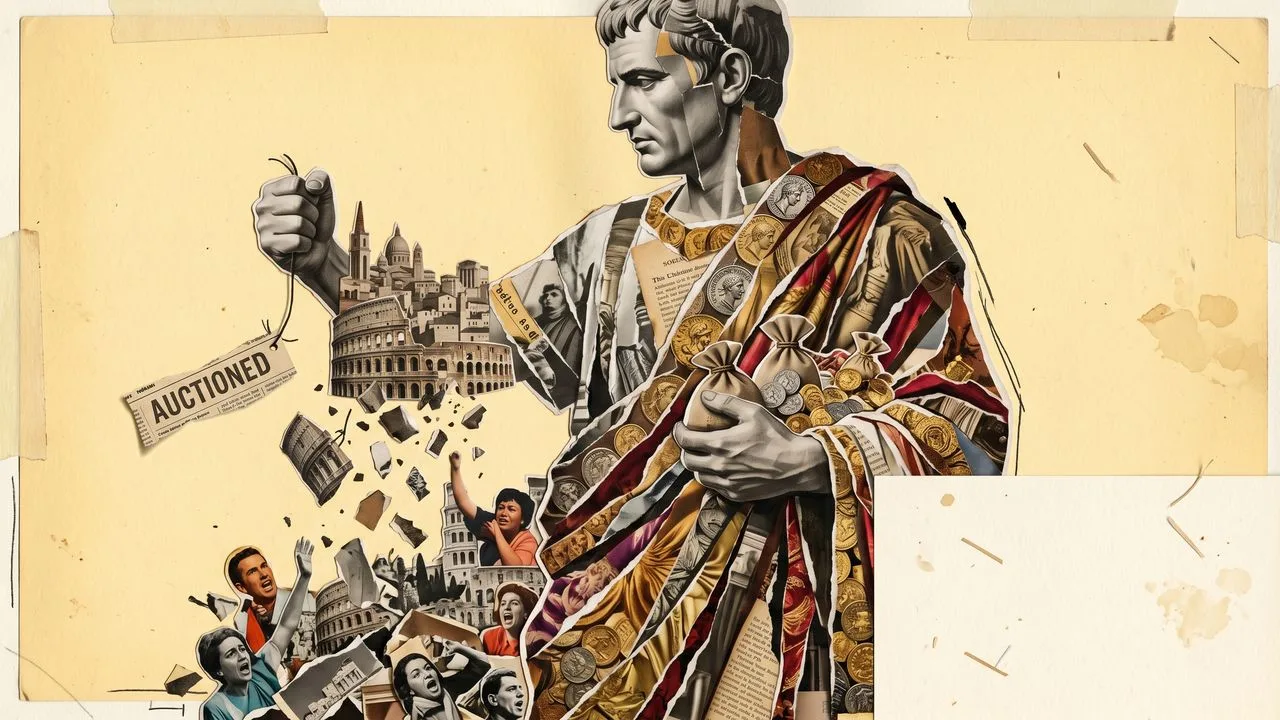
Photo: AI. Wren Sugimoto
There is a version of Roman decline that historians have been making, carefully and in footnotes, for about two centuries. Then there is the version that gets a million YouTube views. A new video from the channel Legendary Lore, titled How The Ruling Class Killed Rome, is firmly in the second category—and yet it is not wrong in the ways you might expect.
The argument, delivered with the cadence of a political manifesto, runs roughly as follows: Rome was not murdered by barbarians. It was hollowed out by its own aristocracy, who replaced the citizen-soldier farmer with slave labor, crashed the currency to buy loyalty, and ultimately relocated the imperial center to Constantinople, abandoning the western provinces to their fate. "Rome never fell," the video opens. "It was auctioned off."
It is a clean thesis. Almost too clean. Which is exactly why it is worth spending some time with.
What the Video Gets Right
The core economic story here is solid, and under-told in popular history. The latifundia—the massive slave-worked agricultural estates that expanded explosively after Rome's conquests in the 2nd and 1st centuries BC—genuinely did devastate the small farmer class that had powered the Republic's military machine. This is not fringe history. Appian wrote about it. The Gracchi brothers died trying to address it. The mechanism the video describes, where soldiers returned from campaigns abroad to find their farms absorbed by elite landholders who could undercut grain prices through slave labor, is documented and real.
The currency debasement story is equally well-evidenced. Roman numismatists and archaeologists have tracked the declining silver content of the denarius with some precision: from near-pure silver under Augustus to coins that were, by the reign of Gallienus in the 260s AD, effectively bronze with a thin silver wash. The numbers the video cites—a legionary's nominal salary rising from roughly 225 denarii to 12,000 denarii over two centuries—are in the right ballpark, representing inflation rather than prosperity. Lactantius, a contemporary witness to the chaos of Diocletian's reign, is quoted to devastating effect: "He raised the price of everything through heavy taxes. Then he tried to fix all prices by law. Much blood was shed over the smallest things. Men feared to bring goods to the market and the shortage became far worse than before."
That is not a YouTube creator editorializing. That is a fourth-century rhetorician watching price controls fail in real time.
Where the Argument Strains
The video's framing is essentially conspiratorial—not in the tinfoil-hat sense, but in the structural sense that it requires Rome's ruling class to have been coherently, almost deliberately, self-destructive. "Self-serving elites" becomes a catch-all explanatory engine that quietly absorbs a great deal of complexity.
Consider Constantine. The video frames his founding of Constantinople as a betrayal—the empire "wearing the Roman name and culture as a skin suit," the east getting "the wealth and the professional legions" while the west got "the bill and the barbarians." This is genuinely compelling as rhetoric. As history, it flattens what was a response to real strategic pressures: the eastern frontier with Persia was more economically productive and more militarily threatened; the Danube-Rhine defensive line in the west was simply longer and more porous. Constantine did not invent western vulnerability—he inherited it. Whether his choices accelerated the west's decline or merely acknowledged existing realities is a question historians still argue about with some heat.
There is also the problem of agency. The video implies that Rome's aristocracy could have chosen otherwise—could have preserved the small farmer, refused to debase the currency, maintained western defenses—but chose private gain instead. This may be true of specific individuals at specific moments (the senatorial opposition to the Gracchan land reforms was nakedly self-interested). But presenting it as the master explanation for a civilization's collapse over six centuries compresses an enormous amount of contingency. Plagues, climate shifts, the structural costs of defending an empire that had simply grown too large for any political system to administer effectively—these are not exonerations of the Roman elite, but they are part of the picture.
And the Gracchi deserve more than a passing mention as evidence of reform attempts "fought by senators with any means possible." They were, yes. But they were also operating within a system that had no institutional mechanism for the kind of redistributive reform they were proposing. The Senate's opposition was self-serving; it was also, from within the logic of Roman property law and precedent, legally defensible. Condemning the Senate for blocking land reform while ignoring why Roman constitutional structures made reform nearly impossible is a little like blaming senators without examining the senate.
The Argument Rome's Fall Always Wants to Be
What makes the Legendary Lore video interesting—and somewhat symptomatic—is that the story it tells about Rome is the story Rome itself told about Rome. Romans were obsessed with decline. Sallust, writing in the first century BC, blamed the corruption of the Republic on the influx of wealth from conquest. Livy mourned the disappearance of ancestral virtue. Juvenal savaged the moral bankruptcy of the imperial elite. The "self-serving ruling class destroyed us" narrative was not invented by YouTube—it was Rome's own preferred autopsy, going back to the Republic itself.
This matters because it should prompt a question the video does not ask: is this narrative true, or is it useful? Useful to whom, and when?
The trope of elite betrayal has served ideological purposes across history, from Roman moralists lamenting Greek luxury to early modern republicans invoking Roman precedent to contemporary populists of both left and right finding in Rome a mirror for their own grievances. The video's conclusion—"superpowers are rarely murdered by outside forces; they die when self-serving elites auction off the middle class until the civilization is foreclosed on"—is stated as historical observation, but it arrives with the force of a political argument. That does not make it wrong. It does mean readers should register what kind of claim is being made.
The historical evidence the video marshals—the latifundia, the currency debasement, the fiscal catastrophe of the third century, the structural abandonment of the western provinces—is real, and the mainstream popular tendency to reduce Rome's end to Visigoths at the gate genuinely does obscure how much of the damage was internal. On that, the video is doing useful work.
What it cannot quite account for is the degree to which Rome's ruling class was itself a product of Roman institutions, Roman law, and Roman political culture—not simply a parasite on an otherwise healthy body, but something the body grew. The harder question is not whether Rome's elites betrayed Rome. It is whether any republic, once it becomes an empire, can keep its elites from doing exactly that.
More Like This

Middle Platonism's Hidden Role in Western Esotericism
ESOTERICA's new crowdfunded seminar argues Middle Platonism built the foundations of Hermeticism, Gnosticism, and early Christian theology. Here's what that means.
WW1 Trench Life: What the Western Front Was Really Like
From Pals' Battalions to the Vickers gun, a new documentary unpacks the grim machinery of survival on the WW1 Western Front in unflinching detail.

The Roman Triumph: Power, Humiliation, and Legacy
Explore the Roman Triumph, a spectacle of power and humiliation, and its enduring legacy.
Unveiling Rome's Gladiator Underworld
Explore the hidden world beneath ancient Rome's arenas, unveiling gladiator training, underground tunnels, and cultural practices.

Why Galactic Empires Are Doomed to Collapse
Explore why galactic empires in sci-fi often fall apart. Discover the challenges of leadership, communication, and governance.

Netflix's Bold February: A Visual Culture Dive
Explore February's Netflix lineup through a design lens, from heists to satire.

Prehistoric Anomalies That Challenge Archaeology's Timeline
From Göbekli Tepe to the Baghdad Battery, we examine the archaeological anomalies fueling debate about how far back advanced human knowledge really goes.

Bank Cards Are Built From Cold War Spy Tech
From CIA security passes to a Soviet bug hidden in a wooden seal, the technology inside your bank card has a wilder history than you'd expect.