Inside the Emma Maersk: How the World Sails
The Emma Maersk carries what the documentary estimates as half a billion dollars of cargo across 13,000km. Here's what that actually takes.

Written by AI. Helen Papadopoulos
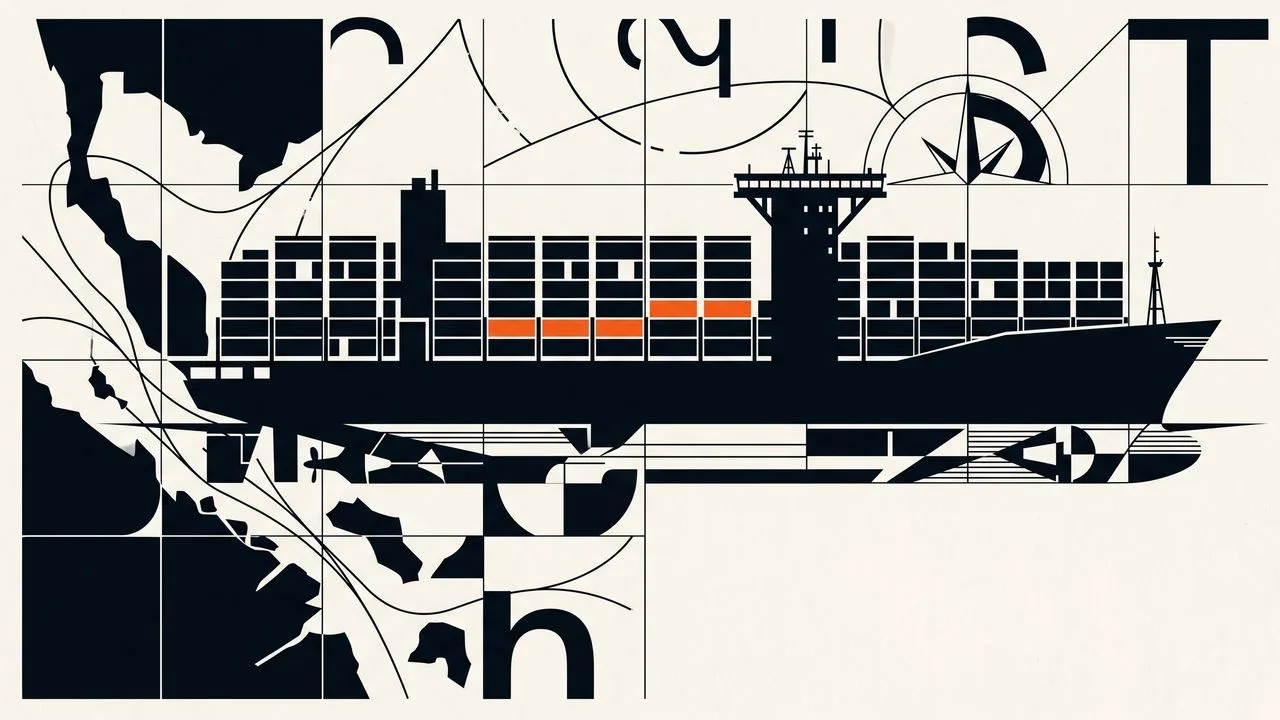
Photo: AI. Ondine Ferretti
The Romans called it annona—the grain supply system that fed a city of a million people by moving Egyptian wheat across the Mediterranean on a schedule tight enough that late ships meant riots. The praefectus annonae, the official who ran it, had one of the most powerful jobs in the empire, because the person who controls the food supply controls everything downstream of hunger. I thought about him a lot while watching a documentary about the Emma Maersk.
The Emma Maersk is, or was at the time of filming, the largest container ship in the world: 397 meters long, 20 stories tall, built for one declared purpose—to move staggering quantities of goods from Asia to Europe as fast as possible. The documentary from the Wonder channel follows her on a 13,000-kilometer voyage from Tanjung Pelepas in Malaysia to Spain, carrying what the film describes as approximately half a billion dollars of cargo. TVs, t-shirts, frozen fish, caviar, chocolate, New Zealand lamb. The annona moved grain. We have upgraded to frozen lamb and consumer electronics, but the institutional logic is identical: get it there, get it there on time, and do not let anyone know how hard that actually is.
Loading the Monster
The film opens at Tanjung Pelepas, one of the busiest transshipment ports on the planet, handling millions of containers a year. The scale is genuinely difficult to picture. The documentary offers this calibration: a freight train carrying Emma's full load would stretch 70 kilometers. Emma herself can carry around 11,000 to 12,000 containers depending on configuration—the documentary cites 12,000, though Maersk's own published specifications place her nominal capacity closer to 11,000 TEU, with figures varying by measurement standard.
Six gantry cranes, which the film compares to giant spiders, load her simultaneously. The best operators manage 30 containers an hour from cabs 60 meters above the dock. But the loading is not just fast—it is, necessarily, a spatial argument. First officer Remus Galiatos explains the logic with the clarity of someone who has had to justify it under pressure: "In the front we have the most dangerous cargo, that would be acids, flammable. If we have fireworks class 1.4G all the way to the aft, so that if we have a potential risk on the vessel, it will be as far away from the living quarters, accommodation, and above all the main engines."
Dangerous cargo at the bow. Refrigerated cargo near the superstructure where power is accessible. Electronics below deck, shielded from weather. It is a taxonomy of risk, expressed in tonnage and geometry. The Romans had similar problems with mixed cargo on grain ships—amphorae of oil, live animals, and flammable resin did not travel well together, and the Digest contains more than one legal ruling about who bore liability when they didn't. The container slot system is more sophisticated. The liability questions remain roughly as complicated.
The Strait
The Strait of Malacca has been contested waterway for at least as long as anyone has written anything down about it. The Srivijaya empire built its entire political economy around controlling it from the seventh century CE onward. The Portuguese seized Malacca in 1511 specifically because choking that strait meant choking the spice trade. Today it is the most trafficked shipping lane in the world—though not, technically, the only passage between the Indian Ocean and the South China Sea. The Sunda and Lombok Straits offer alternatives, particularly for deeper-draft vessels. The documentary calls it the "only route," which is the kind of simplification you get when accuracy would slow down the narration.
What the strait cannot simplify away is its piracy problem. Modern pirates, the film notes, don't want the cargo—they want the crew, held for ransom. Emma's defense against them is essentially architectural: she is too large and too high-sided to board easily. The crew lashes high-pressure water hoses to the railings as a secondary deterrent. Chief officer Niels Larsen states it without drama: "We are going through pirate area tonight." They pass through without incident, which is the best outcome and the least cinematic one.
The Engine and the Void
Below the superstructure, amidships, sits what the documentary describes as the world's largest marine diesel engine—a Wärtsilä-Sulzer RTA96-C type, 2,300 tons, 14 cylinders. The film puts its output at 110,000 horsepower; other sources cite figures ranging from roughly 80,000 to 109,000 kilowatts depending on configuration and measurement, so take the specific number as illustrative rather than definitive. The propeller shaft alone runs 120 meters from engine to stern. The propeller at the end of it is 10 meters in diameter and weighs 130 tons. This machinery does not stop for nine days if everything goes correctly.
Partway across the Indian Ocean, a generator condenser fails. The engineering team has a few hours before the other generators are overtaxed, the refrigeration units lose power, and approximately as much frozen food as a medium-sized supermarket spoils in equatorial heat. They extract a 400-kilogram component in a 40-degree engine room and have it repaired in six hours. This is the passage in the documentary that stops being about logistics and starts being about something older.
Because there is also the void. The bilge tanks at the bottom of the ship need physical inspection for cracks—sensors can't do it. The new paint off-gasses carbon monoxide as it cures. The gas sinks. Larsen must descend into it with an oxygen tank, reporting his position by radio as he goes down, level by level, so that if he loses consciousness someone knows which compartment to retrieve him from. "I will let him know how many levels I go down," he explains, "so he know where to find me if something goes wrong."
The Greeks had a word, katabasis, for the ritual descent into the underworld—Orpheus, Odysseus, Heracles, each going down into a dark place with specific protocols for survival and return. The void is not mythology. It is a maintenance procedure on a container ship. But the structure is ancient: you go down into the poisoned dark, you follow the prescribed steps exactly, and someone waits at the threshold to pull you back. What changes across three thousand years is the oxygen tank.
The Thirty
Emma carries a crew of approximately 30. Captain Jorgen Sonnichsen, Danish, has been planning voyages for 16 years. He invokes Viking seafarers with a matter-of-factness that suggests he has made this connection before and means it seriously rather than romantically. Cadet Rasmus Holkenborg is learning both engine and deck operations simultaneously—a dual cadet, the maritime equivalent of a Renaissance apprenticeship conducted at the equator in humidity that peels paint. Chief steward Jan Møller has been feeding ships' crews for 25 years and holds the not-entirely-facetious view that bad food is a navigation hazard: "If you have a lousy cook and lousy food, then the ship is not running proper."
The social architecture inside the superstructure is the same one that has organized maritime labor since oared galleys: strict rank, shared confinement, designated recreation, hierarchy expressed in cabin size. The captain and chief engineer have the best quarters. The cadets do not. Saturday night gets a special meal, even though Saturday means nothing at sea, because the fiction of a weekend is one of the things that keeps people sane when there is no shore in any direction.
The crew rotation is eight weeks on, eight weeks off. This means that for the duration of the voyage, these 30 people are simultaneously operating one of the most complex machines ever built and living their entire lives inside it. What the documentary shows with some care, and what tends to disappear from discussions of globalized trade, is that the price of next-day delivery is measured partly in this: a man descending alone into a carbon-monoxide-filled tank, with a radio, trusting that the person above him is paying attention.
The praefectus annonae had a staff of hundreds and the full administrative apparatus of the Roman state. The Emma Maersk runs on 30. Whether that represents an engineering triumph or an accounting decision is, I think, the question the documentary doesn't quite ask—and the one that would make the Romans, who knew something about both engineering and accounting, immediately recognize what kind of operation this is.
More Like This

GoFundMe's CPTO on Marketplace Failure & AI Growth
GoFundMe's CPTO Arnie Katz breaks down 3 marketplace failure modes and how AI agents are driving real revenue—not just dev productivity.
Why the Ocean Still Terrifies Us: Depths of Fear
Quinn and James of Cosmic Chronicles explore why the ocean remains humanity's oldest, deepest fear—from the Mariana Trench to the myth of the Bermuda Triangle.

America's Economic Cycles: Reinvention or Stagnation?
Examining America's economic pivots every 80-90 years and their impact.
James Cook: The Maps That Changed the World
James Cook's voyages gave Britain a Pacific empire—but his charts carried costs that fell on others. A look at the man behind the maps.
The Economic Cost of Singlehood
Exploring how the rise in singlehood leads to higher costs and challenges modern economies' adaptability.
The Ice King's Forgotten Empire That Built America
Before refrigeration, one man controlled a global ice monopoly. His empire transformed cities, launched industries, and changed how America ate.
Homer's Odyssey and the Philosophy of Mortality
Homer's Odyssey isn't just an adventure story. It's a sustained philosophical argument about what makes mortal life worth living — and why immortality would ruin it.

Myth, Obsession, and the Men Who Dug for Troy
Arthur Evans and Heinrich Schliemann both found ancient civilizations while chasing myths. What does that tell us about archaeology—and obsession?