GoFundMe's CPTO on Marketplace Failure & AI Growth
GoFundMe's CPTO Arnie Katz breaks down 3 marketplace failure modes and how AI agents are driving real revenue—not just dev productivity.

Written by AI. Yuki Okonkwo
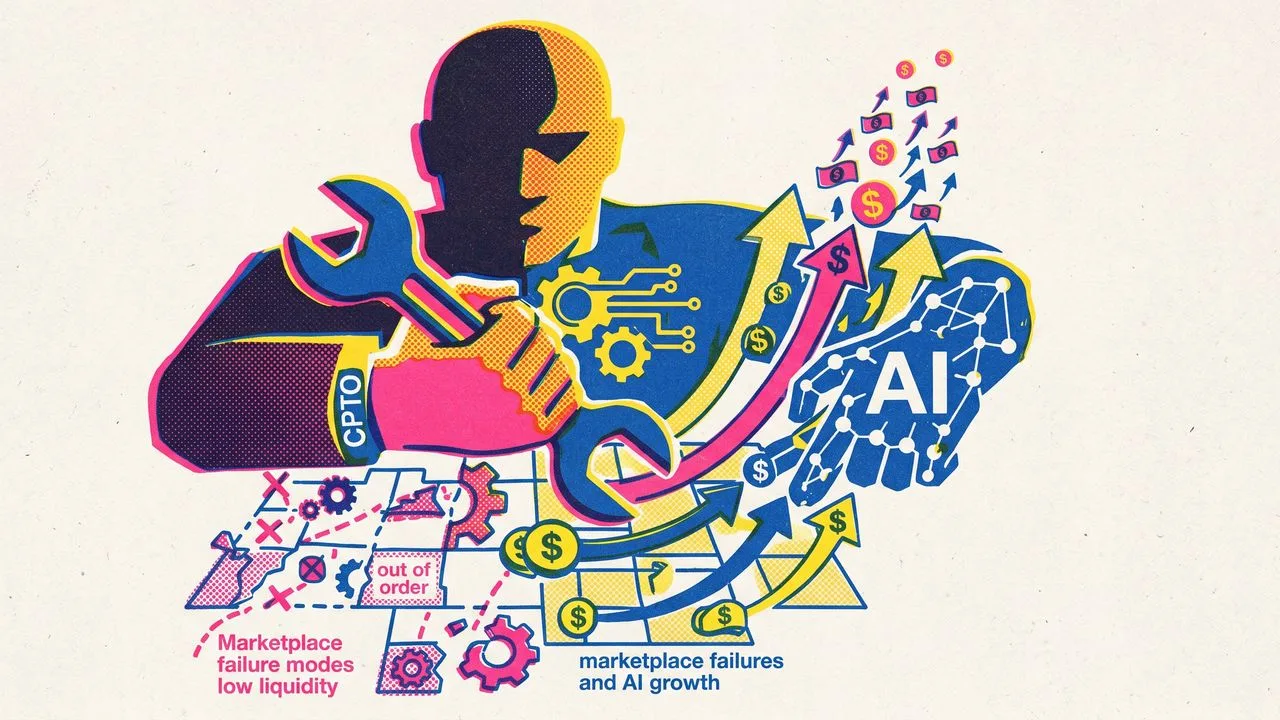
Photo: AI. Jorah Maktoum
A coworker's house burned down last year. Within 48 hours, someone had started a GoFundMe. Within a week, it had spread across two Slack workspaces, a neighborhood Facebook group, and about fourteen Twitter threads. No ad spend. No PR. Just grief and a share button. That's GoFundMe's supply-side flywheel, and it's also its biggest structural vulnerability — a marketplace that depends almost entirely on tragedy going viral.
Arnie Katz has thought about this a lot. He's the Chief Product and Technology Officer at GoFundMe — and by his own account, has held combined product-and-engineering leadership roles (what he calls the "CPTO" structure) since 2019, including at StubHub and TheRealReal before landing at GoFundMe. Note: "CPTO" isn't a standardized title across the industry, and his exact designations at prior companies may have differed — but the scope he describes is consistent across all three. In a recent episode of the Product School podcast, he walked through how GoFundMe actually works as a marketplace, what can kill one, and where AI fits in — and it's a more complicated picture than the feel-good exterior suggests.
The CPTO bet: speed as a competitive moat
Katz is refreshingly direct about why the combined role exists: it's about collapsing the distance between a data signal and a resource reallocation. In a traditional org, an experiment result travels from analytics to product to engineering across org boundaries that each have their own calendars, priorities, and reporting lines. Under the CPTO model, that chain collapses.
"That decision can now come to my leadership table and we can make it together and pivot those resources... and we can react within days to a decision that maybe would have taken weeks or months."
The org structure underneath isn't just "VP of Eng and VP of Product report to one person." Katz runs a layered system: functional leaders (SVP of Engineering, Chief AI Officer, VP of Design, Head of Research) at the top, then "tribes" organized around domains like payments or consumer experience, then squads at the bottom — each a triad of PM, engineering manager, and designer with their own OKRs. The tribes and squads cut horizontally across the vertical functional hierarchy. It's a classic matrix-but-not-technically-a-matrix setup, and the CPTO role is what makes it not collapse into confusion.
The trade-off he names is the one most people dance around: Katz is a product person. His engineering degree and early coding career notwithstanding, he says outright that a company could theoretically hire a stronger pure CTO. His mitigation is to hire exceptionally strong technical leaders — a Chief AI Officer, a Chief Data Officer — to cover the gap. Whether that fully compensates is a question the org itself has to keep answering.
Three ways a marketplace dies
Here's where Katz gets genuinely useful. He maps three failure modes that apply across every marketplace he's worked on — and they're worth understanding whether you're building or just trying to evaluate one.
Cold start failure is the empty marketplace problem: demand shows up, supply isn't there, everyone leaves disappointed and doesn't come back. Katz's StubHub example is clean — if there aren't enough tickets listed for the Super Bowl, the liquidity doesn't exist when it matters most. His Uber callout is sharper: surge pricing isn't just a revenue mechanism, it's a supply recruitment signal. The price spike tells nearby drivers to move toward unmet demand. Without that mechanism, Katz says, "the marketplace would not work. Literally would not work."
Imbalance failure is the ongoing version of cold start — one side consistently overwhelms the other without a corrective mechanism. Too much demand, not enough supply (or vice versa) creates a marketplace that's technically alive but functionally broken.
False positive growth is the sneaky one, and honestly the most interesting to me analytically. Imagine a marketplace growing 100% year-over-year. Looks great. But drill into the data and you find that one supplier is responsible for all of it. That's not marketplace health — that's a single entity using your infrastructure as a distribution channel while the platform itself stagnates. Over time, Katz notes, that dominant supplier can bypass the platform entirely and transact directly with buyers. The marketplace has accidentally subsidized its own disintermediation.
For GoFundMe specifically, the false positive risk takes a different shape. Viral campaigns — a disaster, a celebrity illness, a geopolitically resonant cause — can generate massive donation volume that flatters aggregate metrics while obscuring whether the underlying matching infrastructure is actually working for the other 7,999 campaigns launched that day (that figure comes from Katz via podcast; GoFundMe's published data should be consulted for current verification).
AI as a revenue lever, not a productivity tool
GoFundMe built what Katz calls a "smart coach" — his description is "a collection of agents that help you when you show up to GoFundMe to start a fundraiser." The way he frames it is worth quoting directly:
"You can describe the need. The agent will give you validation of how hard it is and give you empathy for the situation you're in, almost replicating what a human being would have done."
From a technical standpoint, what he's describing sounds like an orchestration layer — a primary agent routing tasks across specialized sub-agents (one for narrative generation, one for tone/emotional calibration, probably one for policy compliance) rather than a single monolithic model doing everything. That architecture matters because it's what allows the system to give a coherent, contextually appropriate response at the intake moment without needing a human in the loop. It's not revolutionary AI research; it's applied agent design doing exactly what it's supposed to do.
And according to Katz, it's working financially. He cites $125 million in additional funds raised as a result of the AI coach. Here's where I need to be straight with you: the podcast framing is ambiguous on whether this is a realized outcome or a modeled projection. The video description uses "expected" — which signals a forecast, not a result. I'm flagging this explicitly because the difference is not trivial. A projection based on improved campaign completion rates and average donation lift is a very different claim than $125M that has actually moved through the platform. Katz didn't clarify on tape, and GoFundMe hasn't published this figure in a verifiable press release that I can find. Take it as a compelling internal metric, not a confirmed outcome.
The broader framing Katz offers — that AI is driving revenue at GoFundMe, not just developer productivity — is where I think he's actually saying something meaningful. Most companies deploying AI right now are measuring it in engineering velocity: code shipped faster, tickets closed, sprints shortened. GoFundMe is sequencing it differently, putting AI at the user acquisition and conversion layer first, which is where money actually moves.
The thing I can't stop thinking about
GoFundMe's supply side is people in crisis. That's not a rhetorical flourish — it's operationally literal. Katz says it plainly: "People come to us when their car engine breaks down and they can't get to work. They come to us for medical needs for their family, sometimes for funeral expenses."
Those are the people the AI coach is now greeting at the door.
The system is designed to give "validation" and "empathy" — to, in Katz's words, replicate what a human being would have done. And the explicit goal is higher campaign conversion and more dollars raised. I'm not saying that's malicious. Better campaigns probably do raise more money, and more money raised is genuinely good for people in crisis. The incentives aren't secretly misaligned — GoFundMe takes a platform tip from donors, so more funds raised is good for everyone at the table.
But there's a design question underneath this that nobody on the podcast asked: when you're A/B testing which empathetic responses generate the most completed campaigns, you are, by definition, optimizing a vulnerable person's emotional experience for conversion. The AI isn't just helping someone tell their story — it's helping them tell their story in the way that statistically produces the most donations. Those two things can coexist. They can also quietly drift apart.
GoFundMe has the data to know the difference. Whether they're measuring it is a different question.
The $40 billion in help since 2010 — Katz's figure, cited across multiple GoFundMe contexts though without a specific audit date — is real money that reached real people. The marketplace architecture Katz is describing is genuinely thoughtful. And the AI application is among the more interesting I've seen: not writing internal memos, not summarizing meetings, but sitting at the exact friction point where a person decides whether to ask for help at all.
That's a meaningful place to deploy intelligence. It's also a meaningful place to get it wrong.
More Like This
ElevenLabs and the Voice AI Bet Nobody Wanted
ElevenLabs CEO Mati Staniszewski explains how a two-person team from Warsaw suburbs built a $400M voice AI business by betting on the domain nobody wanted.

GitHub Copilot's Billing Problem Is Bigger Than You Think
Theo's livestream experiment to burn GitHub Copilot's $40/mo plan reveals a fundamental flaw in how AI tools are priced—and who eventually pays for it.
America's Economic Cycles: Reinvention or Stagnation?
Examining America's economic pivots every 80-90 years and their impact.
Why Rushing Ads Can Sabotage Your Brand
Explore the pitfalls of early ad spending and the power of organic growth for brand success.
The Economic Cost of Singlehood
Exploring how the rise in singlehood leads to higher costs and challenges modern economies' adaptability.
OpenAI Researcher Quits Over Ads: A Pattern Emerges
Zoe Hitzig's resignation from OpenAI reveals deeper tensions about AI monetization, user trust, and the company's evolving priorities.

How Optimization Powers Modern AI and Engineering
From training ChatGPT to imaging black holes, optimization is the hidden engine behind modern AI and engineering. Steve Brunton's lecture explains how.

David Patterson on CPUs, GPUs, TPUs, and 50 Years in Computing
Turing Award winner David Patterson breaks down RISC vs. CISC, the GPU-to-TPU shift, Moore's Law's real status, and what 50 years in computing actually taught him.