Rogue Waves: The Ocean Phenomenon Science Got Wrong
For centuries, scientists dismissed rogue waves as sailor myth. Then one hit a North Sea oil platform and rewrote everything we thought we knew about the ocean.

Written by AI. Nadia Marchetti
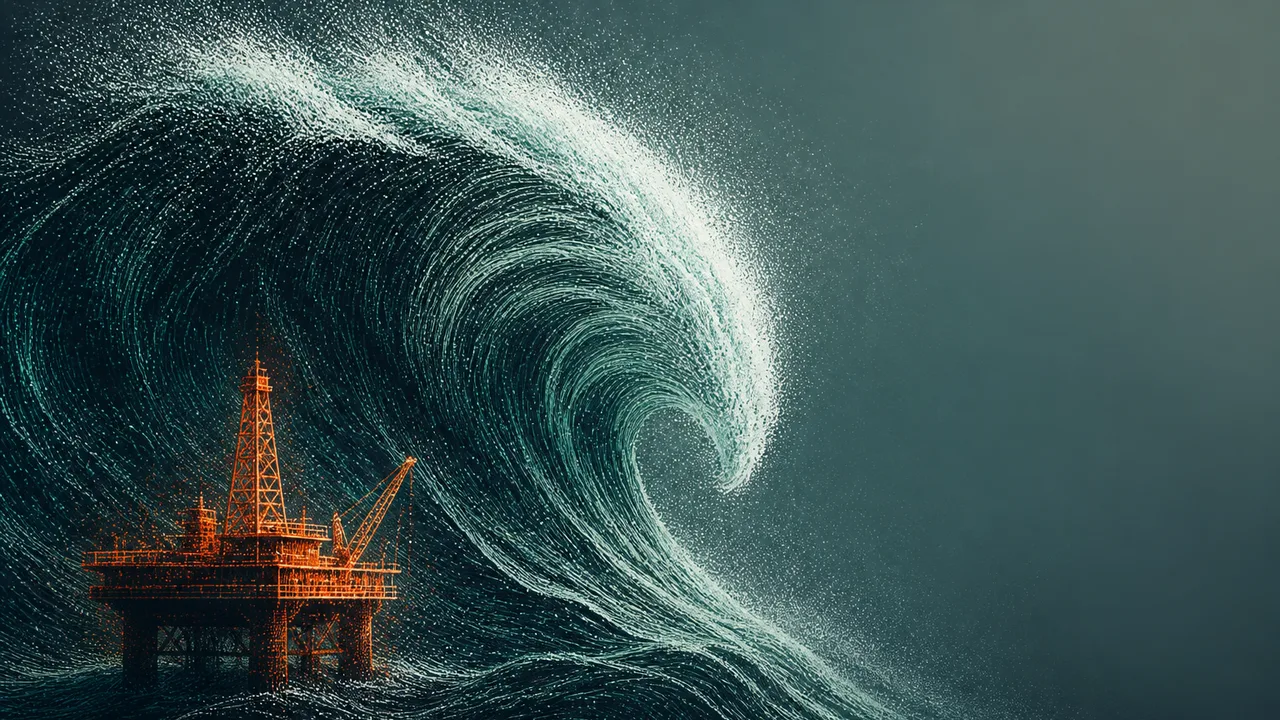
Photo: AI. Dexter Bloomfield
In December 1978, the MS München—a German cargo ship so well-engineered it was considered unsinkable—vanished somewhere in the Atlantic on its 62nd voyage. No distress call. No wreckage that made sense. Just gone.
It took nearly two decades for investigators to arrive at an explanation: a rogue wave. A wall of water so massive and so sudden that a ship designed to withstand the worst the Atlantic could offer didn't stand a chance.
What makes that conclusion interesting isn't just the tragedy of it. It's what it says about the gap between what science confidently believed and what the ocean was actually doing.
The Model That Said "Impossible"
For most of modern maritime history, oceanographers operated on a clean, reassuring set of assumptions. Waves form when wind drags across water, building energy into rhythmic, predictable swells. Run the math on wave height distributions—something called linear wave theory—and you get a tidy bell curve. Extreme outliers exist in theory, but the probability of a wave more than twice the height of surrounding waves occurring in any given place at any given time was vanishingly small. Some estimates put it at once every 10,000 years.
This wasn't fringe science. It was the consensus. And it's why sailor accounts of monstrous freak waves—walls of water appearing from calm seas, swallowing ships whole—were filed alongside Kraken sightings. Colorful. Culturally interesting. Almost certainly exaggerated.
The model felt solid. The ocean, it turns out, wasn't particularly interested in the model.
New Year's Day, 1995
On January 1st, 1995, the Draupner oil platform in the North Sea got hit by something that shouldn't have existed. The platform carried laser sensors designed to measure wave heights—not to validate or invalidate wave theory, just routine monitoring. The surrounding seas were running around 39 feet. Then a single wave registered at 84 feet.
As NOVA's What the Physics?! host Athena Brensberger puts it in the episode: "The Draupner wave was one of the largest ever documented, and having it on record confirmed once and for all that rogue waves are real. Plus, our linear wave models were way off."
The platform survived. The scientific consensus did not.
What the Draupner event provided wasn't just a data point—it was irrefutable physical evidence with a timestamp, a location, and a measurement. You couldn't dismiss laser telemetry on an instrumented oil rig the way you could dismiss a sailor's account. Suddenly, the question shifted from "are rogue waves real?" to "why do our models not account for them, and how do we fix that?"
By 2007, researchers had compiled a list of 50 historical maritime incidents—ships lost, hulls mysteriously buckled, crew members swept away—that rogue waves probably explain. The München was on that list.
The Mechanism Problem
Here's where it gets genuinely complicated, and where I think the science is most interesting: confirming that rogue waves exist turned out to be significantly easier than explaining why they exist.
The leading theory for a while was modulational instability—a process where the regular spacing and size of a wave group gets disrupted, causing energy to redistribute unevenly until it concentrates catastrophically in a single wave. It's a compelling mechanism. It works elegantly in controlled conditions: laboratory channels, computer simulations of waves traveling in one direction.
The open ocean, however, is not a laboratory channel. Energy doesn't just pile up neatly when it can disperse in every direction. Modulational instability couldn't fully account for what actually seems to happen out there, and some researchers remained skeptical it was the right primary explanation.
One such skeptic led a team that spent time with 18 years of North Sea wave data—the same waters that produced the Draupner event—looking for patterns. What they found wasn't a single dramatic mechanism but a combination of two relatively ordinary wave behaviors that, when they coincide, produce something extraordinary.
The first is linear focusing: waves traveling at different speeds and directions sometimes align, their crests stacking to form a temporarily taller wave. Normal physics, nothing exotic.
The second is second-order bound nonlinearities: waves alter their own shape as they travel, with troughs flattening and crests steepening. This effect can make individual waves 15 to 20 percent larger than standard models predict. Also not exotic on its own.
But when both effects happen simultaneously in the same location? The video describes it cleanly: "when those two effects come together at the same time, they can create a wave that's much, much larger than the waves around it."
This is a meaningful reframe. It suggests rogue waves may not require some rare, exotic physical process to trigger them—just the right ordinary processes overlapping at the wrong moment. Which would explain why they're considerably more common than 10,000-year-event thinking suggested.
How Common Is "Common"?
This is the part that I keep turning over. Current scientific estimates hold that there are roughly ten rogue waves forming somewhere in the world's oceans at any given moment.
Sit with that for a second.
Not ten per year. Ten right now. As you read this, somewhere in the Pacific or the North Atlantic or the Southern Ocean, a wave is forming that's more than twice the height of everything around it.
The definition matters here, and it's worth being precise about it. A rogue wave isn't necessarily a 100-foot monster. Technically, a 4-foot wave qualifies as a rogue wave if the surrounding seas are running at 2 feet. The defining characteristic is the ratio, not the raw size. That makes the phenomenon simultaneously more common and—in most cases—less apocalyptic than the popular image suggests.
The MS München scenario required a specific, terrible coincidence: a wave that met the rogue threshold and happened to be enormous in absolute terms and hit a ship in a vulnerable way. Most rogue waves, by that same logic, form, crash, and dissipate without consequence.
But "most" is not "all," and the ocean does not distribute its catastrophes conveniently.
The Fingerprint Problem
The more tractable question now isn't just why rogue waves form—it's whether we can see them coming. Researchers have identified that rogue waves leave detectable signatures in the wave groups that precede and follow them. By studying those patterns, it may eventually be possible to identify conditions that make rogue wave formation more likely and issue warnings before one materializes.
That's not a solved problem. Forecasting models are improving, but wave behavior in the open ocean involves enough variables—wind fields, currents, swell interactions, ocean temperature gradients—that precise rogue wave prediction remains aspirational rather than operational. The fingerprint exists; reading it reliably in real time is another matter.
What's already changed is the engineering conversation. Shipbuilders and offshore platform designers now have to account for wave loading scenarios that the old linear models would have dismissed as physically impossible. The Draupner wave didn't just reshape wave physics—it reshaped what it means to build something meant to survive the ocean.
There's something philosophically interesting about a phenomenon that existed for as long as oceans have existed, killed people reliably throughout recorded history, and was nonetheless classified as scientifically impossible until a laser sensor happened to be pointing in the right direction on New Year's Day 1995.
The sailor stories were right. The models were wrong. The question researchers are still working toward answering is whether the next version of our models—better, more complete, incorporating nonlinear dynamics and real-world wave data—will finally be right, or whether the ocean is holding something else in reserve.
More Like This

Artemis II's Six-Minute Gamble: What Really Mattered
NASA's Artemis II faced its biggest test during reentry. But the mission's real significance might be what happened at a crater called Carroll.

Is Time Fundamental? New Physics Says Maybe Not
Physicists are questioning whether time is real or emergent. A climate journalist finds the stakes unexpectedly familiar—and the implications surprisingly close to home.
Inside the Emma Maersk: How the World Sails
The Emma Maersk carries what the documentary estimates as half a billion dollars of cargo across 13,000km. Here's what that actually takes.

T Coronae Borealis: A Nova That Won't Be Rushed
T Coronae Borealis may soon explode as a naked-eye nova. Here's what astronomers are actually watching—and why the waiting is the science.
Ocean Currents, Arctic Strategy, and a Broken Thermostat
A retired colonel examines what ocean current science means for Arctic strategy, NATO stability, and the defense planners who keep nodding politely.
Can Figure Skaters Actually Pull Off a Quintuple Jump?
Physics says a quintuple jump in figure skating is within human capabilities—but landing it might require the explosive power of Michael Jordan.

Do DMT Entities Point to Alien Consciousness?
Cognitive scientist Donald Hoffman claims DMT entities may be real alien minds. The math is real. Whether it proves anything about consciousness is a different question.

Viking Landers and the Unsolved Mars Life Debate
Fifty years after Viking landed on Mars, one experiment's positive result remains unexplained. Here's what the science actually shows—and what we've learned since.